
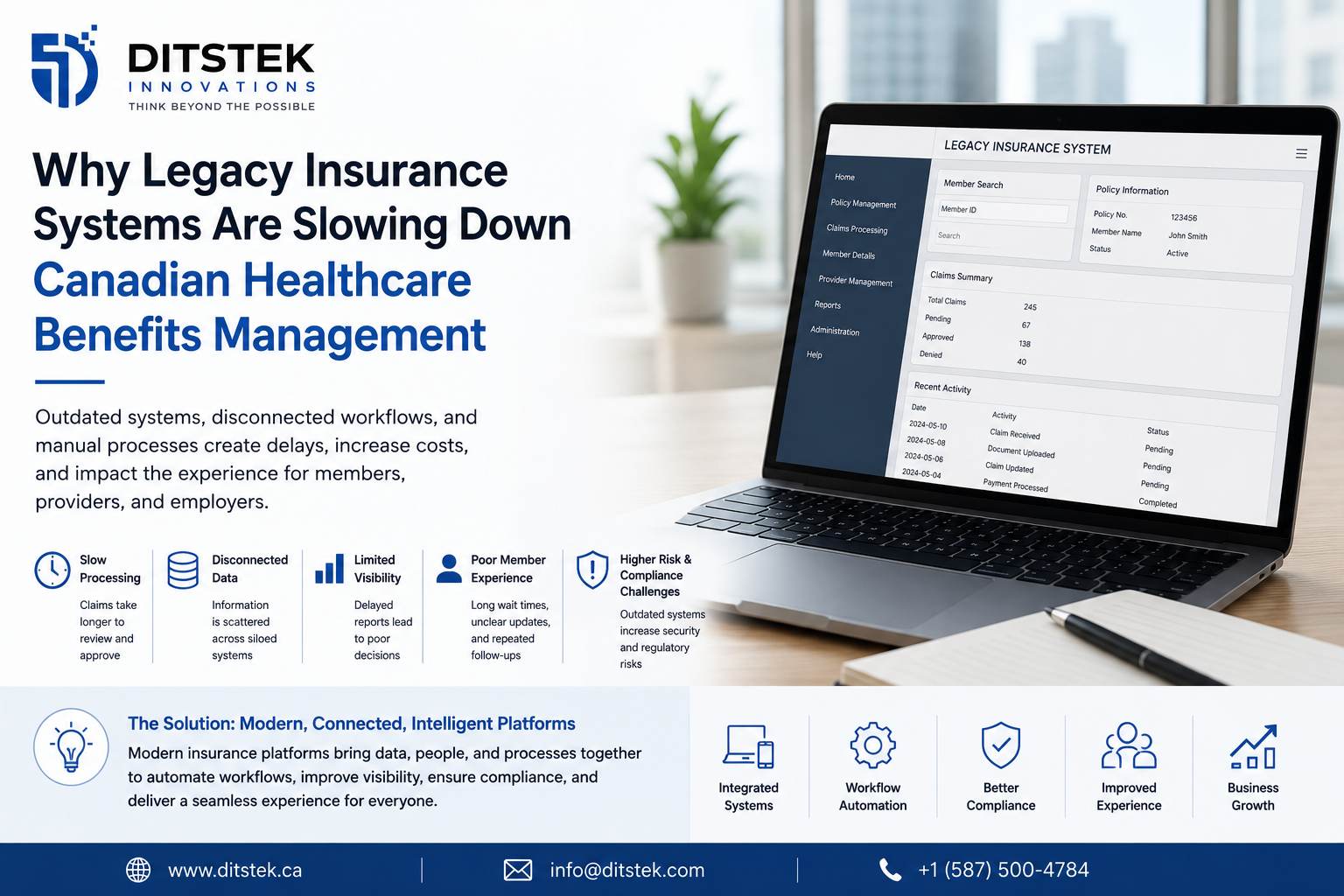
Healthcare benefits management in Canada has become far more complex than it used to be. Members expect faster claim updates. Employers want smoother group benefits administration. Providers need quicker coordination. Internal teams are under pressure to process claims accurately while handling increasing volumes of documents, approvals, policy variations, and support requests.
But many insurance organizations are still trying to manage this growing complexity with legacy systems.
These older systems may still perform basic functions, but they often slow down daily operations in ways that are easy to underestimate. Teams rely on manual workarounds, disconnected tools, repeated data entry, delayed reporting, and fragmented communication just to keep the workflow moving.
This is why legacy insurance systems are becoming a serious operational challenge for Canadian healthcare benefits management. The issue is not only that the technology is old. The bigger issue is that it limits speed, visibility, integration, scalability, and user experience at a time when all of those factors matter more than ever.
What makes a system “legacy” in insurance?
A legacy insurance system is not simply an old platform. It is usually a system that no longer fits the way the business needs to operate today.
In many cases, it still handles core functions such as member records, claim processing, policy data, or payment workflows. The problem is that it was built for an earlier operating environment, one with fewer integrations, lower customer expectations, simpler reporting needs, and less demand for real-time visibility.
A legacy system often shows up through its limitations:
It may not integrate well with newer platforms.
It may require manual work to move information between systems.
It may make reporting slow and incomplete.
It may not support modern member portals or provider access.
It may make it difficult to automate repetitive workflows.
It may create security or maintenance concerns over time.
So the issue is not just age. It is operational fit.
Why healthcare benefits management is especially affected
Healthcare benefits management involves many interconnected processes. Claims are submitted by members or providers. Eligibility has to be checked. Documents have to be reviewed. Policy rules must be applied. Reimbursements need to be tracked. Employers may need visibility into group plans. Brokers may need client-level information. Support teams have to answer status questions. Leaders need reporting to understand claim trends and workload.
When this ecosystem runs on disconnected or outdated systems, delays appear everywhere.
Even small inefficiencies become expensive because the process is highly operational. A team may lose time switching between systems, checking the same information repeatedly, or manually following up on missing documents. Members may wait longer because the workflow is not connected. Managers may struggle to identify where claims are getting stuck.
In healthcare benefits management, speed and clarity matter. Legacy systems reduce both.
1. Legacy systems create workflow fragmentation
One of the biggest problems with older insurance systems is that they rarely support the full process in one connected environment.
A company may use one system for member records, another for claims, another for documents, another for communications, and perhaps spreadsheets to fill the gaps. Staff then spend time moving information manually across tools.
This leads to fragmented workflows.
A claim may be received in one place, validated in another, reviewed in another, and updated through email instead of through the actual system. That fragmentation slows down operations and increases the likelihood of missed details, duplicated effort, and inconsistent handling.
For healthcare benefits organizations, fragmented workflows make even basic operational control more difficult.
2. Manual work increases because the system cannot support automation
When legacy systems cannot connect data properly or apply workflow rules in a flexible way, manual work becomes the default solution.
Teams may need to review incomplete submissions manually, copy claim information between systems, verify benefits by checking multiple records, request documents through email, or update members one by one.
This is not just inefficient. It makes scaling harder.
As member volume increases, the organization often responds by adding more manual effort instead of improving the underlying system. Over time, the workload grows faster than the team’s capacity to handle it.
Modern digital platforms help automate these routine tasks. Legacy systems often block that progress.
3. Reporting becomes delayed and less reliable
Healthcare benefits leaders need clear data to manage operations effectively. They need to understand claim volume, processing time, denial patterns, support workload, reimbursement activity, document issues, and member experience trends.
But legacy systems often make reporting slow and incomplete.
Data may sit in different places. Teams may need to export information manually. Reports may depend on spreadsheets that take time to prepare and validate. By the time leadership sees the numbers, the operational issue may already be affecting service quality.
This weakens decision-making.
Without reliable reporting, leaders cannot easily see where delays are happening, where manual work is highest, or which workflows need attention first.
4. Member experience suffers when systems are outdated
Members may never see the internal architecture of an insurance organization, but they feel the effects of it.
If a claim takes too long, if the status is unclear, if documents must be submitted multiple times, or if support teams cannot answer questions quickly, the member experience suffers.
Legacy systems are often not designed for modern self-service expectations. They may not support intuitive member portals, real-time notifications, mobile access, document visibility, or easy status tracking.
As a result, members end up depending more heavily on support teams for information that should already be available digitally.
That creates frustration for users and more workload for staff.
In healthcare benefits management, customer experience is no longer separate from operations. It is directly shaped by the system behind the process.
5. Provider and employer coordination becomes harder
Healthcare benefits workflows often involve more than just the member and the insurer. Employers may need to manage group benefits data. Providers may need to submit supporting documentation or check claim status. Brokers may need policy and renewal visibility.
Legacy systems make this collaboration harder because they were not built for seamless external access. Many older platforms cannot easily support provider portals, employer dashboards, or secure partner workflows.
This forces organizations to depend on manual communication channels such as email, calls, or offline files.
The more the business depends on outside coordination, the more damaging these system limitations become.
6. Changes become expensive and slow
Another problem with legacy insurance systems is that they are often difficult to modify.
Even a small workflow change may require complex development effort, high vendor dependency, or risky changes to older architecture. This makes improvement slow and expensive.
That becomes a major issue when the business wants to launch a new plan, add digital features, improve member communication, update reporting logic, or support a new integration.
Instead of enabling innovation, the system starts resisting it.
This creates a gap between what the business needs and what the platform can realistically support.
7. Security and compliance risks increase over time
Older systems are not always insecure by default, but they often become harder to maintain securely over time. Limited support, outdated architecture, weak access controls, and disconnected file-sharing practices can create avoidable risk.
In healthcare benefits management, data sensitivity is high. Member records, claims, provider documents, financial details, and health-related information all need proper protection.
When organizations rely on workarounds outside the core platform, such as email chains, downloaded spreadsheets, or unmanaged document transfers, risk grows further.
A more modern system helps centralize access, strengthen permissions, improve traceability, and reduce dependence on unsafe manual practices.
8. Legacy systems hide the true cost of inefficiency
One reason legacy systems stay in place for so long is that their cost is not always obvious.
The organization may not see one single large expense line called “legacy inefficiency.” Instead, the cost appears indirectly:
More staff time spent on repetitive tasks
Slower claims processing
Longer support queues
More rework
Lower visibility
Delayed decisions
Higher training effort
Poorer member satisfaction
Reduced flexibility for growth
Because these costs are spread across teams and workflows, they often get normalized.
But for business leaders, this hidden operational drag matters. It affects margins, service quality, employee productivity, and scalability.
9. Modernization is about business performance, not just technology
Many organizations hesitate to modernize because they think it means replacing everything at once. That assumption creates delay.
In reality, modernization can be phased and targeted.
A company may begin by improving claims intake, document management, reporting, member access, or workflow automation. The goal is not to rebuild the entire environment overnight. The goal is to reduce friction where it matters most.
That is why modernization should be viewed as a business performance initiative.
The question is not only, “What software do we need?”
The better question is, “Which operational problems are legacy systems causing, and which of those problems should be solved first?”
10. What a better healthcare benefits platform should support
A stronger digital platform should help insurers and benefits organizations work with more speed, clarity, and control. Depending on the business model, useful capabilities may include:
The most important thing is that the system should reflect the way the business actually works today, not the way it worked ten years ago.
Claims submission and tracking
Eligibility and coverage verification
Document upload and validation
Member portals
Employer and broker dashboards
Provider access tools
Workflow routing and task assignment
Notifications and reminders
Reporting and analytics
Role-based access and auditability
Secure integrations with existing systems
Automation and AI support where useful
How DITS can help
DITS helps insurance and healthcare organisations modernise complex operational workflows through secure, scalable digital platforms. We focus on understanding the business process first, then designing solutions that reduce manual effort, improve workflow visibility, and support better service delivery.
For healthcare benefits management, this can include claims management systems, member portals, provider workflows, document handling, reporting dashboards, automation, integration support, and phased modernization of legacy platforms.
Our approach is designed to help organizations move from disconnected operations toward a more connected and measurable digital environment.
Conclusion
Legacy insurance systems are slowing down Canadian healthcare benefits management because they make it harder to connect workflows, reduce manual work, improve reporting, support member experience, and respond to changing business needs. What once served as a functional system can now become a barrier to efficiency, visibility, and growth.
For insurers and benefits organisations, the challenge is no longer just about maintaining old technology. It is about deciding how long the business can continue operating around its limitations.
This is where health insurance software development becomes important, helping organizations build smarter, more connected platforms that improve claims operations, member experience, and long-term business performance.