

On many construction sites, storage has historically been treated as a secondary logistics issue. Materials arrive, tools are staged where they can fit, and crews work around whatever system exists. That approach is becoming harder to sustain. Across South Louisiana, jobsite storage is taking on a more central operational role as contractors face growing pressure to control materials, protect schedules, reduce site disorder, and limit avoidable exposure. In practice, the question is no longer whether a project has enough space to store items. The more important question is whether the storage method is secure, accessible, and structured enough to support the pace and complexity of the work itself.
Why Storage Is Becoming More Important on Active Jobsites
Construction activity remains strong enough that site efficiency continues to matter. Associated Builders and Contractors reported that its Construction Backlog Indicator increased in December 2025, and the group also said construction industry employment in early 2026 was running ahead of the prior year. Those indicators do not say everything about local conditions, but they do support a broader point. Contractors are still operating in an environment where active work, scheduling pressure, and labor coordination require better control of what is happening on-site. In that kind of setting, storage becomes more than a convenience. It becomes part of how the job is kept moving.
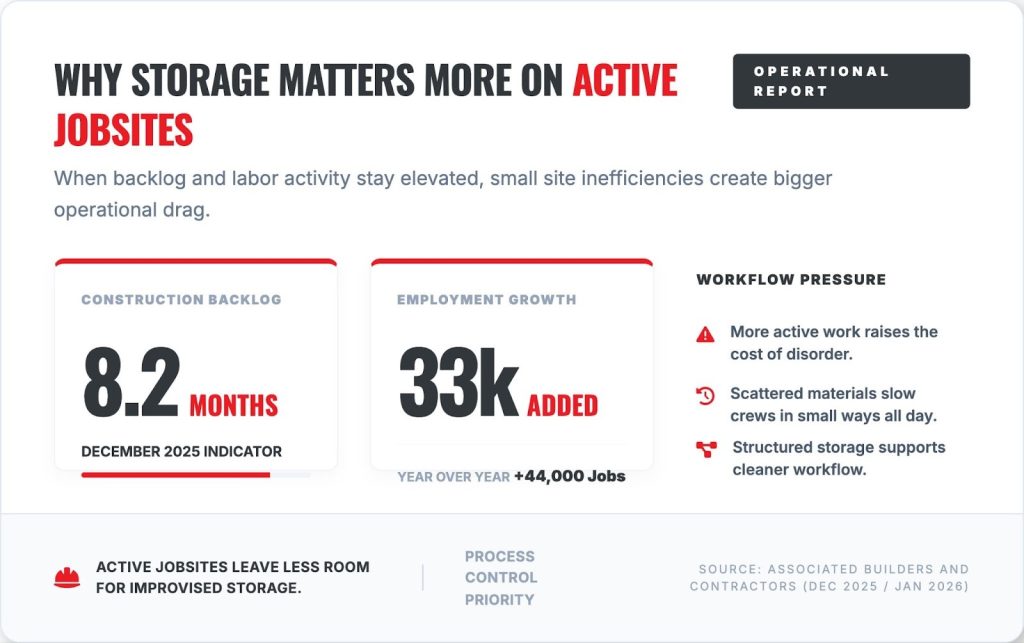
South Louisiana intensifies that challenge because jobsites often have to manage changing weather, outdoor exposure, multiple trades, and materials that cannot simply be left exposed without consequences. A site can lose time in small ways long before a major disruption occurs. Workers search for tools that were relocated informally. Materials become harder to access because they were stacked for lack of a better option. Deliveries arrive before there is a clean place to secure them. Those problems may look minor individually, but together they can create friction that slows productivity and weakens site control.
Storage Is Also a Safety and Compliance Issue
Storage matters operationally, but it also matters from a safety standpoint. OSHA’s construction material storage standard requires that stored materials not pose hazards and that they be stacked, blocked, interlocked, and limited in height to remain stable and secure. That language is important because it reinforces a basic principle of construction management. Storage is not only about where things fit. It is about whether the site remains safe, navigable, and organized enough to support ongoing work without introducing unnecessary risk.
On a busy site, poor storage can create more than clutter. It can affect walkways, handling patterns, equipment access, and how quickly crews can complete routine tasks. It can also create a false sense that the site is functioning acceptably because materials are technically present, even if they are not staged in a way that supports the project’s operation. That is why storage has become a bigger operational priority. The strongest sites increasingly treat storage as part of workflow design rather than as a leftover space problem.
Why Exposure Is a Bigger Issue in South Louisiana
In South Louisiana, exposure is one of the clearest reasons storage deserves more attention. Exposure does not only mean weather, although weather is obviously part of the equation. It also means exposure to theft, tampering, moisture, repeated handling, and the gradual loss of site order that happens when materials and tools do not have a defined place. The longer items remain loosely staged, the more vulnerable they become to disorder and disruption.
That is one reason temporary secured storage is drawing more interest from contractors, remodelers, and trade crews. A jobsite that uses containerized storage can reduce the number of variables affecting key tools, materials, and supplies during the workday and after hours. Instead of treating storage as scattered overflow, the site can create a more deliberate control point. That makes it easier to protect what matters most, limit unnecessary movement, and reduce the amount of time crews spend adjusting to avoidable disorganization.
Why Containerized Storage Fits the Jobsite Reality
Containerized storage is gaining traction because it solves several common jobsite problems at once. It provides a defined, lockable footprint. It helps keep tools and materials off the open site when they are not in use. It gives crews a more predictable place to stage inventory. It also allows the contractor to create a clearer boundary between active work areas and stored assets. On jobs where site conditions shift over time, that kind of stability can matter more than people assume.
For many contractors, the appeal is practical rather than theoretical. They do not need a grand logistics strategy. They need a storage setup that protects on-site assets, remains accessible to the crew, and reduces the daily improvisation required to keep the work moving. A local example can be seen in this 20-foot shipping container rental overview, which reflects the kind of temporary, secure storage solution contractors often use when they need a controlled footprint without committing to a permanent storage structure.
What Zach Fields Says Contractors Need Most
Zach Fields says contractors are increasingly looking at storage less as a convenience and more as a way to protect workflow. In his view, the value of a container on a site lies not just in its ability to hold tools and materials. It creates more order around how those items are managed. When crews know where things live, when materials are protected from unnecessary exposure, and when the site has a more stable storage rhythm, the job tends to operate with fewer interruptions. That does not eliminate every site problem, but it removes a category of preventable friction that can quietly erode efficiency.
That observation aligns with the broader trade reality. Many jobsite slowdowns do not begin as major failures. They begin as small disruptions repeated over time. A missing tool, a damp material package, a delayed setup, or a disorganized staging area may not stop the project outright, but these issues can add up. Better storage reduces the chances that such problems become part of the daily operating environment.
Why Contractors Are Rethinking Storage as Site Infrastructure
One of the biggest changes underway is that more contractors are starting to view storage as part of the jobsite’s infrastructure. That shift matters because infrastructure gets planned, not improvised. Once storage is treated as an operational system, the contractor can think more clearly about what needs to be secured, how access should work, where materials should be staged, and how site organization can support cleaner handoffs between crews. This leads to better control not only over assets, but also over the job’s overall rhythm.
That kind of thinking is especially useful in South Louisiana, where crews often work in conditions that reward preparedness. Outdoor sites, changing weather patterns, and active project schedules all increase the value of a dependable storage method rather than an improvised one. A container may look simple from the outside, but operationally it can function as a stabilizing element within a site that otherwise changes day by day.
Why This Priority Is Likely to Keep Growing
Jobsite storage is likely to remain a bigger operational priority because the pressures behind it are not temporary. Contractors still need tighter control over materials, cleaner sites, safer staging, and better workflow discipline. Industry guidance continues to treat material storage as a real safety issue, while active project conditions continue to reward contractors who reduce unnecessary exposure and site disorder. In that environment, storage planning becomes less optional and more strategic.
Conclusion
Across South Louisiana, jobsite storage is becoming more important as contractors increasingly need sites that are secure, organized, and better suited to real working conditions. Storage is no longer just about finding extra space. It is about reducing exposure, improving accessibility, protecting materials, and supporting safer day-to-day operations. That is why containerized storage is drawing more attention as a practical jobsite tool. In an industry where small inefficiencies can quickly add up, the strongest storage setup is not simply the one that holds more. It is the one that helps the site work better.
