
Why It’s Time to Rethink What Goes Down Your Drain
Most of us don’t think about our drains until something goes wrong. A slow sink, a kitchen that smells odd despite regular cleaning, or a bathroom floor that takes forever to dry after a shower — these are the small signs we tend to ignore. And when things finally get bad enough to act, the instinct is to grab a bottle of chemical drain cleaner, pour it in, and hope for the best.
For decades, that approach seemed reasonable. But here’s the thing — it really isn’t. Not for your pipes, not for the people around you, and certainly not for the environment. At Ekam Eco Solutions, we’ve spent over 12 years helping hospitals, hotels, schools, factories, and homes across India move toward smarter, cleaner, and genuinely sustainable hygiene practices. Enzyme-based drain cleaning is one of the most practical shifts any facility can make — and it’s one more people are making every day.
The Problem with Chemical Drain Cleaners — Beyond the Obvious
Walk down the cleaning aisle of any store and you’ll find bottles promising to dissolve blockages fast. What they don’t advertise is what happens after. Chemical drain cleaners work by generating intense heat through acid or alkali reactions. That heat breaks down the blockage, yes — but it also eats away at the inside of your pipes over time. For older metal plumbing and PVC systems especially, this kind of repeated exposure quietly causes cracks, weakens joints, and eventually leads to leaks that cost far more to fix than any blocked drain ever would.
There’s also the environmental side. Those same chemicals don’t just disappear after they go down the drain. They pass through wastewater systems and, in many cases, end up in soil and water bodies, disrupting aquatic ecosystems in ways that are genuinely difficult to reverse.
And then there’s the practical reality of working around these products. In a commercial kitchen or a small bathroom, the fumes from chemical cleaners can cause real discomfort — and for anyone with respiratory sensitivities, they can be a genuine health concern. This matters especially in healthcare facilities, schools, and hospitality spaces where the people inside already deserve a cleaner and safer environment.
Perhaps most frustratingly, chemical solutions rarely actually solve the problem. They tend to break through surface-level clogs while the deeper organic buildup — grease, food residue, soap scum, biological matter — continues to accumulate. Which is why the blockage comes back. Every few weeks, the cycle repeats.
What Enzyme-Based Drain Cleaning Actually Does
Enzyme-based drain treatment works on a completely different principle. Rather than forcing a chemical reaction that burns through a blockage, it introduces naturally occurring enzymes and beneficial bacteria into the drainage system — and those microorganisms get to work on the organic waste that’s been building up inside your pipes.
The process is biological, not destructive. Enzymes break down complex molecules — fats, proteins, carbohydrates — into simpler compounds. Beneficial bacteria then digest those compounds and convert them into water and carbon dioxide. What you’re left with is a drainage system that’s genuinely cleaner, not just temporarily unblocked.
The real advantage is what happens over time. Because the bacteria continue to work as long as they’re present, regular use of an enzyme-based treatment creates a self-sustaining cleaning cycle. Grease doesn’t get the chance to accumulate. Organic residue breaks down before it can cause problems. And the bacteria that cause those persistent drain odors — the ones that no amount of air freshener seems to fix — are eliminated at the source rather than masked.
This is drain maintenance that actually prevents problems instead of just reacting to them.
Safe for Everything It Touches
One of the concerns people naturally have about any new cleaning approach is: will this work with my existing plumbing? The answer with enzyme-based solutions is an unambiguous yes. Because these formulations are non-corrosive by nature, they’re completely safe for PVC pipes, stainless steel, older cast iron plumbing — any drainage infrastructure, regardless of age or material. There’s no heat, no harsh reaction, nothing that weakens joints or degrades pipe surfaces.
This makes enzyme-based solutions particularly valuable in facilities that can’t afford plumbing disruptions — hospitals that need to maintain strict hygiene standards around the clock, hotels where guest experience depends on everything running smoothly, food courts and commercial kitchens where drains are working hard every single day.
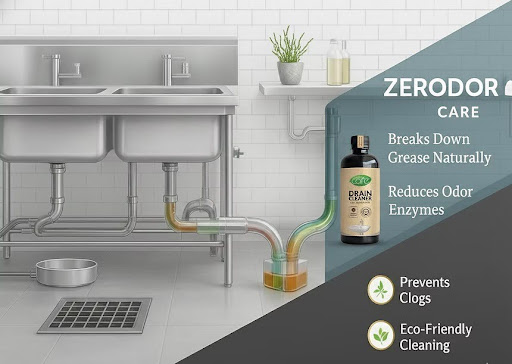
Zerodor by Ekam Eco Solutions’ drain line cleaning products are specifically formulated with these environments in mind. Non-toxic, eco-safe, and easy to incorporate into any regular maintenance routine, they’re designed for consistent use — not just as an emergency fix when things go wrong.
Where This Approach Makes the Most Difference
Think about the environments where drain maintenance genuinely matters:
Residential Homes
Ideal for kitchens, bathrooms, and laundry areas where organic waste buildup is common.
Restaurants and Commercial Kitchens
Helps break down grease and food waste efficiently, preventing frequent clogging in high-use drains.
Hotels and Hospitality Sector
Ensures hygiene standards are maintained while reducing maintenance disruptions.
Educational Institutions
Schools and colleges benefit from safe, chemical-free drainage maintenance on large campuses.
Hospitals and Healthcare Facilities
Supports hygiene-critical environments where chemical exposure must be minimized.
Industrial Facilities
Helps manage organic wastewater in production and processing units.
In all of these settings, chemical drain cleaners create problems even as they solve them — health risks, environmental liability, ongoing pipe damage, and a maintenance cycle that never really ends. Enzyme-based treatment breaks that cycle.
The Cost Argument Is Simpler Than It Looks
It’s easy to look at a bottle of chemical drain cleaner and think it’s the economical choice. It’s inexpensive, it’s familiar, and it works in the short term. But consider what the actual long-term cost looks like: repeated purchases because blockages keep coming back, eventual pipe repair or replacement from chemical damage, plumber call-outs that could have been avoided, and in commercial settings, the operational disruption every time something goes wrong.
Enzyme-based drain maintenance shifts the equation from reactive to preventive. The pipes last longer. The maintenance intervals stretch out. The cycle of repeated blockages slows down and often stops entirely. For organizations managing dozens of washrooms and drainage points across a large facility — the kind of scale Ekam Eco Solutions works with regularly — the savings compound quickly.
The Bigger Picture
At Ekam Eco Solutions, the shift toward enzyme-based drain cleaning fits into a larger philosophy about how hygiene infrastructure should work. Since 2013, we’ve been building solutions — backed by research from IIT Delhi and trusted by over 700 organizations including Tata, Indian Railways, ITC, ICICI Bank, and the Indian Armed Forces — around the idea that sustainability and performance aren’t in conflict. The most effective solutions are often also the most responsible ones.
Our drain line cleaning products are part of a broader portfolio that includes waterless urinal systems that have saved over 3.5 billion liters of water across India, VOC-free surface cleaning solutions certified for green building compliance, and odor management systems that actually neutralize rather than mask. Each product reflects the same thinking: real problems deserve solutions that work in the long run, not just in the moment.
Enzyme-based drain cleaning is exactly that kind of solution. It works with biology rather than against it. It protects infrastructure rather than quietly degrading it. It eliminates odors and prevents blockages at the root cause rather than addressing symptoms after the fact. And it does all of this without creating new problems in the process.
If your facility is still relying on chemical drain cleaners — or if you’re dealing with drains that block repeatedly despite regular treatment — it may be time to try a smarter approach. Explore Ekam Eco Solutions’ drain line maintenance solutions at ekameco.com, or get in touch with our team to find out what preventive, enzyme-based drain care could look like for your specific environment.