
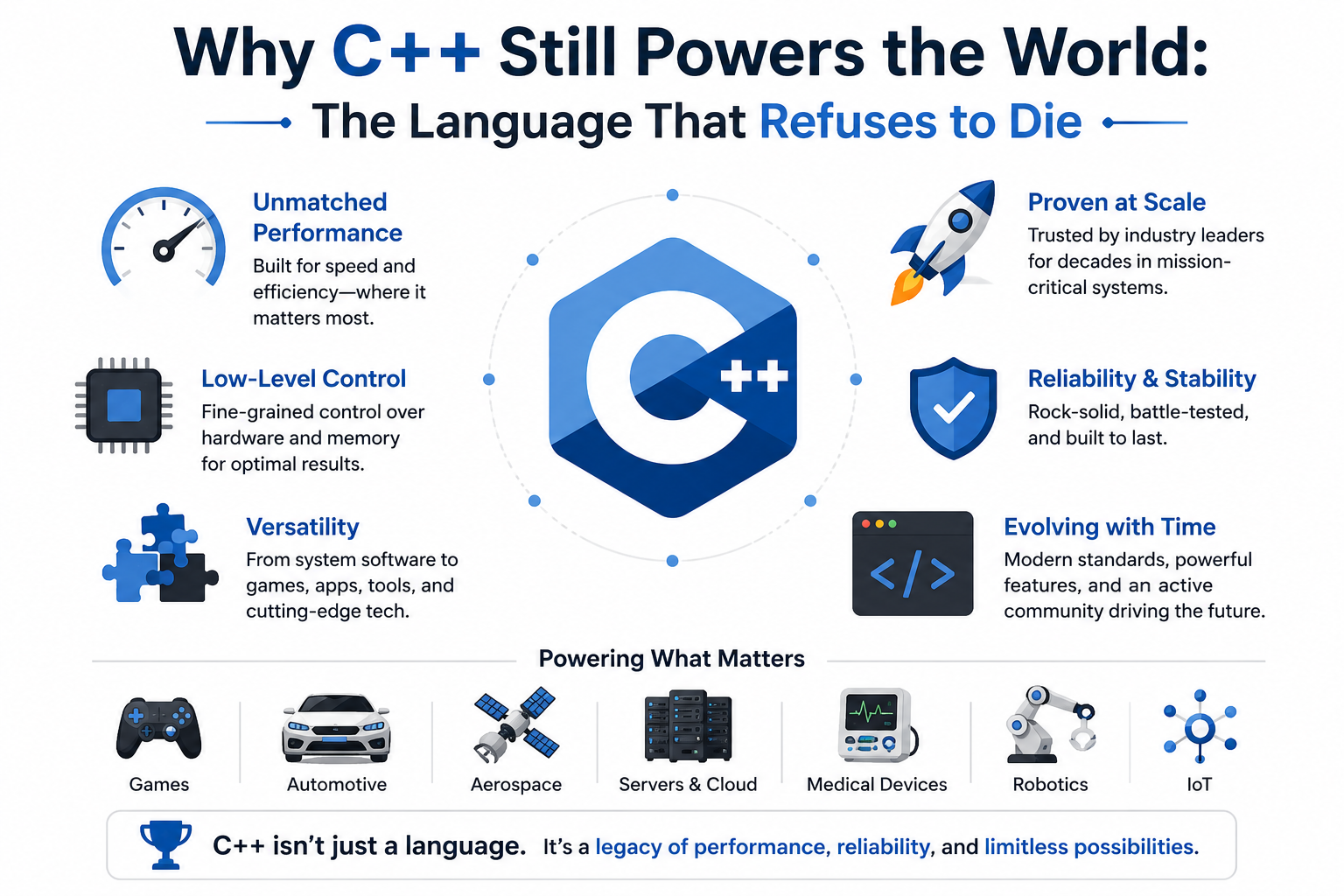
When developers debate which programming language will rule the future, they often overlook the one that has quietly ruled the present for over four decades. C++ in modern technology is not a relic clinging to relevance; it is the invisible engine humming beneath the software that runs your games, trades your stocks, launches your rockets, and connects your devices. It refuses to die not because developers are too stubborn to replace it, but because nothing else has yet matched its extraordinary combination of raw power, expressive design, and zero-overhead performance. This is the story of why C++ still powers the world, and why that is unlikely to change anytime soon.
The Foundation That Never Cracked: A Brief Look at C++ Origins (1979 – 2000)
Understanding why c++ in modern technology remains dominant begins with understanding what it was built to do. Bjarne Stroustrup started designing the language in 1979 at Bell Labs, creating what he initially called “C with Classes.” His goal was deceptively simple: take the systems-level efficiency of C and layer on the organizational power of object-oriented programming. The result, formally named C++ in 1983 and standardized by ISO in 1998, was a language that could operate inches above the hardware while offering the abstraction tools that large, complex software demands.
That dual identity, low-level control combined with high-level expressiveness, is precisely what makes c++ in modern technology so hard to displace. Most languages choose one side of that tradeoff. C++ refuses to.
Exploring the full history of C++ reveals a language that has continuously evolved without ever betraying the developers who built careers on it. Backward compatibility is not just a feature; it is a foundational promise that the ISO C++ Standard committee takes seriously with every new release.
Performance That No Runtime Can Match
The single most powerful argument for c++ in modern technology is performance. Not theoretical performance on benchmarks, but real-world, production-grade execution speed that matters when milliseconds translate to millions of dollars or the difference between a responsive application and a broken one.
C++ achieves this through several interlocking mechanisms. First, it compiles directly to machine code, eliminating the interpreter overhead that burdens languages like Python or JavaScript. Second, it gives developers direct control over memory management, allowing precise allocation and deallocation without waiting for a garbage collector to decide when memory is no longer needed. Third, the zero-overhead principle, a concept Stroustrup embedded into the language’s DNA, guarantees that you never pay a performance cost for abstractions you do not use.
Consider a simple high-performance loop processing financial data:
#include <vector>
#include <numeric>
#include <iostream>

int main() {
    std::vector<double> prices = {102.5, 98.3, 105.7, 99.1, 107.8};
    double total = std::accumulate(prices.begin(), prices.end(), 0.0);
    double average = total / prices.size();
    std::cout << "Average price: " << average << std::endl;
    return 0;
}
This code compiles to tightly optimized machine instructions. No virtual machine, no garbage collection pause, no runtime interpretation layer. In high-frequency trading algorithms where execution time is measured in nanoseconds, this difference is not academic; it is the entire business model.
C++ in Game Development: The Engine Behind Every Epic World
Few industries demonstrate c++ in modern technology more vividly than game development. The Unreal Engine, one of the most powerful game engines ever built, is written almost entirely in C++. Unity’s core runtime, while scripted in C#, is itself a C++ application. Every AAA title you have ever played that demanded seamless physics simulations, real-time rendering, and responsive AI was almost certainly running C++ at its core.
The reasons are architectural. Games demand deterministic destruction of objects, meaning you cannot afford an unpredictable garbage collection pause when a player is mid-battle. C++ delivers this through RAII (Resource Acquisition Is Initialization), a pattern where resources are tied to object lifetimes and automatically released when objects go out of scope. No garbage collector, no pauses, no surprises.
class Texture {
public:
    Texture(const std::string& path) {
        // Load GPU texture resource
        data = loadFromDisk(path);
    }
    ~Texture() {
        // Automatically freed when Texture goes out of scope
        freeGPUMemory(data);
    }
private:
    void* data;
};
The destructor fires automatically at the exact moment the object leaves scope. This is deterministic destruction in action, and it is why C++ game development remains the gold standard for performance-critical interactive software.
For developers curious about deepening their game development skills, exploring advanced C++ concepts like move semantics, template metaprogramming, and custom allocators is the natural next step after mastering the basics.
Operating System Kernels and Systems Programming
When you boot your computer, the first substantial code that executes is almost certainly written in C or C++. The Windows kernel contains enormous amounts of C++ code. Major components of macOS and iOS are written in C++. The LLVM compiler infrastructure, which powers Clang, Rust’s compiler, and Swift’s compiler, is C++. The V8 JavaScript engine that runs Node.js and Chrome is C++.
This is system-level programming territory, where hardware abstraction is required, memory layouts must be precise, and performance cannot be negotiated away. C++ is one of the very few languages capable of operating at this level while still offering the organizational tools needed to manage codebases of millions of lines.
The relationship between c++ in modern technology and operating system development is symbiotic. C++ needs the hardware access that systems programming demands to prove its worth, and systems software needs the expressiveness and type safety that C++ provides over raw C.
Embedded Systems and Resource-Constrained Environments
Beyond desktop and server computing, c++ in modern technology reaches deep into the physical world. Embedded systems, from automotive control units to medical devices to aerospace flight computers, routinely run C++ code. The reasons are the same: direct hardware access, predictable performance, and no dependency on a heavy runtime environment.
In resource-constrained environments, every byte of RAM matters. A garbage-collected language that quietly allocates memory behind the scenes is simply not an option. A virtual machine that adds kilobytes of overhead before your code even runs is a nonstarter. C++ lets developers work directly with hardware registers, control interrupt handlers, and manage memory with surgical precision.
// Embedded-style LED control on a microcontroller
#define LED_PORT (*(volatile unsigned int*)0x40020000)

void toggleLED() {
    LED_PORT ^= (1 << 5);  // Toggle bit 5 directly
}
This kind of direct memory-mapped hardware control is natural in C++. It is the kind of code running in the car you drive, the pacemaker keeping someone alive, and the satellite orbiting overhead.
The C++ Standard Library: A Powerful Ally
Part of what keeps c++ in modern technology so productive is the C++ standard library, a vast collection of containers, algorithms, utilities, and I/O tools that ship with every conforming C++ implementation. The STL (Standard Template Library) provides data structures like vectors, maps, and queues, along with a comprehensive algorithm library covering sorting, searching, and transformation operations.
#include <algorithm>
#include <vector>
#include <iostream>

int main() {
    std::vector<int> scores = {85, 92, 67, 78, 95, 88};
    std::sort(scores.begin(), scores.end(), std::greater<int>());
    for (int s : scores) {
        std::cout << s << " ";
    }
    return 0;
}
// Output: 95 92 88 85 78 67
The C++ STL guide is essential reading for any developer who wants to write idiomatic modern C++. Mastering the standard library dramatically reduces the need for custom implementations and keeps code readable, maintainable, and fast.
Why C++ Outlasts Every “C++ Killer” Language
Every few years, a new language arrives with promises to finally replace C++. Java promised platform independence and memory safety. Go promised simplicity and fast compilation speed. Rust promises memory safety without garbage collection. Each of these languages has genuine strengths and occupies important niches. None has displaced C++.
C++ in modern technology survives these challenges for a concrete reason: legacy codebase maintenance is real and expensive. Billions of lines of production C++ code run financial exchanges, medical devices, telecommunications infrastructure, and aerospace systems. Rewriting them is not a business decision; it is a fantasy. The organizations running this code invest in hiring C++ developers and upgrading to modern C++ standards rather than attempting rewrites that would cost billions and introduce catastrophic new risks.
Beyond legacy code, C++ continues to be chosen for new projects in domains where its unique profile of performance, control, and expressiveness cannot be matched. A comparison of C++ vs Python makes this immediately clear: Python wins on developer velocity and ecosystem breadth, but C++ wins decisively on execution time, memory efficiency, and deployment to environments without a Python runtime.
Modern C++ Is Not Your Father’s C++
A common misconception is that C++ is a frozen, archaic language. The reality is that modern C++ features introduced in C++11, C++14, C++17, C++20, and C++23 have transformed the language into something genuinely elegant and expressive. Auto type deduction, lambda expressions, smart pointers, coroutines, modules, concepts, and ranges have made modern C++ dramatically safer and more productive than the C++ of the 1990s.
// Modern C++20 with ranges and lambdas
#include <ranges>
#include <vector>
#include <iostream>

int main() {
    std::vector<int> nums = {1, 2, 3, 4, 5, 6, 7, 8, 9, 10};
    auto evens = nums | std::views::filter([](int n){ return n % 2 == 0; })
                      | std::views::transform([](int n){ return n * n; });
    for (int val : evens) {
        std::cout << val << " ";
    }
    return 0;
}
// Output: 4 16 36 64 100
This code is clean, readable, and compiles to highly optimized machine code. Memory management in C++ today is largely handled through smart pointers like std::unique_ptr and std::shared_ptr, which eliminate the memory leaks and type safety nightmares of raw pointer usage while preserving full performance.
For developers who want to understand the building blocks of this modern approach, studying OOP in C++ and pointers and references forms the essential foundation. The C++ vs Java comparison is also illuminating: where Java relies on a garbage-collected virtual machine, C++ delivers comparable expressiveness with deterministic, runtime-efficient memory control.
Cross-Platform Development and C++ Backend Development
C++ is one of the most portable languages ever created. Code written to the ISO standard compiles cleanly on Windows, Linux, macOS, iOS, Android, and dozens of embedded platforms. This cross-platform development capability means a single codebase can target an enormous range of hardware with minimal platform-specific changes.
In C++ backend development, this portability combines with raw throughput to handle workloads that other languages struggle with. Database engines like MySQL, RocksDB, and FoundationDB are written in C++. Web browsers, which handle millions of user interactions per second, are written in C++. The compiler optimization capabilities of modern toolchains mean that C++ backend systems consistently outperform equivalents written in garbage-collected languages under heavy load.
Frequently Asked Questions
Is C++ Still Worth Learning in 2026?
Absolutely. C++ in modern technology is actively used in game engines, financial systems, embedded devices, operating systems, compilers, and high-performance backends. The job market for skilled C++ developers remains strong, salaries are consistently above average for software engineers, and the language itself is evolving rapidly with C++23 recently ratified and C++26 in development. If you want to understand how software really works at a deep level, C++ is one of the most valuable skills you can build.
Why Does C++ Not Have Garbage Collection?
C++ deliberately omits garbage collection because deterministic destruction and runtime efficiency are core to its design philosophy. Garbage collectors introduce unpredictable pauses and overhead that are unacceptable in real-time systems, games, and high-frequency trading algorithms. Instead, C++ uses RAII and smart pointers to manage memory automatically without a runtime garbage collection cycle. This gives developers the safety of automatic memory management with none of the performance unpredictability.
How Does C++ Compare to Rust for Systems Programming?
Both C++ and Rust target system-level programming and offer exceptional performance without garbage collection. Rust enforces memory safety at compile time through its ownership and borrowing system, eliminating entire classes of bugs. C++ offers more flexibility, a vastly larger ecosystem, decades of tooling maturity, and a massive installed base of legacy code. For new projects where memory safety is the top priority, Rust is a compelling choice. For projects involving existing C++ codebases, integrating with C libraries, or leveraging the full depth of the C++ standard library, C++ vs Rust often resolves in C++’s favor for pragmatic reasons.
What Industries Rely Most Heavily on C++?
C++ in modern technology dominates game development (Unreal Engine, AAA titles), financial technology (high-frequency trading algorithms, risk engines), automotive and aerospace (embedded control systems, flight computers), telecommunications (network infrastructure, routers), operating systems (Windows, macOS components), web browsers (Chrome, Firefox, Safari), and database engines (MySQL, MongoDB, RocksDB). The common thread across all these industries is a requirement for maximum performance, direct hardware access, or both.
Is C++ Hard to Learn for Beginners?
C++ has a steeper learning curve than Python or JavaScript, primarily because it requires understanding memory management, pointers and references, and compilation. However, modern C++ with smart pointers, the standard library, and clear coding guidelines is significantly more approachable than the C++ of two decades ago. Beginners who invest in learning C++ gain an extraordinarily deep understanding of how computers actually work, which makes every other language easier to master afterward.
Conclusion
C++ in modern technology is not surviving on nostalgia. It is thriving on merit. Its unmatched performance, zero-overhead abstractions, direct hardware control, and decades of ecosystem depth make it irreplaceable in the domains that demand the absolute best from software. From the Unreal Engine rendering breathtaking worlds to high-frequency trading algorithms executing billions of trades, from satellite firmware to the compilers that build every other language, c++ in modern technology is the invisible force behind the digital infrastructure of modern civilization.
The language has evolved dramatically. Modern C++ is safer, more expressive, and more productive than ever before. The developers who invest in mastering it join a community of engineers solving the hardest problems in computing. If you are ready to start that journey, begin with the fundamentals, understand the history, and build toward the advanced topics that make C++ genuinely extraordinary. The language that refuses to die has more life in it than ever.