
Introduction
The beauty industry looks, from the outside, like one of the most attractive markets to build a business in. The global cosmetics market is worth hundreds of billions of dollars. Social media is filled with successful-looking beauty brands. Consumers spend consistently on skincare, makeup, and wellness products regardless of broader economic conditions.
So why do so many cosmetic businesses — launched with real products, real passion, and real customers — hit a ceiling they can’t seem to break through?
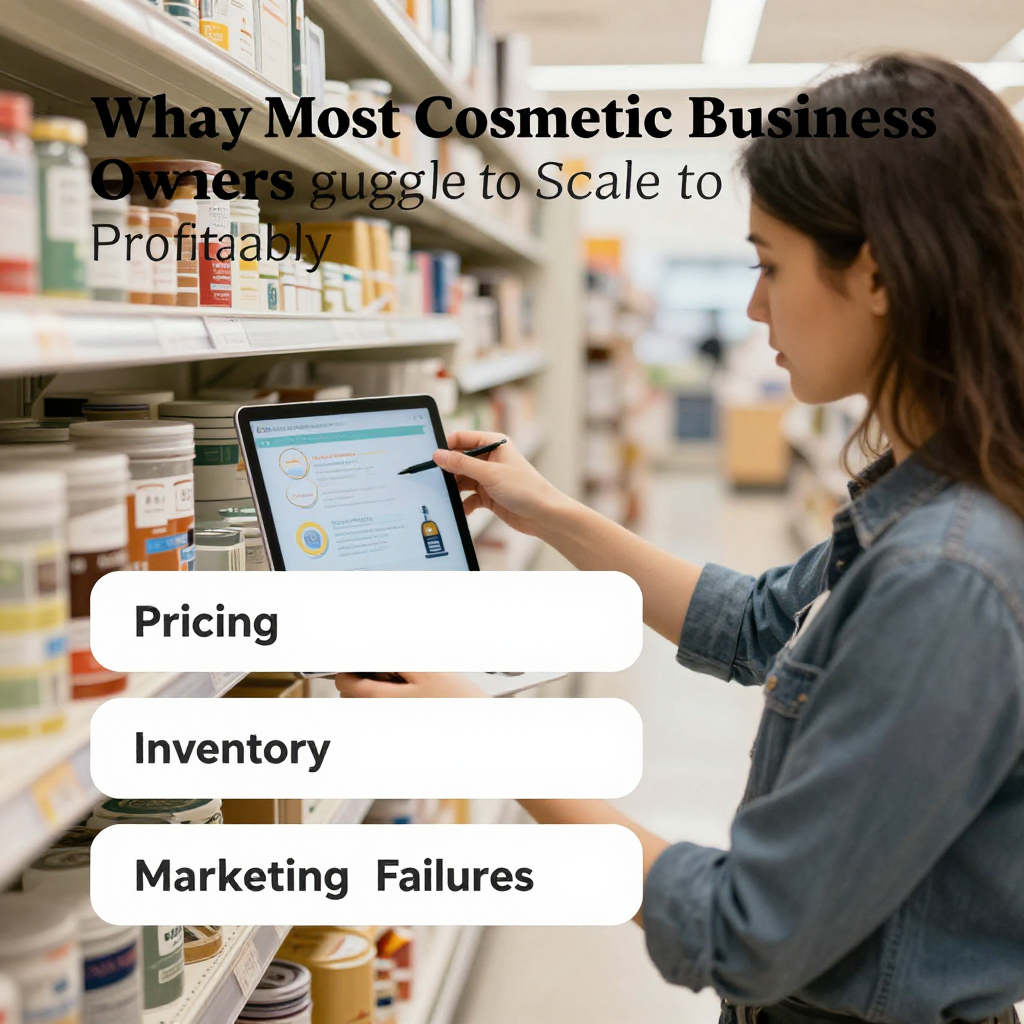
The answer is rarely about the product itself. Most cosmetic startups that struggle to scale are dealing with a combination of financial structures that don’t hold up under growth pressure, marketing approaches that generate attention but not sustainable revenue, and operational challenges that compound as volume increases.
Scaling in the beauty industry is genuinely difficult. But the difficulty is predictable — and predictable problems have solutions. Here’s an honest look at what’s actually getting in the way, and what to do about it.
The Financial Reality Most Beauty Startups Ignore
Margins That Look Healthy Until They Don’t
Cosmetics can appear to be a high-margin business. Raw material costs for many formulations are relatively low, and retail prices — particularly in the premium and luxury segments — can be multiples of production cost.
The problem is what sits between production cost and net profit. Packaging, regulatory compliance, third-party manufacturing minimums, storage, fulfillment, returns, payment processing fees, and platform commissions all take their cuts before a dollar reaches the business owner. Add customer acquisition costs on top of that, and margins that looked attractive on paper become uncomfortably thin in practice.
Many cosmetic startups build their pricing based on production cost alone, without fully accounting for the true cost of getting a product to a paying customer. The result is a business that generates revenue and looks active, but doesn’t actually accumulate capital — making growth financing itself from profit essentially impossible.
The Minimum Order Trap
Contract manufacturers typically require minimum order quantities that make sense at scale but create serious cash flow problems for early-stage brands. A founder might need to tie up $15,000 in inventory of a single SKU before they’ve proven that product has demand at volume.
This creates a painful dilemma. Underorder and pay a higher per-unit cost that kills margin. Overorder and risk tying up capital in slow-moving stock. Either way, the financial pressure limits the ability to invest in the marketing and brand-building that would actually accelerate growth.
Customer Acquisition Costs Are Eating Beauty Brand Margins
The rise of paid social advertising gave beauty brands access to scalable customer acquisition channels. It also created a competitive environment where the cost of reaching a new customer has risen dramatically as more brands compete for the same attention.
A cosmetic business that relies primarily on paid Meta or TikTok advertising to drive sales is essentially renting its customer base. The moment the ads stop, the revenue stops. And as customer acquisition costs rise — which they consistently do in competitive categories — the margin on each first-time sale shrinks toward zero.
The brands that scale profitably are the ones that build organic acquisition channels in parallel with paid ones. SEO-driven content that attracts customers searching for solutions. A referral program that turns satisfied customers into acquisition channels. A social media presence built on genuine community rather than pure content volume.
These channels take longer to build but generate compounding returns rather than one-time transactions.
The Brand Trust Problem in a Saturated Beauty Market
Why Being Good Isn’t Enough
The global beauty market contains thousands of brands that make genuinely good products. Effective formulations, clean ingredients, pleasant textures — these qualities are increasingly table stakes rather than differentiators.
What separates brands that grow from brands that stagnate isn’t usually product quality. It’s the trust and emotional connection that a brand builds with its audience over time.
Beauty consumers are making decisions that feel personal. Skincare goes on their face. Cosmetics become part of how they present themselves to the world. The brands they choose say something about their values, their aesthetic, and their standards. Building the kind of trust that makes customers choose you — and keep choosing you — requires more than a good formula and attractive packaging.
It requires consistency of communication, transparency about ingredients and practices, visible social proof from people the customer trusts, and a brand voice distinct enough to feel like a real point of view rather than a generic beauty aesthetic.
Packaging Is a Trust Signal, Not Just a Presentation Choice
First impressions in cosmetics happen twice — once online, through photography and content, and once physically, when the product arrives. The physical moment is particularly high-stakes because it’s when the customer’s expectations meet reality.
Brands that invest thoughtfully in packaging communicate product quality before the customer has experienced the formula. Custom Cosmetic Boxes designed to reflect the brand’s positioning — in materials, finish, color palette, and structural quality — create an immediate sensory impression that primes the customer to evaluate the product favorably. Cheap or generic packaging does the opposite, creating doubt that even an excellent formulation has to overcome.
In a market where customers frequently share their purchases on social media, packaging also functions as organic marketing. Beautifully presented products get photographed and shared. That content reaches new potential customers at zero acquisition cost to the brand.
Why Social Media Alone Cannot Scale a Beauty Business
Social media built many of today’s most recognizable beauty brands. It’s also generated a widespread misunderstanding about what social media can and cannot do for a scaling business.
Social media is an exceptional awareness and community-building tool. It is not a sustainable standalone revenue engine for most beauty brands trying to scale profitably.
The algorithm-dependency problem is real. Reach that was organic three years ago now requires paid amplification. Formats that perform today may be deprioritized next quarter. A brand that has built its entire growth strategy around a single platform’s algorithm has built on unstable ground.
Brands that scale successfully use social media as part of a broader ecosystem. Email marketing that converts engaged followers into owned relationships. Retail partnerships that provide distribution independent of digital performance. Content marketing that builds long-term search visibility. A loyalty structure that generates repeat purchase without requiring ongoing acquisition spend.
Customer Retention: The Metric That Determines Long-Term Profitability
Here’s a simple truth that changes how you think about cosmetic business economics: the most profitable customer is the one you don’t have to acquire again.
Customer acquisition cost is a one-time expense if the customer becomes a repeat buyer. Spread across multiple purchases, it becomes a manageable part of the unit economics. But if the majority of your customers buy once and don’t return — which is the reality for many cosmetic brands — you’re paying full acquisition cost for every single sale, indefinitely.
Improving retention by even modest percentages has an outsized impact on profitability. This means investing in the post-purchase experience: follow-up communication that feels personal rather than automated, subscription options that make repurchasing frictionless, loyalty rewards that make continued engagement feel valuable, and customer service that handles issues so well that problems become reasons to stay rather than reasons to leave.
What Sustainable Growth in Cosmetics Actually Looks Like
The beauty brands that scale profitably share several characteristics that aren’t immediately visible in their public-facing success.
They know their unit economics precisely — not just production cost, but full cost-to-serve per customer. They build owned marketing channels alongside paid ones. They focus on customer lifetime value rather than optimizing for first-purchase conversion. They manage inventory conservatively and resist the pressure to over-expand their product range before they’ve fully penetrated demand for their existing SKUs.
They also make deliberate choices about brand positioning and hold them consistently. Premium positioning requires premium consistency — in product quality, in communication, in every customer touchpoint. Brands that cut corners on any element of the experience undermine the positioning that justifies their price point.
Conclusion
Scaling a cosmetics business profitably is hard — but it’s hard in ways that are understandable and addressable. The founders who figure it out aren’t necessarily the ones with the best products or the most social media followers. They’re the ones who understand their financial structure clearly, build marketing systems that don’t depend entirely on paid acquisition, invest in customer retention as seriously as customer acquisition, and create a brand experience consistent enough to command loyalty in a market with endless alternatives.
The beauty industry rewards brands that earn trust and maintain it. Build that trust deliberately, at every touchpoint, and the scale will follow.