
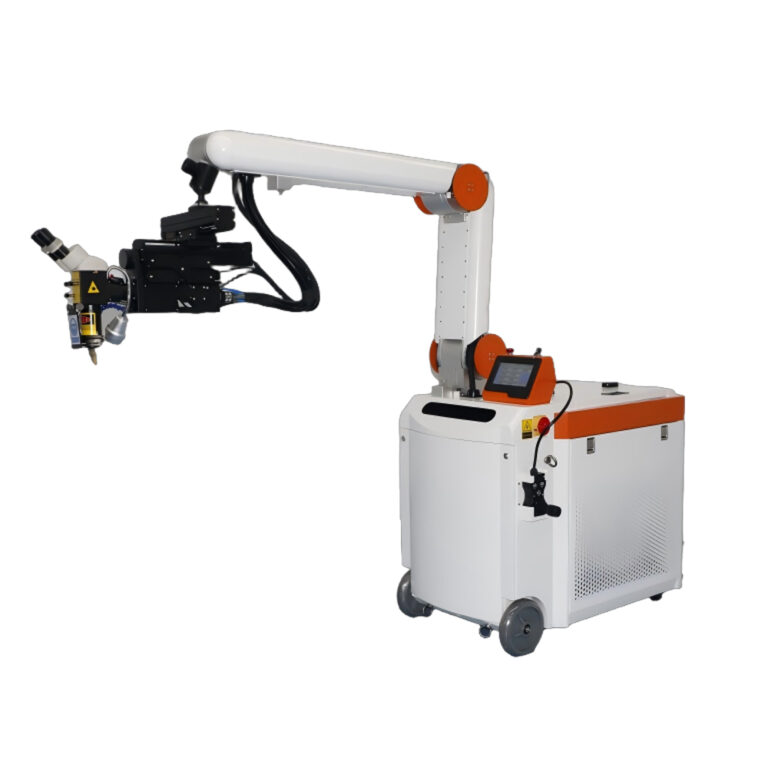
For manufacturers seeking to elevate their joining and fabrication capabilities, choosing the right laser welding machine supplier is a decision with long-term operational implications. The supplier you choose determines not only the quality and performance of your equipment but also the level of technical support, spare parts availability, and application expertise you can access throughout the machine’s operational life. Laser welding has fundamentally changed precision manufacturing — the focused high-intensity beam produces narrow, deep welds with dramatically reduced heat input compared to conventional arc or resistance welding, resulting in less distortion, smaller heat-affected zones, and higher weld integrity.
System Range: From Handheld Units to Robotic Integration
When evaluating a laser welding machine supplier, begin by assessing the range of systems they offer. Leading suppliers provide solutions spanning handheld laser welders for small shops and field applications, desktop systems for laboratory and prototype work, automated workcell systems for medium-volume production, and fully integrated robotic systems for high-volume multi-shift operations. A supplier who can offer solutions across this spectrum is well-positioned to serve your needs as production volumes and capabilities evolve. This breadth of offering also signals deep engineering capability and real-world application experience across diverse manufacturing environments.
Laser Power, Wavelength, and Beam Quality Specifications
Laser power and wavelength are fundamental technical specifications determining weld characteristics. Higher power lasers enable greater penetration depth and faster welding speeds. Wavelength affects how different materials absorb laser energy — infrared wavelengths of around 1 micron produced by fiber and disk lasers are well-absorbed by most metals, while green wavelength lasers offer enhanced absorption for highly reflective materials such as copper and gold, critical in electronics and battery manufacturing. Beam quality, expressed as the beam parameter product or M-squared value, affects how tightly the beam can be focused, enabling narrower welds and higher energy density.
Process Monitoring, Quality Control, and Integration
Process monitoring and quality control capabilities are important differentiators among laser welding machine supplier. Real-time weld monitoring using optical sensors, pyrometers, and high-speed cameras enables detection of defects such as lack of fusion, porosity, and cracking as they occur rather than during post-weld inspection. Ease of integration with existing production equipment is a practical concern affecting total cost of ownership — machines that offer standard communication interfaces, compatible fixture mounting options, and PLC integration simplify incorporating new equipment into existing production lines without extensive engineering work.
Training, Commissioning, and Maintenance Support
Training and commissioning support provided by the supplier directly impacts how quickly your team becomes productive with new laser welding equipment. Suppliers who offer structured operator training, application trials in their demo facility, and hands-on commissioning support at your site reduce the learning curve and help you achieve target performance levels faster. Maintenance requirements and the availability of consumable parts are ongoing considerations affecting operational costs — high-quality laser systems are designed for reliability, but regular maintenance of optical components, cooling systems, and motion axes is necessary to sustain peak performance throughout the machine’s life.
Environmental Compliance, Financing, and Customer References
Environmental compliance including fume extraction and laser safety enclosure requirements should be addressed in collaboration with the supplier. Suppliers who provide guidance on regulatory compliance and offer integrated solutions such as built-in fume extractors simplify facility compliance and protect worker safety. Progressive suppliers also offer leasing arrangements, extended warranty programs, and service contracts that reduce upfront investment. Customer references and case studies from the supplier’s existing customer base provide real-world insight into system performance, service responsiveness, and overall supplier reliability that no brochure or sales presentation can replicate.
