

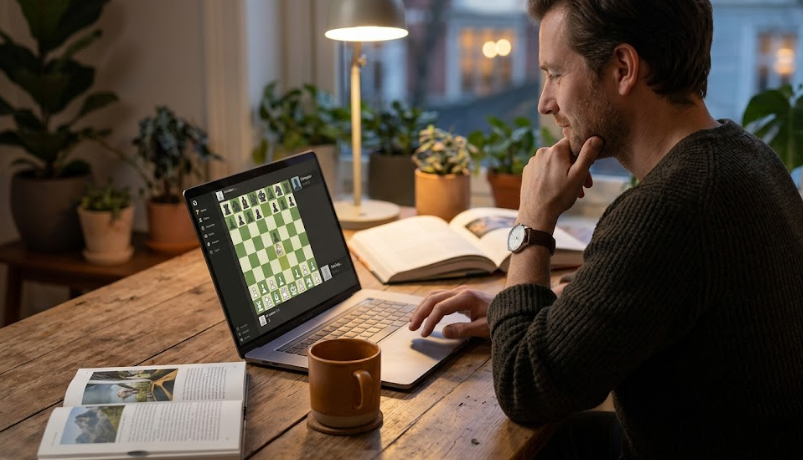
I picked up chess again at 34. Had not played seriously since university, where a flatmate and I used to play late at night when neither of us could sleep. Decent memories. So when I saw someone streaming chess online a couple of years back, I thought, why not? Let me try again. Went straight to one of the big competitive platforms, got absolutely taken apart in every game, and nearly quit again within the first week. A colleague who plays regularly suggested I try chess vs computer first, just to ease back in. That was good advice. Really good advice, as it turned out.
What I did not expect was that computer chess would not just be a stepping stone back to competitive play. It would become the main way I enjoy the game, probably permanently. And talking to other people in similar situations, I do not think that is unusual at all.
Life Does Not Pause for a Chess Game
Here is a reality that competitive chess platforms are not really built around: most adults have unpredictable lives. Work runs late. Kids need something. A phone call comes in at exactly the wrong moment. Dinner takes longer than expected. Life does not care that you are twenty moves into a chess game and things are just getting interesting.
Online competitive chess punishes all of this. Walk away mid-game, and you lose on time. Get distracted for two minutes and your clock runs down. Get interrupted right when you were about to find a good move, and you come back flustered and make something hasty instead. The format assumes you have a clean, uninterrupted block of time to commit to a game, and that is just not how most adult lives actually work.
Against a computer, there is no punishment for real life getting in the way. Step away for ten minutes because something came up; the board is exactly where you left it when you get back. Nobody abandoned the game. Nobody is frustrated. The computer does not even notice you were gone. You just pick up and keep playing whenever you are actually ready to think again.
That flexibility sounds like a small thing, but it makes chess genuinely sustainable as a hobby for someone with a busy schedule. Instead of needing to carve out a dedicated uninterrupted block of time, you can just play whenever you have a few minutes and pause whenever you need to. The game fits around your life rather than demanding that your life fit around it.
Coming Back to Chess After a Long Break Is Hard Enough Already
When you return to chess after years away, you are not starting from zero, but you are not where you left off either. Things that used to feel natural feel rusty. Patterns you recognized immediately take a few extra seconds now. Your calculation is slower than it was. That is fine, that is just what happens when you step away from something for a long time.
The problem is that competitive online platforms do not really accommodate this in-between state. You get matched against people playing regularly, people who have not taken a ten-year break, people who are sharp and fast and in practice. You spend your first few weeks just getting beaten in ways that are not particularly instructive because the gap in current sharpness is just too big to learn much from.
Computer chess lets you reenter at the right level. Not too easy, not overwhelming. You can find opponents that match where you actually are right now, not where you were a decade ago. And because there is no rating attached to it, there is no shame in taking your time to work back up to a comfortable level before thinking about playing people again. You just practice, get your chess legs back under you, and go at whatever pace makes sense for where you are.
The Mental Decompression Angle Is Real
A lot of people my age play chess not primarily to improve or to compete but because it gives their brain something to do that is not work. After a day of meetings and emails and decisions and responsibilities, sitting down with a chess problem to solve is genuinely relaxing. Not passive relaxing like watching television, but active relaxing where you are engaged and thinking but thinking about something completely separate from everything that was stressing you out an hour ago.
Competitive online chess breaks this for a lot of people. The pressure of rated games, the possibility of unpleasant opponents, the time controls forcing you to move faster than feels comfortable; all of it adds a layer of stress on top of a hobby that was supposed to be a break from stress. That is exactly backwards from what you want.
Playing chess vs computer keeps the good part, the focused engaging problem-solving, without adding the competitive anxiety on top of it. You sit down, you play a game that makes your brain work, you finish it feeling like you used your mind well, and you go to bed. No frustration lingering from a bad opponent. No annoyance at yourself for losing rating points. Just a good game and a clear head afterward.
I started playing a game or two most evenings before bed. Twenty, thirty minutes. It replaced a bad habit I had of just scrolling my phone in that time and honestly it is a much better use of those minutes. My sleep is better too, I think, because I am actually winding down with something calm rather than feeding myself an endless stream of notifications.
You Actually Learn More This Way
This surprised me more than anything else. I assumed that playing against real people would be better for improvement because the opponents are more unpredictable and varied. And eventually, yes, that variety matters. But in the early stages of getting back into chess, playing computer opponents is better for learning. Not worse.
The reason is simple. You have time to think. When I play online with a clock running, maybe fifteen percent of my mental energy goes toward the actual chess. The rest goes toward the clock, toward managing nerves, toward reacting to whatever my opponent just did without properly processing it. That is not a great learning environment.
Against a computer at my own pace, almost all of my mental energy goes toward the chess itself. I look at the whole board. I think about what my opponent is planning. I consider several moves before picking one. Every game becomes a small lesson because I am actually paying attention to what is happening rather than just reacting to it.
The bots on Chessiverse help with this specifically because they play like real people rather than engines. They create the kinds of problems a human opponent would create; attacking ideas, positional pressure, tactical tricks. Working through how to handle those things, with time to actually think, builds the kind of chess understanding that transfers directly to playing real people later on.
There Is No Wrong Reason to Enjoy Chess
Something I have noticed in chess communities online is a subtle pressure to take the game seriously in a particular way. Study openings. Analyze your games. Push your rating up. Treat every game like it matters. And if you are not doing all of that, you are sort of treated like you are not a real chess player.
I find that attitude exhausting. I play chess because I enjoy it. I enjoy the thinking, the problem-solving, the occasional moment when you find a move that feels clever and it actually works. I am not trying to become a grandmaster. I am not trying to win anything. I just like the game.
Playing chess vs computer lets you enjoy it on those terms without apology. You set the pace. You choose the kind of challenge you want. You play as much or as little as fits your life. Nobody is grading you or judging your progress or implying you should be taking it more seriously. It is just a game that you play because you like it, and that is a completely valid way to spend your time.
If Any of This Sounds Familiar
If you are someone who used to play chess and drifted away, or someone who tried competitive online play and found it more stressful than fun, or just someone with a busy life who wants to enjoy a proper thinking game without a lot of friction around it; computer chess is worth a serious look.
Chessiverse does this particularly well. The opponents feel like real players, not like difficulty-slider algorithms. The experience is calm and genuinely enjoyable. And there is nothing about it that demands more from you than you want to give. You can play one game on a Tuesday evening and not touch it again until the weekend, and that is perfectly fine. Chess vs computer on your own terms, at your own pace, without any of the baggage that makes competitive platforms exhausting for the rest of us.
Sometimes the best version of a hobby is the one that fits quietly into your actual life rather than the one that demands you reorganize your life around it.