
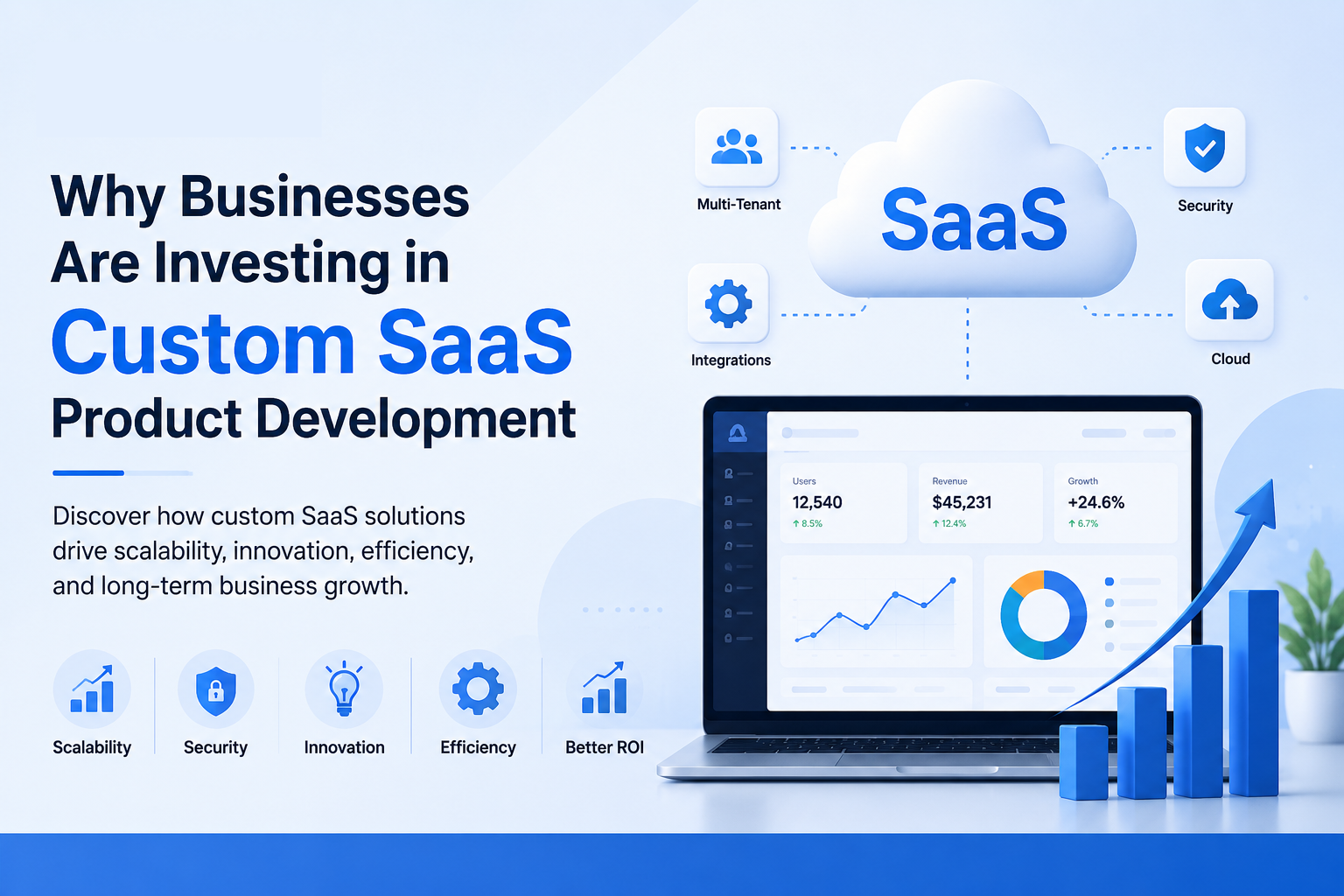
Every growing business eventually reaches a point where off-the-shelf software starts creating more problems than it solves. At first, generic tools seem like the perfect answer. They’re affordable, quick to deploy, and often packed with features. But as teams expand, processes become more specialized, and customer expectations evolve, those same platforms begin to feel restrictive.
I’ve seen organizations rely on multiple disconnected applications just to complete a single business workflow. Sales teams export spreadsheets from one platform, operations manually import them into another, and finance spends hours reconciling data across systems. What begins as a temporary workaround slowly turns into an expensive operational habit.
This is one of the biggest reasons businesses are investing in custom SaaS product development. Instead of adapting their operations to fit generic software, they’re building cloud-based solutions designed around the way their business actually works.
The shift isn’t only about technology. It’s about creating software that supports long-term growth, enables innovation, and gives organizations greater control over their digital future.
What Custom SaaS Product Development Really Means
Software as a Service, or SaaS, has transformed the way businesses consume software. Rather than installing applications on local servers, organizations access cloud-hosted platforms through a web browser while the provider manages infrastructure, updates, and maintenance.
Custom SaaS product development takes this model a step further.
Instead of licensing a one-size-fits-all application, businesses develop a cloud-native platform specifically designed around their own workflows, customer requirements, and long-term objectives.
Unlike traditional software projects that often become outdated after deployment, a custom SaaS platform is built to evolve. New features, integrations, and performance improvements can be introduced continuously without disrupting users.
Several characteristics distinguish modern SaaS products from conventional enterprise software.
Cloud-Native Architecture
Today’s SaaS platforms are designed for cloud environments from the beginning. This enables automatic scaling, high availability, and faster deployment cycles while reducing infrastructure overhead.
Rather than investing heavily in physical servers, organizations can allocate computing resources based on actual demand.
Multi-Tenant Design
Many SaaS platforms support multiple customers through a shared infrastructure while securely isolating each organization’s data.
This architecture reduces operational costs without sacrificing security or performance.
Built for Scalability
One of the greatest strengths of SaaS lies in its ability to grow alongside the business.
Whether a company serves one hundred users or one million, the underlying architecture can expand without requiring a complete rebuild.
Long-Term Flexibility
Business requirements rarely stay the same.
New regulations emerge.
Customer expectations shift.
Markets evolve.
A custom SaaS platform allows organizations to introduce new modules, automate emerging workflows, and integrate with future technologies without replacing their existing investment.
Security as a Core Requirement
Modern SaaS applications are expected to incorporate encryption, identity management, role-based permissions, activity logging, and continuous monitoring from the very beginning rather than treating security as an afterthought.
Why Businesses Prefer Custom SaaS Solutions
Organizations across industries aren’t investing in custom platforms simply because SaaS is popular. They’re making strategic decisions based on measurable business outcomes.
Better Scalability Without Constant Rebuilding
Many businesses experience rapid changes in demand.
An education platform may see enrollment spike during admissions.
Retail companies experience seasonal traffic.
Healthcare systems often face unpredictable patient volumes.
A well-designed SaaS platform automatically adjusts to these fluctuations, helping organizations maintain consistent performance without overspending on infrastructure.
Lower Operational Costs Over Time
Developing custom software requires a larger upfront investment than subscribing to generic applications.
However, the long-term financial picture often tells a different story.
Businesses eliminate recurring licensing fees for multiple disconnected tools.
Manual processes become automated.
Support costs decrease.
Employees spend less time switching between systems.
Over several years, many organizations discover that owning a platform tailored to their operations provides significantly better value.
Faster Innovation
Markets change quickly.
Companies that can launch new capabilities in weeks instead of months often gain a meaningful competitive advantage.
With a custom SaaS platform, product teams control their own roadmap rather than waiting for third-party vendors to prioritize requested features.
This freedom enables continuous experimentation and faster response to customer feedback.
A Better Customer Experience
Customers rarely judge software by the complexity of its architecture.
They remember how easy it was to accomplish their goals.
Custom SaaS products allow businesses to simplify onboarding, personalize user journeys, reduce unnecessary steps, and create experiences aligned with customer expectations.
These improvements often translate into higher retention and increased customer satisfaction.
Easier Integration Across Business Systems
Modern organizations rely on dozens of digital platforms.
Customer relationship management.
Accounting.
Marketing automation.
Payment gateways.
Inventory systems.
Communication tools.
A custom SaaS platform can connect these systems through APIs, eliminating duplicate data entry and creating a unified view of business operations.
Organizations evaluating a saas based product development company often prioritize integration capabilities because disconnected software remains one of the biggest barriers to operational efficiency.
Competitive Differentiation
Technology has become part of the product itself.
Companies that rely entirely on identical third-party software often struggle to distinguish themselves.
Custom SaaS platforms allow organizations to introduce proprietary workflows, intelligent automation, unique reporting capabilities, and personalized customer experiences that competitors cannot easily replicate.
Stronger Security and Compliance
Industries handling sensitive information cannot rely solely on default security settings.
Healthcare providers must protect patient records.
Financial institutions process confidential transactions.
Manufacturers safeguard intellectual property.
Custom platforms allow organizations to implement security policies aligned with their regulatory requirements while maintaining greater visibility into system activity.
Better Return on Investment
ROI isn’t determined solely by software costs.
It also reflects productivity gains, reduced operational inefficiencies, improved customer retention, faster decision-making, and increased business agility.
When viewed from this broader perspective, custom SaaS investments frequently deliver value well beyond technology itself.
Industries Driving SaaS Adoption
Nearly every industry has embraced cloud software in some form, but several sectors are accelerating investment more aggressively than others.
Healthcare
Healthcare providers are digitizing appointment scheduling, patient engagement, electronic medical records, telemedicine, and remote monitoring while maintaining strict compliance standards.
FinTech
Financial technology companies require secure, scalable platforms capable of processing thousands of transactions while integrating with banks, payment providers, and fraud detection systems.
Education
Learning management systems, virtual classrooms, assessment platforms, and student analytics have become essential components of modern education.
Cloud-native SaaS products make these services accessible from virtually anywhere.
Retail
Retailers increasingly depend on SaaS solutions for inventory management, customer loyalty, omnichannel commerce, and personalized shopping experiences.
Manufacturing
Manufacturers are moving beyond traditional ERP systems and investing in SaaS platforms that provide real-time production visibility, predictive maintenance, quality control, and supply chain monitoring. Cloud-based dashboards allow decision-makers to monitor factory performance across multiple locations without relying on outdated reports.
Logistics
The logistics industry depends on speed and visibility. Custom SaaS platforms help businesses optimize route planning, track shipments in real time, automate warehouse operations, and improve communication between carriers, suppliers, and customers. These capabilities reduce delays while improving overall operational efficiency.
Real Estate
Real estate companies are using SaaS products to simplify property management, automate lease administration, manage maintenance requests, and improve communication with tenants and buyers. Digital platforms also provide valuable insights into occupancy rates, customer preferences, and investment performance.
Key Technologies Behind Modern SaaS Products
A successful SaaS product is built on more than a good idea. The technology stack plays a critical role in determining how well the platform performs, scales, and adapts over time.
Cloud Infrastructure
Cloud providers have made enterprise-grade infrastructure accessible to businesses of all sizes. Instead of purchasing and maintaining expensive hardware, organizations can scale computing resources on demand. This flexibility helps businesses manage costs while maintaining high availability.
Microservices Architecture
Rather than building one large application, many SaaS platforms are developed as a collection of smaller, independent services. Each service handles a specific business function and can be updated or scaled without affecting the rest of the application. This approach improves reliability and supports continuous innovation.
APIs and Seamless Connectivity
Today’s software ecosystem depends on integration. APIs enable SaaS platforms to communicate with payment gateways, CRM systems, marketing tools, accounting software, communication platforms, and countless third-party services.
Strong backend development services are often the foundation of these integrations, ensuring data flows securely and efficiently between systems.
Containers and DevOps
Containerization has transformed how software is deployed and maintained. Technologies such as Docker and Kubernetes make it easier to deliver consistent environments across development, testing, and production.
Equally important is adopting reliable devops consulting services that help automate deployments, improve release quality, reduce downtime, and accelerate software delivery without compromising stability.
Artificial Intelligence
Artificial intelligence is no longer reserved for large technology companies. Businesses are embedding AI into SaaS platforms to automate repetitive tasks, improve customer support, generate predictive insights, and personalize user experiences.
Whether it’s intelligent document processing, recommendation engines, or demand forecasting, AI is becoming a practical business tool rather than an experimental feature.
Analytics and Business Intelligence
Every interaction within a SaaS application generates valuable data. Modern analytics tools transform that information into actionable insights that help organizations identify trends, measure performance, and make informed decisions.
Instead of relying on intuition alone, leaders can monitor customer behavior, product adoption, and operational efficiency through real-time dashboards.
Automation
Automation reduces manual work, minimizes human error, and allows employees to focus on higher-value activities. From workflow approvals to customer notifications and billing processes, automation has become a defining characteristic of successful SaaS platforms.
Common Challenges in Custom SaaS Development
While the benefits are substantial, building a SaaS product isn’t without challenges. Understanding these obstacles early can save considerable time and resources.
Architecture Planning
Poor architectural decisions made during the early stages often become expensive problems later. Businesses should design systems with scalability, maintainability, and future expansion in mind rather than focusing solely on immediate requirements.
Security
Cybersecurity threats continue to evolve. Strong authentication, encryption, access control, secure coding practices, and continuous monitoring should be integrated into every stage of development instead of being added after launch.
Scaling the Platform
Many products perform well during initial testing but struggle when user numbers increase. Performance testing and infrastructure planning are essential to ensure the platform remains responsive as adoption grows.
Compliance Requirements
Businesses operating in regulated industries must consider standards such as GDPR, HIPAA, SOC 2, or industry-specific compliance requirements. Ignoring these obligations early can lead to costly redesigns later.
Performance Optimization
Users expect applications to load quickly and operate reliably. Slow response times can negatively affect customer satisfaction and retention, making performance optimization an ongoing priority.
Maintenance and Continuous Improvement
Launching the product is only the beginning. Software requires regular updates, security patches, feature enhancements, and infrastructure improvements to remain competitive.
Technical Debt
Rushing development may accelerate initial delivery, but shortcuts often create technical debt that becomes increasingly difficult to manage. Investing in clean architecture and maintainable code from the outset typically reduces long-term costs.
Best Practices for Building a Successful SaaS Product
Organizations planning a custom SaaS initiative can improve their chances of success by following several proven practices:
- Start by solving a clearly defined business problem rather than building features for their own sake.
- Validate ideas with real users before investing heavily in development.
- Design the platform with scalability in mind from day one.
- Prioritize security and compliance throughout the development lifecycle.
- Build modular systems that can evolve as business needs change.
- Use analytics to guide product decisions instead of assumptions.
- Invest in automated testing and continuous deployment to maintain quality.
- Plan for long-term product ownership, including maintenance and ongoing enhancements.
Technology choices also matter. Businesses developing modern web interfaces often evaluate angular development services for building scalable enterprise front ends, while those requiring high-performance server-side applications frequently work with a trusted node js web development company to support real-time functionality and efficient API development.
Choosing the Right Development Partner
Selecting a technology partner is about more than technical expertise. The right team should understand your business objectives, industry challenges, and long-term vision.
When evaluating potential partners, consider the following questions:
- Have they built SaaS products similar in complexity to yours?
- Can they demonstrate experience with cloud-native architecture?
- How do they approach security, scalability, and compliance?
- What is their process for product discovery and planning?
- Do they provide ongoing maintenance and support after launch?
- How do they communicate progress and manage project risks?
Some organizations also benefit from working with an experienced enterprise web application development company when broader digital transformation initiatives extend beyond a single SaaS product.
For businesses replacing outdated legacy systems, partnering with a web app modernization development consultancy can help modernize existing applications while preserving valuable business logic and minimizing operational disruption.
Ultimately, a successful partnership is built on transparency, collaboration, and a shared commitment to creating long-term business value rather than simply delivering software.
Conclusion
The growing investment in custom SaaS product development reflects a broader shift in how organizations approach technology. Businesses are no longer satisfied with software that forces them to change established processes or limits their ability to innovate. They want platforms that align with their goals, adapt as they grow, and create meaningful value for both employees and customers.
Custom SaaS solutions provide that flexibility. They enable businesses to streamline operations, improve customer experiences, integrate diverse systems, and respond more quickly to changing market demands. While developing a custom platform requires thoughtful planning and sustained investment, the long-term benefits often outweigh the initial effort.
The most successful SaaS products aren’t defined by the number of features they include. They succeed because they solve genuine business problems, evolve alongside user needs, and are built on a strong technical foundation. Organizations that take a strategic, long-term approach to SaaS development position themselves to innovate with confidence and remain competitive in an increasingly digital marketplace.