
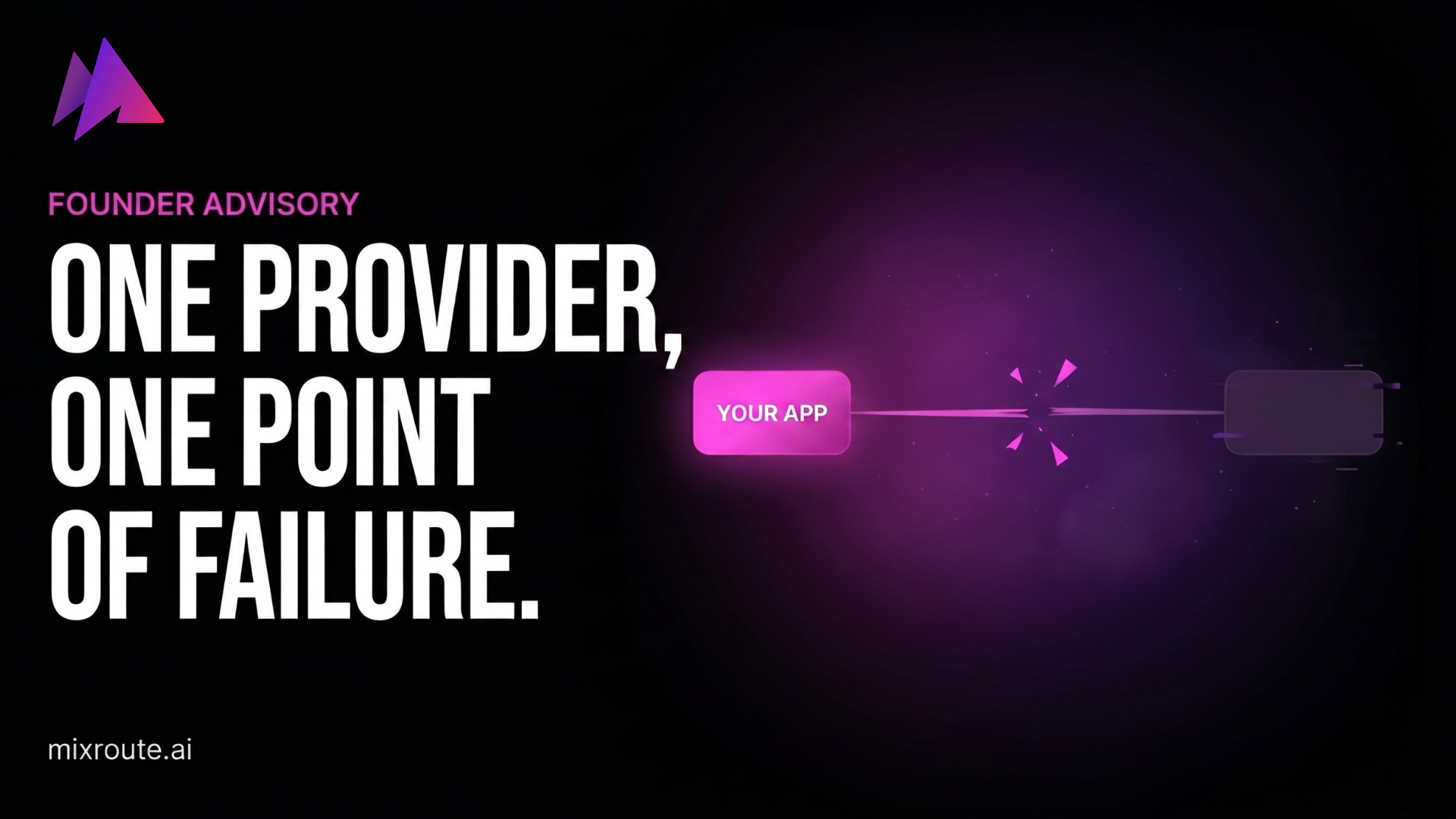
Companies building AI-powered products start off fast. Founders choose a model, stitch together some integration code, and ship. There’s typically one provider they reach for first. OpenAI has that position locked down. Anthropic is a close second. Choosing seems straightforward when you’re just starting to get started.
What founder wants to spend time evaluating dozens of models from different providers when there’s a product to build? The issue is locking yourself into a single AI provider is one of the costliest architecture decisions a founding team will make. They just don’t realize it until too late.
The Setup Looks Reasonable at First
Starting with one provider makes complete sense when you’re building a prototype. You have one API key to keep track of, one set of docs to read through, and one invoice to manage. Suddenly your product is in the market months ahead of competitors who took an “eat many, pastries” approach. If you’re an early team that needs to move FAST, that tradeoff is worth it.
The issue is the codebase you don’t touch after launch slowly becomes catered to that provider. Functions are written to format around their response objects. Your error handling is built around how they throw exceptions. The way your team structures prompts are tuned for their specific models. Your team stops using an AI provider. Your product assumes it will always be there.
What Happens When the Provider Changes
What happens when your provider changes? AI providers rotate models, change pricing, and adjust rate limits ALL. THE. TIME. What was once a great default model gets deprecated six months later. Price tiers get adjusted with minimal warning. Rate limits get cut in half when everyone is sprinting to build more AI features (almost always during peak business hours for your growing product).
When that happens to your team who has built their tech stack around a single provider, you have few options. If you want to migrate to a new model (or provider), you have to revisit chunks of your codebase. Weeks of integration work suddenly needs to be done all over again. Your product can either underperform (great customer experience!) or pay through the nose to stay on a legacy model.
Reliability Becomes a Business Risk
To make matters worse, your pricing problem gets even worse at scale. By relying on a single provider your founder team has also given up all negotiating leverage. You accept the pricing your provider gives you because the Build Stuff team can’t realistically switch providers without massive overhaul. At “skin in the game” usage this isn’t a problem. But at production scale where fees start to become a large percentage of operational costs, the pricing differences between providers with similar capabilities can be substantial.
The mistake we see teams make here is that not all tasks are created equally. Some parsing tasks are better served by cheaper, slower models. Some products require state of the frontier reasoning. A single-provider product uses the same model for both. You either overspend on menial tasks or bleed effectiveness on high-value interactions. Multi-provider routing corrects this issue by allowing you to route each request to the most appropriate model.
How to build the Right Way
Multi-provider routing is the tool that allows you to move away from single-provider dependency. This is where MixRoute.ai can help. This AI API gateway can connect to over 200 models via a single endpoint.
On-boarding is simple as well. New users get $5 of free credits when they sign up at mixroute.ai.
