

In today’s hyper-competitive digital economy, every dollar of infrastructure spend is under scrutiny. Engineering teams are expected to ship faster, operations teams are expected to spend less, and business leaders want both at the same time. That tension is exactly why AWS Lambda has emerged not just as a developer tool, but as a legitimate business strategy.
Since its launch in 2014, AWS Lambda has grown from a niche compute experiment into the backbone of modern cloud-native architecture. In 2026, it powers API backends, data pipelines, automation workflows, and AI-driven workloads for organizations ranging from early-stage startups to Fortune 500 enterprises. The serverless computing market it helped create hit $26.33 billion in 2025 and is on track to reach $116.58 billion by 2033 at a 20.6% annual growth rate.
This article breaks down what AWS Lambda actually is, why it matters for your business in 2026, how to use it effectively, and what you need to know to build a career around it. For a detailed technical deep dive, the team at ThinkCloudly has put together an excellent resource: AWS Lambda Explained: Everything You Need to Know in 2026, which covers execution models, cold start analysis, and production architecture patterns in full detail.
What Is AWS Lambda? The Business-Friendly Explanation
AWS Lambda is Amazon’s serverless compute service. In plain terms: you write code, upload it to Lambda, and AWS runs it automatically in response to events — without you ever touching a server.
There is no operating system to patch, no auto-scaling policy to write, no load balancer to configure. Lambda handles all of it. Your engineering team focuses entirely on application logic, not infrastructure management.
Here is the billing model that makes Lambda genuinely different from traditional cloud compute:
• Requests: $0.20 per million invocations (the first 1 million per month are free, every month, forever)
• Duration: $0.0000166667 per GB-second, billed per millisecond — you pay only for the exact compute time your code uses
• Zero idle cost: When your code is not running, you pay nothing — no minimum monthly fees, no reserved instances
Compare that to running EC2 instances or managed containers, where you pay 24/7 for capacity whether or not your application is under load. For bursty, unpredictable, or event-driven workloads, the cost difference can be dramatic.
What Has Changed in AWS Lambda: 2025-2026 Updates
Lambda in 2026 is a substantially more capable platform than it was just two years ago. Here are the most significant updates that businesses and developers need to know:
1. Durable Functions
Lambda now supports stateful, long-running workflows natively through Durable Functions. Previously, coordinating multi-step serverless workflows required AWS Step Functions as an external orchestrator. Durable Functions bring stateful coordination closer to the function execution layer, reducing architecture complexity for many common patterns.
2. Managed Instances
A new Managed Instances feature gives teams greater control over their Lambda execution environments. This is particularly valuable for organizations with strict compliance requirements, specialized hardware needs, or performance-sensitive production workloads that benefit from more predictable execution environments.
3. Graviton ARM Processors
Lambda functions can now run on AWS Graviton ARM-based processors, delivering 15-20% lower costs compared to x86 at identical performance levels. For high-volume workloads, switching to Graviton requires a single configuration change and immediately reduces your compute bill.
4. INIT Phase Billing (August 2025)
As of August 2025, AWS charges for the cold start initialization (INIT) phase of Lambda execution. This change makes function optimization — reducing package size, trimming unused dependencies, choosing faster runtimes — financially significant for the first time.
5. Tiered Pricing at Scale
Automatic tiered pricing now kicks in for high-volume users, providing savings of up to 20% once usage exceeds 6 billion GB-seconds per month. Enterprises running large-scale serverless workloads now have a structural cost advantage.
6. 10 GB Ephemeral Storage
Lambda functions can now access up to 10 GB of /tmp ephemeral storage, enabling a wider range of data-processing, ML inference, and document-handling use cases directly within a function — without requiring external storage services for temporary data.
The Real Business Case for AWS Lambda in 2026
The technical capabilities are impressive, but the business case for Lambda comes down to three core value propositions:
Operational Cost Reduction
Traditional server-based infrastructure requires ongoing capacity planning. You estimate peak load, provision for it, and pay for that capacity around the clock. Lambda flips this model entirely: you provision nothing and pay only for actual usage. For workloads that are bursty, scheduled, or event-driven — which describes the majority of backend services — this translates directly to lower infrastructure spend.
A realistic example: a 10 million request-per-month API at 256 MB memory and 200ms average execution time costs roughly $10 in Lambda compute charges. The same workload on always-on EC2 instances sized for peak throughput might cost $80-200/month depending on instance type, availability zone configuration, and load balancer fees.
Engineering Velocity
Infrastructure management is a significant overhead cost in traditional engineering organizations. Developers context-switch between writing product code and managing servers, debugging deployment pipelines, and handling OS patches. Lambda eliminates this overhead. Teams ship features faster when they are not distracted by infrastructure.
Scaling Without Risk
Lambda scales automatically from zero to thousands of concurrent executions without any configuration. A product launch that brings 50x normal traffic does not require emergency capacity planning. Lambda absorbs the spike and scales back down when it subsides — and you pay only for those additional executions, not for pre-provisioned headroom.
AWS Lambda Use Cases Driving Business Value in 2026
Lambda is being applied across a wide range of enterprise and startup workloads in 2026. Here are the most impactful use cases:
• API Backends: Lambda paired with Amazon API Gateway powers scalable HTTP APIs without any server management. Every new API endpoint is a new function — no need to redeploy a monolith
• Real-Time Data Processing: Financial transaction processing, IoT telemetry ingestion, and log analysis pipelines trigger Lambda from Kinesis or DynamoDB Streams to process events as they arrive
• Scheduled Automation: Business-critical jobs like nightly report generation, database maintenance, subscription renewal checks, and compliance audits run as Lambda functions triggered by EventBridge schedules
• File and Document Processing: Automatic document conversion, image resizing, PDF generation, and media transcoding triggered when files land in S3 — no polling, no idle workers
• AI and ML Inference: Lightweight AI inference workloads now run efficiently on Lambda, particularly with the expanded memory options and ARM compute available in 2026
• Security Automation: Automated incident response, compliance checks, and infrastructure audit workflows that trigger on CloudTrail events or GuardDuty findings
• Third-Party Webhook Processing: Receiving and processing webhooks from Stripe, GitHub, Twilio, Salesforce, and other external platforms — each webhook triggers a Lambda function with no permanent infrastructure required
Understanding Lambda Pricing: What Businesses Actually Pay
Lambda’s pricing appears deceptively simple, but real-world costs involve the broader AWS service stack. Here is an honest breakdown:
Lambda compute alone — for a typical API serving 10 million monthly requests at 256 MB and 200ms average duration, Lambda compute costs approximately $10/month.
The full stack cost — add Amazon API Gateway ($10-35/month depending on HTTP vs REST API type), CloudWatch Logs (varies with log volume and retention settings), and NAT Gateway if functions run inside a VPC, and that same workload can realistically land at $57-350/month.
The key insight for finance and engineering leaders: Lambda’s supporting services often represent 80% of your total serverless bill. Designing with this in mind from the start prevents billing surprises.
Practical cost optimization levers for 2026:
• Switch to ARM/Graviton processors — 15-20% cost reduction with no code changes required
• Use AWS Lambda Power Tuning to identify the optimal memory-to-performance ratio for your specific workload
• Set CloudWatch log retention to 7-30 days instead of the default ‘forever’ to prevent accumulating storage costs
• Use direct AWS service integrations (API Gateway to DynamoDB, EventBridge to SQS) to skip Lambda invocations for simple pass-through logic
• Use AWS Step Functions for workflows that wait on external events — Lambda bills for wait time, Step Functions does not
• Enable tiered pricing benefits automatically by consolidating workloads under a single AWS account where usage thresholds apply
Cold Starts in 2026: What Business Leaders Need to Know
Cold starts — the latency penalty incurred when Lambda initializes a new execution environment — remain a relevant consideration for latency-sensitive applications. Here is the current picture in 2026:
• Python and Node.js: 200-500ms for simple functions — generally acceptable for most API and async workloads
• Java and .NET: 2-5 seconds due to JVM and CLR initialization — a significant user-experience concern for synchronous APIs
• Container images: Variable based on image size; larger images have longer cold starts
Mitigation options in 2026:
• Provisioned Concurrency: Pre-warm a configured number of Lambda instances at all times — eliminates cold starts but adds a fixed monthly cost
• Runtime selection: Choosing Python or Node.js over Java for new services significantly reduces cold start exposure
• Package optimization: Smaller deployment packages initialize faster — trim unused libraries and dependencies aggressively
• VPC configuration: Use the latest ENI-per-VPC configuration to avoid a 10-second networking penalty that older VPC attachment methods introduced
For most business workloads — especially asynchronous processing, scheduled jobs, and tolerant-latency APIs — cold starts are a non-issue. The exception is customer-facing synchronous APIs where sub-100ms response times are critical. Those warrant Provisioned Concurrency or a runtime selection strategy.
AWS Lambda vs the Competition in 2026
Lambda invented the FaaS category and remains its dominant player, but the competitive landscape has matured:
• Google Cloud Run has become the 2026 leader for concurrency-heavy workloads and AI inference, handling up to 1,000 concurrent requests per container instance with strong cost efficiency at scale
• Azure Flex Consumption is Microsoft’s 2026 standard for serverless, offering sub-second scaling and integrated VNet support without a premium plan requirement
• AWS Lambda leads for event-driven, bursty workloads and for organizations already embedded in the AWS ecosystem, where 220+ native service integrations remove integration friction
The strategic reality: for organizations already running on AWS, Lambda is the path of least resistance and lowest total cost of ownership. Switching providers to chase marginal price-performance differences often costs more in migration effort, tooling changes, and team retraining than it saves.
Building a Serverless Career: AWS Certification in 2026
As serverless becomes the default architecture pattern for new cloud-native applications, AWS expertise — specifically around Lambda, serverless design patterns, and the AWS services that surround them — is increasingly valuable in the job market.
The AWS Certified Solutions Architect — Associate (SAA-C03) certification is the most widely recognized credential for cloud practitioners. It validates your ability to design scalable, resilient, and cost-optimized AWS architectures — including serverless patterns built around Lambda, API Gateway, DynamoDB, Step Functions, and EventBridge.
If you are preparing for the SAA-C03 or want to deepen your AWS expertise beyond surface-level tutorials, ThinkCloudly’s AWS Solutions Architect Associate course is one of the most comprehensive structured programs available in 2026. It covers the full exam curriculum including serverless architecture, VPC networking, IAM security, storage design, and database selection — with hands-on labs and practice exams designed to build genuine cloud competency, not just exam memorization.
Professionals who combine practical serverless experience with a recognized AWS certification consistently command stronger salaries and more senior roles. The investment pays off quickly in a market where certified cloud architects remain in short supply relative to demand.
How to Evaluate If Lambda Is Right for Your Workload
AWS Lambda is not the right tool for every job. Here is a straightforward evaluation framework:
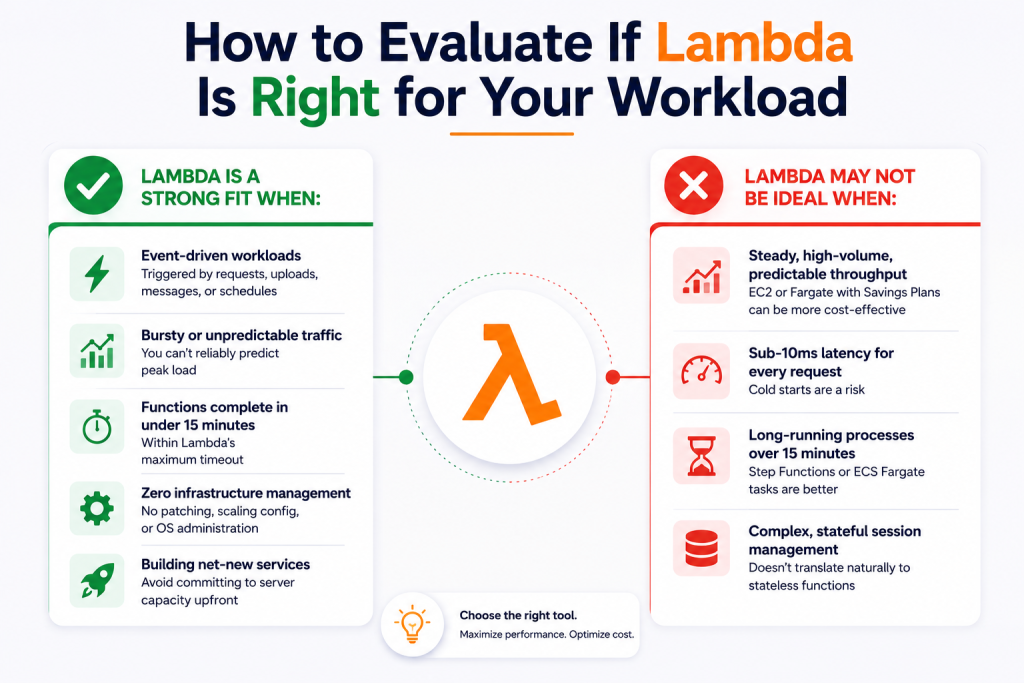
Lambda Is a Strong Fit When:
• Your workload is event-driven — triggered by user requests, file uploads, messages, or schedules rather than running continuously
• Traffic is bursty or unpredictable — you cannot reliably predict peak load in advance
• Functions complete in under 15 minutes — Lambda’s maximum timeout
• You want zero infrastructure management overhead — no patching, no scaling configuration, no OS administration
• You are building net-new services and want to avoid committing to server capacity upfront
Lambda May Not Be Ideal When:
• You have steady, high-volume, predictable throughput — at sufficient scale, EC2 or Fargate with Savings Plans can be more cost-effective
• Your workload requires sub-10ms latency for every request without exception — cold starts are a risk even with mitigation strategies
• You need long-running processes that exceed 15 minutes — Step Functions or ECS Fargate tasks are better suited
• Your application has complex, stateful session management that does not translate naturally to stateless function execution
Getting Started with AWS Lambda in 2026: A Practical Path
For businesses and developers ready to begin adopting Lambda, here is a practical onboarding path:
• Start with the free tier: Every AWS account receives 1 million Lambda requests and 400,000 GB-seconds of compute per month at no cost — permanently. You can build and validate substantial workloads before spending a dollar
• Pick a simple trigger: Begin with an S3 event trigger for file processing or an API Gateway trigger for a single endpoint. These are the most common starting points and have abundant documentation and examples
• Use infrastructure-as-code from day one: AWS SAM (Serverless Application Model) or Terraform makes Lambda deployments reproducible, version-controlled, and auditable from the start
• Instrument before you scale: Enable AWS X-Ray distributed tracing and set up CloudWatch dashboards before your functions go to production — observability becomes essential once traffic grows
• Build your AWS foundation: Lambda is most powerful in combination with the broader AWS ecosystem. A structured course like ThinkCloudly’s SAA-C03 program helps you understand how Lambda integrates with VPC, IAM, S3, DynamoDB, and the other services you will inevitably use alongside it
The Bottom Line: Why AWS Lambda Belongs in Your 2026 Strategy
AWS Lambda is not a passing trend. The serverless computing market is growing at 20.6% per year, organizations are running mission-critical production workloads on Lambda at scale, and AWS continues to invest in the platform with meaningful new capabilities — Durable Functions, Managed Instances, Graviton ARM support, and tiered pricing among them.
For businesses, Lambda represents a structural shift from paying for capacity to paying for usage. For engineering teams, it represents freedom from infrastructure management. For architects, it provides a composable, event-driven building block that integrates natively with over 220 AWS services.
Whether you are evaluating Lambda for the first time or optimizing existing serverless workloads, the foundation is the same: understand how it works at a technical level, design your cost structure intentionally, and build on the AWS services that amplify its value.
For a comprehensive technical reference, the AWS Lambda serverless guide from ThinkCloudly is one of the most thorough and up-to-date resources available — covering execution models, cold start patterns, real-world use cases, and architecture best practices in a single place. And for those building a cloud career, the ThinkCloudly AWS Solutions Architect Associate course provides the structured curriculum to go from Lambda fundamentals to full AWS architecture competency.
The businesses winning in cloud infrastructure in 2026 are not the ones with the most servers. They are the ones that have eliminated the servers they do not need.