
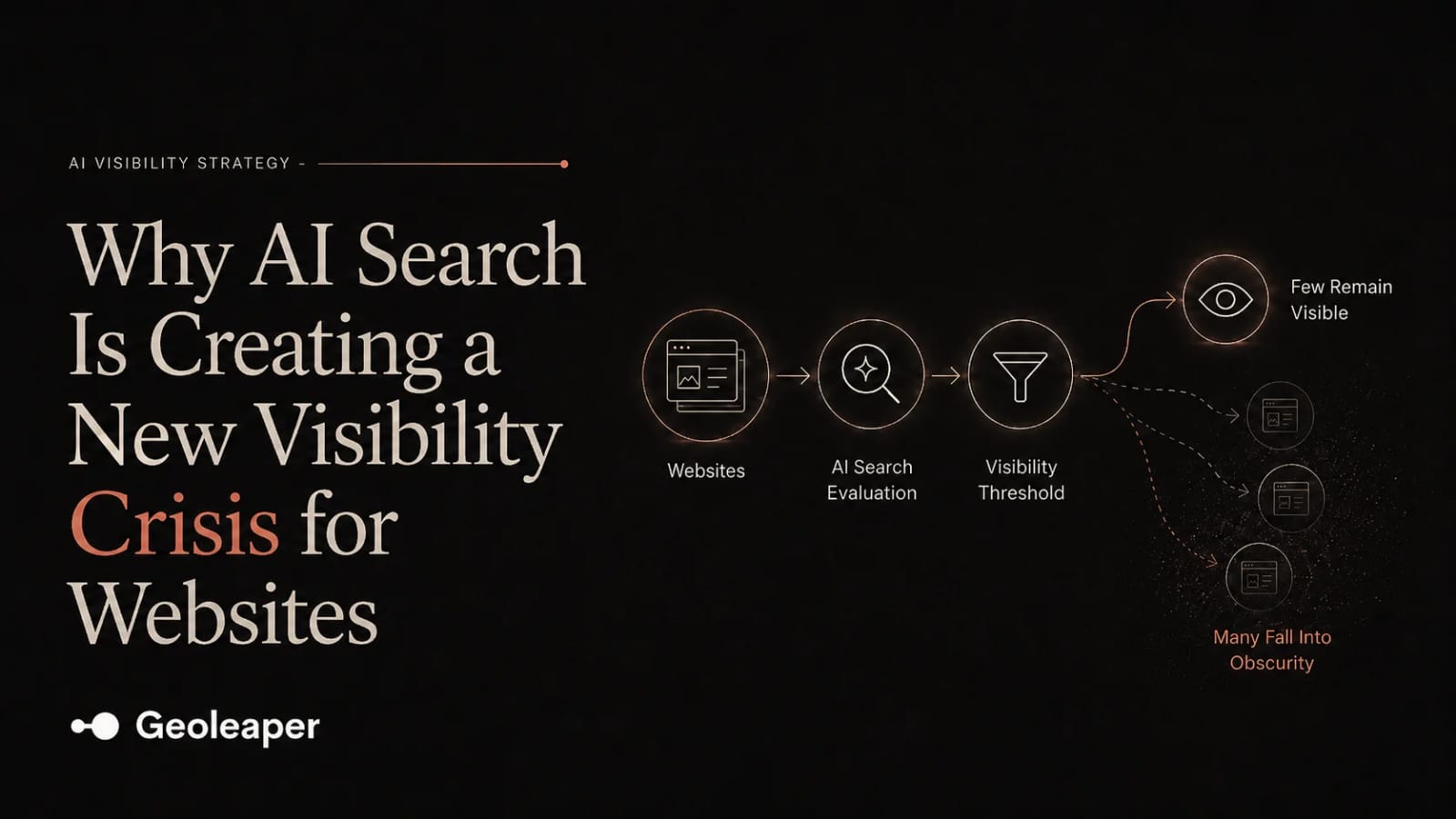
Artificial intelligence is rapidly changing how people discover information online.
Instead of browsing through ten blue links on a search engine results page, users are increasingly asking AI systems directly:
- What’s the best tool?
- Which provider should I choose?
- What product is recommended?
- How does this work?
Platforms like OpenAI ChatGPT, Google Gemini, Microsoft Copilot, and Perplexity AI Perplexity are beginning to replace traditional search behavior with generated answers.
And that shift creates a major problem for websites.
Most websites were built for search engines — not AI systems.
For years, SEO focused heavily on rankings, backlinks, keywords, and indexing. While those factors still matter, AI-powered search systems increasingly evaluate websites differently. They attempt to interpret meaning, context, trust, structure, and semantic relationships before deciding what sources to reference.
That means a website can rank reasonably well in traditional search while remaining largely invisible inside AI-generated answers.
This emerging gap is becoming one of the biggest strategic risks for businesses online.
AI Systems Need More Than Content
A common misconception is that AI visibility is simply about publishing more articles or generating AI-written content.
In reality, many generative systems rely heavily on machine-readable signals that help them understand:
- what a page represents
- who published it
- how entities connect together
- whether information appears trustworthy
- whether content is structurally coherent
This is where concepts like semantic structure, entity optimization, and schema markup become increasingly important.
The websites that AI systems can interpret confidently are often the ones most likely to be surfaced, cited, or referenced in generated responses.
The Rise of AI SEO
As a result, a new category of optimization is beginning to emerge.
Some refer to it as AI SEO.
Others call it Generative Engine Optimization (GEO).
Regardless of terminology, the objective is similar:
help websites become easier for AI systems to understand, trust, and recommend.
This goes beyond traditional metadata management.
It includes:
- semantic clarity
- structured data quality
- entity relationships
- machine-readable architecture
- contextual consistency
- content interpretability
Several new platforms are now appearing specifically to address this challenge.
For example, tools like this AI search WordPress pluginpowered search environments by strengthening semantic understanding and structured data implementation.
Why This Matters Now
AI search is still evolving, but the behavioral shift is already happening.
Users increasingly expect direct answers rather than lists of links.
That changes the economics of visibility online.
Instead of competing only for rankings, websites increasingly compete for:
- citations
- mentions
- inclusion
- semantic trust
- answer eligibility
Businesses that adapt early may gain a significant advantage as AI-driven search continues to grow.
Those that ignore the shift risk becoming increasingly invisible in the environments where future discovery happens.
The internet is gradually moving from an index-based web toward an interpretation-based web.
And many websites are not prepared for that transition yet.