
Trees are among the most valuable natural resources on Earth, playing a crucial role in environmental stability, biodiversity, and human livelihoods. When discussing the highest quality trees the term can refer to several factors, including timber strength, durability, growth patterns, resistance to pests, and ecological importance.
What Defines High-Quality Trees?
High-quality trees are typically strong, durable, and resistant to environmental damage. Factors such as slow growth, dense wood, straight grain, and minimal defects contribute to better timber quality. Climate, soil conditions, and proper forest management also play an important role.
Countries Known for the Best Timber in the World
While no single country dominates in every aspect, several nations are recognized globally for producing premium-quality trees and timber.
Canada’s High-Quality Softwood
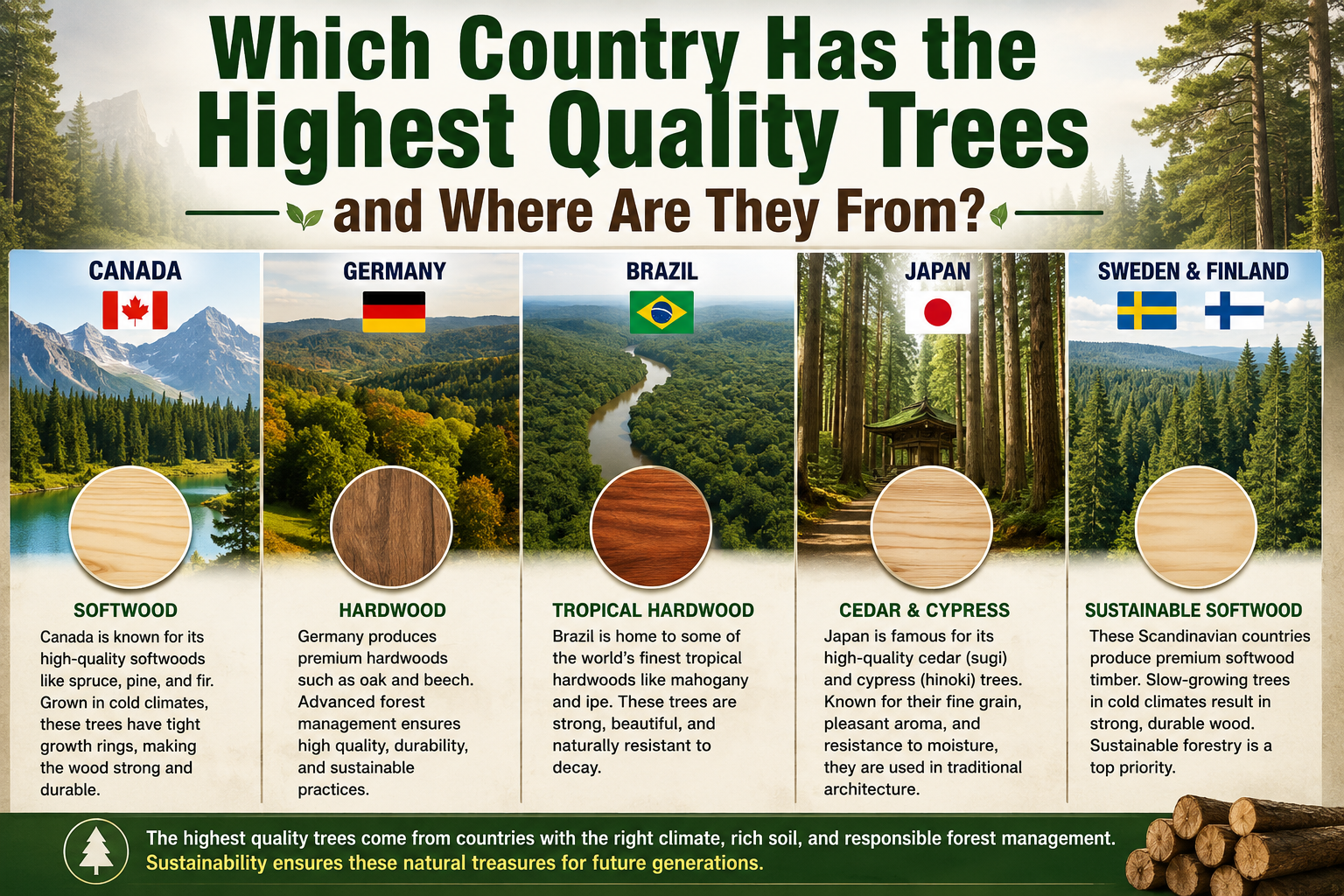
One of the leading countries in terms of high-quality timber is Canada. Known for its vast boreal forests, Canada produces strong, straight, and durable softwoods such as spruce, pine, and fir. The cold climate slows tree growth, resulting in dense wood with tight growth rings, making it ideal for construction and furniture.
Germany’s Advanced Forestry and Hardwood Quality
Germany is famous for its advanced forest management systems. It produces high-quality hardwoods like oak and beech, which are widely used in flooring and furniture. Scientific forestry practices ensure consistent quality and sustainability.
Tropical Hardwood Trees from Brazil
Brazil stands out for its tropical hardwoods such as mahogany and ipe. These trees grow in the Amazon rainforest under ideal conditions, producing wood that is strong, visually appealing, and resistant to decay. However, sustainability is an important concern.
Japan’s Premium Cedar and Cypress Trees
Japan is known for its high-quality cedar (sugi) and cypress (hinoki). These woods are valued for their fine grain, pleasant aroma, and resistance to moisture. They are widely used in traditional architecture and cultural structures.
Scandinavian Countries and Sustainable Forestry
Countries like Sweden and Finland produce premium softwood timber. Their cold climates help trees grow slowly, resulting in strong and durable wood. These nations are also leaders in sustainable forestry practices.
Factors That Affect Tree Quality
Tree quality depends on environmental conditions such as climate, soil fertility, rainfall, and sunlight. Trees in colder regions tend to have denser wood, while tropical trees often have natural oils that increase durability.
Importance of Sustainable Forest Management
Sustainable forestry ensures that high-quality trees continue to grow for future generations. Countries that invest in proper harvesting, replanting, and certification systems maintain both quality and environmental balance.
Conclusion
There is no single country that universally produces the highest quality trees as quality depends on usage and characteristics. Canada and Scandinavian countries excel in softwoods, Germany leads in hardwood management, Brazil offers strong tropical hardwoods, and Japan produces unique premium timber. Ultimately, the best trees come from regions with suitable environments and responsible forest management.
