
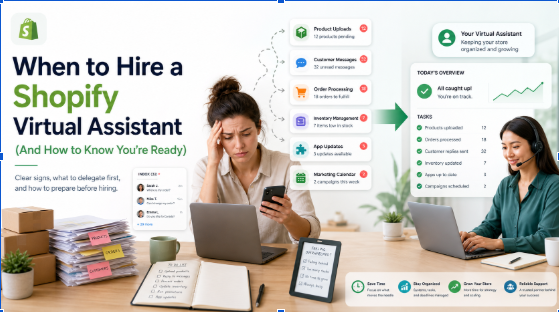
Most Shopify store owners start the same way: doing everything themselves.
You set up the store, upload the products, handle customer messages, process orders, manage apps, and somehow squeeze in time for marketing. In the early days, that works. You know every part of the business, and the volume is manageable.
But as the store grows, the daily task list doesn’t shrink; it expands. Product updates take longer. Customer inquiries stack up. Inventory mistakes creep in. Your marketing calendar sits half-empty because there’s no time to execute. And the strategy work you know would actually move the business forward? That keeps getting pushed to next week.
This is the moment a lot of store owners start wondering whether hiring a Shopify virtual assistant is the right move.
The short answer is: probably yes, but timing and preparation matter. This article walks through the signs that tell you it’s time, what to delegate first, and how to set yourself up for a successful hire.
What Is a Shopify Virtual Assistant?
A Shopify virtual assistant is a remote professional who helps store owners manage the day-to-day operations of their Shopify store.
Unlike a general virtual assistant, a Shopify VA understands the platform, how the admin panel is structured, how orders flow from checkout to fulfillment, how products are organized, and how apps plug into the store. They can step in and start contributing without a lengthy technical onboarding.
Depending on the store’s needs, a Shopify VA typically handles:
- Product uploads and updates, adding new listings, editing descriptions, updating pricing
- Order processing, monitoring order status, flagging issues, coordinating with fulfillment
- Customer support, responding to inquiries, handling returns, processing refund requests
- Inventory management, tracking stock levels, flagging low inventory, updating quantities
- App management, maintaining tools for reviews, email, upsells, loyalty, and more
- Basic marketing support, scheduling promotions, updating banners, uploading campaign content
- Reporting and admin, pulling weekly summaries, organizing data, maintaining internal records
If you’ve never hired a VA before, think of a Shopify VA as a capable, store-familiar team member who works remotely and handles the operational work that doesn’t require you specifically, but still needs to get done consistently.
Why Timing Matters Before Hiring a Shopify VA
Hiring a Shopify VA too early, before you have clear tasks, documented processes, or consistent store activity, can create more confusion than it solves. You’ll spend more time managing the VA than you would have spent doing the tasks yourself.
Hiring too late is a different problem. If you wait until you’re completely overwhelmed, you won’t have the bandwidth to properly onboard anyone. The result is a rushed hire, unclear expectations, and mistakes that erode trust quickly.
The right time is usually somewhere in between: when the volume of repetitive daily tasks is clearly beyond what you can handle efficiently, but you still have enough headspace to set the VA up properly.
Hiring a Shopify VA isn’t just about saving time. It’s about creating a better operational system, one where tasks happen consistently, nothing falls through the cracks, and you’re freed up to focus on the work only you can do.
Signs You’re Ready to Hire a Shopify Virtual Assistant
You Spend 2+ Hours Daily on Repetitive Tasks
If you’re logging more than two hours a day on work that follows a predictable pattern, uploading products, updating prices, responding to the same customer questions, that’s a signal. Not because two hours is a lot, but because two hours of repetitive work is two hours you’re not spending on strategy, partnerships, or growth.
Customer Replies Are Getting Delayed
A response time that stretches beyond 24 hours is a problem. Customers who don’t hear back quickly tend to assume the worst, and some will open disputes or leave negative reviews before you even get a chance to respond. If your inbox is regularly backlogged, that’s not a workload problem. That’s a capacity problem.
Product Uploads and Updates Are Inconsistent
New products sitting in a spreadsheet for two weeks because you haven’t had time to list them. Outdated descriptions on older SKUs. Images that haven’t been optimized. These inconsistencies hurt your store’s credibility and your search visibility. A Shopify VA can keep your catalog clean and current.
Orders Are Taking Longer to Process
When order processing starts slipping, late fulfillment flags, missed supplier communications, address errors going unchecked, it’s often because the store owner is stretched across too many things at once. Order management needs consistent daily attention, and that’s hard to give when you’re also doing everything else.
Inventory Mistakes Are Happening More Often
Overselling because stock levels weren’t updated. Missing a low-inventory alert. Selling a discontinued product that wasn’t deactivated. These mistakes are costly and usually preventable with consistent monitoring, the kind a VA can handle as part of their daily routine.
You Have No Time for Marketing or Strategy
Marketing gets pushed aside first when operations get heavy. If your email campaigns are on pause, your homepage hasn’t been updated in months, or you haven’t had time to think through your next product launch, operations are consuming bandwidth that should be going toward growth.
Store Maintenance Tasks Are Being Ignored
Broken links. Outdated FAQs. Discount codes that expired but are still visible. Review responses that have been sitting unanswered for weeks. These details accumulate quietly, and they all chip away at the store experience. If your maintenance backlog is growing, you need more hands.
You Feel Burned Out from Doing Everything Yourself
Burnout is a real operational risk. When the person making every decision is also processing every order and answering every email, the business becomes fragile. If you’re exhausted by the volume of small tasks, that’s the business telling you it’s ready for more structure.
Growth Is Stuck Because of Day-to-Day Tasks
This is the clearest sign of all. When you know what needs to happen to grow, new products, better marketing, stronger supplier relationships, more testing, but you can’t execute because daily operations consume everything, the business has outgrown a one-person operation.
Common Shopify Tasks You Can Delegate First
You don’t need to hand everything over at once. Start with the tasks that are most repetitive, well-defined, and lowest risk.
Product Listing Support
A VA can take your product data, titles, descriptions, images, pricing, variants, and get listings live in Shopify. They can also update existing products when information changes. This alone can save several hours a week for stores with active catalogs.
Order Processing
Your VA monitors the order queue daily, flags any issues (failed payments, address mismatches, high-risk orders), and coordinates with your fulfillment team or supplier. You stay informed without being in the weeds.
Customer Support
Using templates you approve, a VA handles routine inquiries about shipping, returns, order status, and product questions. They escalate anything genuinely complex. Customers get faster replies; you get fewer interruptions.
Inventory Updates
Daily or weekly inventory checks, stock level updates, low-inventory alerts, and coordination with your warehouse or supplier contact. Consistent monitoring prevents the most common and costly inventory mistakes.
Shopify App Management
Most stores run a stack of apps, reviews, email flows, upsells, loyalty programs. A VA can handle basic day-to-day app maintenance: updating product feeds, adjusting settings, pulling reports, and troubleshooting minor issues.
Discount and Promotion Updates
Uploading new discount codes, scheduling sale pricing, updating promotional banners, activating or deactivating offers on the right dates. These are small tasks, but missing them during a sale window is a real problem.
Review Management
Monitoring new reviews, flagging issues that need your attention, and posting responses to existing reviews keeps your store looking active and engaged, without you needing to check daily.
Reporting and Admin Work
A VA can pull weekly or monthly reports from Shopify, sales summaries, refund rates, product performance, and format them in a way that’s quick for you to review. They can also manage supplier emails, update internal spreadsheets, and keep documentation organized.
Basic SEO and Content Updates
Adding meta titles and descriptions to product pages, writing alt text for images, updating collection page copy, fixing broken links. Not a replacement for a full SEO strategy, but a consistent baseline that keeps your store in good shape.
How Hiring a Shopify VA Helps You Grow Faster
Removing operational work from your plate doesn’t just reduce stress, it changes how fast the business can move.
Faster execution. When a VA is handling product uploads, new SKUs go live in days, not weeks. When a VA is managing promotions, campaigns launch on schedule. Speed matters more than most store owners realize.
Cleaner backend operations. Accurate inventory, organized product catalog, up-to-date customer records, when the backend is clean, everything else runs better. Errors happen less often, and fixing the ones that do is easier.
Better customer response time. Fast, consistent replies reduce friction, improve trust, and lower the likelihood of disputes. A VA managing your inbox means customers hear back the same day.
More consistent store updates. Seasonal banners that go live on time. Sales that end when they’re supposed to. Collections that reflect your current inventory. These details build a professional impression that compounds over time.
More time for the work that drives growth. Ads, content, partnerships, product development, supplier negotiations, the high-leverage activities that actually scale a Shopify store require focused attention. A VA creates the space for that attention.
Better preparation for busy seasons. Black Friday and Q4 hit differently when you have operational support. A VA who already knows your store can absorb the volume spike without you scrambling to keep up.
What You Should Prepare Before Hiring
A good hire can still go badly without the right preparation. Before bringing on a Shopify VA, make sure you have:
- A clear task list. Document exactly what you want the VA to handle. Vague scope leads to missed work and misaligned expectations.
- Basic SOPs. Even a short Loom video showing how you want a task done is enough to start. Written checklists work too.
- Defined working hours and response expectations. When should they be available? How quickly should they respond to messages?
- Login and access rules. Use Shopify staff accounts with appropriate permission levels. Don’t share your main admin credentials.
- A communication channel. Slack, WhatsApp, email, pick one and keep it consistent.
- A task tracking system. A shared Trello board, Notion doc, or even a Google Sheet. You need visibility into what’s being done.
- A priority list. Not all tasks are equal. Be clear about what needs to happen every day versus what can wait.
- A simple quality checklist. What does “done correctly” look like for each task? Set the standard clearly from day one.
Preparation doesn’t need to be elaborate. But without it, even a capable VA will struggle to meet your expectations.
What to Look for in a Shopify Virtual Assistant
The skills and traits that matter most:
- Shopify admin experience, they should already know the platform, not learn it on your time
- Attention to detail, accuracy matters for product listings, orders, and customer communication
- Good written communication, especially important for customer-facing tasks
- Understanding of eCommerce workflow, they should know how orders, inventory, and fulfillment connect
- Ability to follow instructions, a VA who improvises constantly creates inconsistency
- Reliability, consistent availability and follow-through are non-negotiable
- Confidentiality, they’ll have access to customer data and business information
- Willingness to learn your processes, every store is different; the best VAs adapt quickly
During the hiring process, give candidates a small test task that mirrors your real work. How they approach it tells you more than any resume.
Mistakes to Avoid When Hiring a Shopify VA
Hiring without a clear task list. If you can’t explain what you need done, the VA can’t deliver it. Define the work before you post the role.
Expecting perfection from day one. Any new hire needs time to learn your store’s rhythm. Allow for a ramp-up period and give clear feedback rather than assuming it won’t work out.
Giving full store access too early. Start with limited staff permissions. Expand access as trust and competence are established.
Not creating SOPs. Without documented processes, the VA will either guess or constantly ask for clarification. Both slow things down.
Not checking work quality. Review completed tasks regularly, especially early on. Catching small errors early prevents them from becoming habits.
Not tracking task output. Without visibility into what’s being completed, problems accumulate silently. A simple shared tracker takes five minutes to set up and saves a lot of frustration.
Changing priorities too often. Constant reprioritization creates confusion and reduces the VA’s ability to build reliable workflows. Set a consistent weekly task structure and adjust gradually.
Conclusion
Hiring a Shopify virtual assistant is not just about getting help with tasks. It’s about recognizing when your time is genuinely better spent elsewhere, on growth, strategy, marketing, and the decisions that shape where your business goes.
The store owners who scale successfully aren’t the ones who do everything themselves the longest. They’re the ones who build operational systems early, delegate intelligently, and protect their attention for the work that actually moves the needle.
If your daily task list is consuming the time and energy you should be putting into growth, that’s not a sign your business is too demanding. It’s a sign it’s ready for the next stage, and a Shopify VA might be exactly the support that gets you there.