

Think about the last time you signed up for a software tool and genuinely felt like you got your money’s worth from the first week. Not just opened it, poked around, and told yourself you would use it properly once things slowed down. Actually used it; pulled insights from it; made decisions with it. For a lot of business owners, that question has an uncomfortable answer when it comes to SEO tools. They are paying for platforms they barely understand, subscriptions they renewed out of inertia, and data dashboards they visit once a quarter. The question of what the cost of popular SEO optimization tools is goes beyond the monthly charge. It includes what those tools actually do for you and whether the spending is connected to any real result.
Platforms like SEOZilla have shifted the conversation by building tools designed around the workflow of a small team rather than an enterprise marketing department. But before you can evaluate any option fairly, you need to understand the full pricing picture from the top of the market down. That is what this article covers.
Why the Same Tool Can Be Worth Everything to One Business and Nothing to Another
An SEO platform costing $140 per month is a rounding error for a digital agency billing clients $8,000 monthly for search marketing services. For that agency, accurate keyword data, deep competitor research, and comprehensive site auditing directly enable the work they charge for. The tool earns back its cost every time a junior analyst opens it.
Now take the same platform and put it in front of a florist running a local shop who has heard that SEO is important and decided to do something about it. She logs in, sees graphs she cannot interpret, clicks through several menus that mean nothing to her, and two weeks later resets her password because she forgot she had an account. Same tool. Same $140. Completely different value. Zero return.
That contrast is not an exaggeration; it happens constantly. Understanding what the cost of popular SEO optimization tools is requires understanding which type of user each platform was designed for, because the number on the pricing page is only part of the real cost.
The Premium Tier: What Enterprise SEO Platforms Charge and Why
The three names that come up most consistently in any serious discussion of professional SEO software are Semrush, Ahrefs, and Moz Pro. Each of them built their products over many years for agencies, in-house marketing teams, and experienced practitioners who needed comprehensive data at scale.
Semrush prices its Pro plan at approximately $140 per month, covering five projects, keyword tracking for up to 500 positions, and page crawls capped at 100,000 per audit cycle. Their Guru plan, which unlocks historical data and content marketing tools, runs around $250 per month. Ahrefs starts its Lite plan at $129 per month with restrictions on data history and user seats, while its Standard tier climbs to $249. Moz Pro begins at $99 per month, though with notably narrower competitive intelligence at that price point; its most useful features tend to sit in the $179 per month tier.
Annual billing typically reduces these figures by around 15 to 20 percent. Still, even at discounted annual rates, these platforms represent a meaningful spend for any business not generating consistent returns from organic search already.
What justifies that spend: large and frequently updated keyword databases; backlink indices covering billions of URLs; crawl infrastructure that handles enterprise-scale websites; team collaboration features; white-label reporting; and integrations with other marketing platforms. For a business using all of that, the value is clear. For most small businesses, the majority of those features remain permanently untouched.
Pricing Structures: Monthly Plans, Annual Subscriptions, and Free Tiers Explained
Nearly every SEO platform offers both monthly and annual billing, and the pricing structures across the market follow a broadly similar pattern. Monthly billing tends to run 15 to 25 percent higher than the equivalent annual rate. The trade-off is obvious: monthly gives you flexibility to cancel if the tool is not working; annual locks you in for a year in exchange for a lower effective monthly cost.
For a new business testing an SEO platform for the first time, monthly billing usually makes more sense, even at the higher rate. Twelve months of subscription fees for a tool you abandon in month three is significantly more expensive than paying a monthly premium until you are confident the platform fits your workflow.
Free tiers deserve an honest note here. Google Search Console and Google Analytics are the only genuinely free tools that form a legitimate foundation for any SEO strategy. They pull real data directly from your website’s actual performance in search: impressions, click-through rates, position history, crawl coverage, and indexing status. No paid tool replicates that because no paid tool has access to the same source.
Free tiers from commercial platforms serve a different purpose. They exist to let you evaluate the interface and sample the output quality before committing financially. Query limits, project restrictions, and crawl caps are built in deliberately. Treating a commercial-free tier as a long-term solution to your SEO data needs is setting yourself up for an incomplete picture.
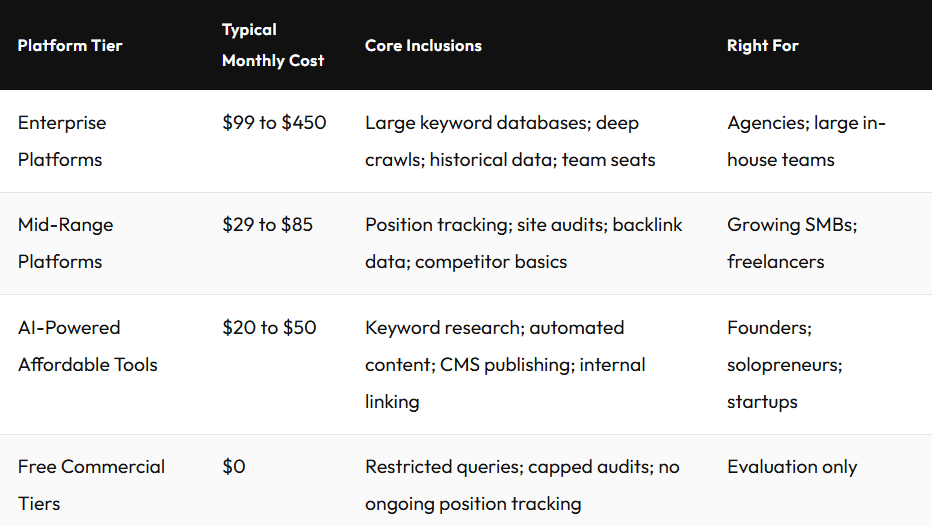
When businesses research what the cost of popular SEO optimization tools is, the number that matters most is not the sticker price. It is the cost per result: what does it cost you per ranking gained, per article published, and per lead generated through organic search?
Why Small Businesses Search Specifically for Affordable SEO Tools
The phrase “affordable SEO tools for small businesses” has become one of the more searched terms in the digital marketing software space for a reason that is both simple and important. Small businesses are not just looking for cheaper versions of enterprise platforms. They are looking for tools that were built with their constraints in mind from the start: one or two websites to manage; a team of one to five people; limited hours available for data analysis; and a need for output that produces results without requiring a specialist to interpret.
Enterprise platforms were designed the other way around. They assumed users who understood keyword difficulty curves, domain rating percentiles, and crawl budget optimization. They built for depth first and accessibility second. The result is powerful software that is genuinely difficult to use productively if you do not already know what you are looking for.
The affordable tier has responded to this gap by building differently. The best platforms in this range surface insights in plain language, automate the repetitive tasks, and reduce the expertise barrier significantly. For a business owner who knows they need better organic visibility but does not have time to become an SEO specialist, that design philosophy is more valuable than any individual feature.
How Affordable SEO Tools Help Businesses Hit Real Marketing Goals

The practical value of any SEO tool comes down to one thing: does it help you publish better content more consistently and track whether that content is working? Everything else is secondary. Keyword data matters because it points your content in the right direction. Audits matter because technical problems silently suppress rankings you have already earned. Backlink monitoring matters because understanding your domain authority trajectory tells you how competitive you can realistically be in the next six months.
What makes affordable SEO tools for small businesses genuinely effective in 2026 is that many of them now do all of this plus content production inside one workflow. You identify the keyword opportunity, the tool generates the article, the article publishes to your CMS, and you monitor the results over the following weeks. That cycle, repeated consistently, builds organic traffic in a way that compounds. A piece you published eight months ago keeps pulling visitors. A cluster of well-linked articles built around a core topic starts ranking for dozens of related queries you did not even explicitly target.
If you are looking at options in the affordable range, the best approach is to start with a free trial that shows you real output rather than a demo video. Cheap SEO does not mean low quality anymore; it means purpose-built for businesses working at a different scale than a global brand. The platforms earning trust in this space back that claim with actual content you can read and evaluate before you hand over a card number.
Making a Decision You Will Not Regret in Three Months
The most common SEO tool mistake is not choosing the right platform. It is choosing the right platform for the wrong stage of your business and then blaming the tool when it does not produce results because you are not using it the way it was designed. Semrush is not wrong for a small business; it is wrong for a small business that does not yet have the time, knowledge, or content infrastructure to use it properly. When that infrastructure exists, it might be exactly right.
Start with what you can actually operate today. If that means a $20 AI-powered tool that writes and publishes for you while you focus on running your business, that is not a compromise. It is a smart allocation of limited resources at an early stage. You can upgrade later. Rankings you build now will still be there when you do.