
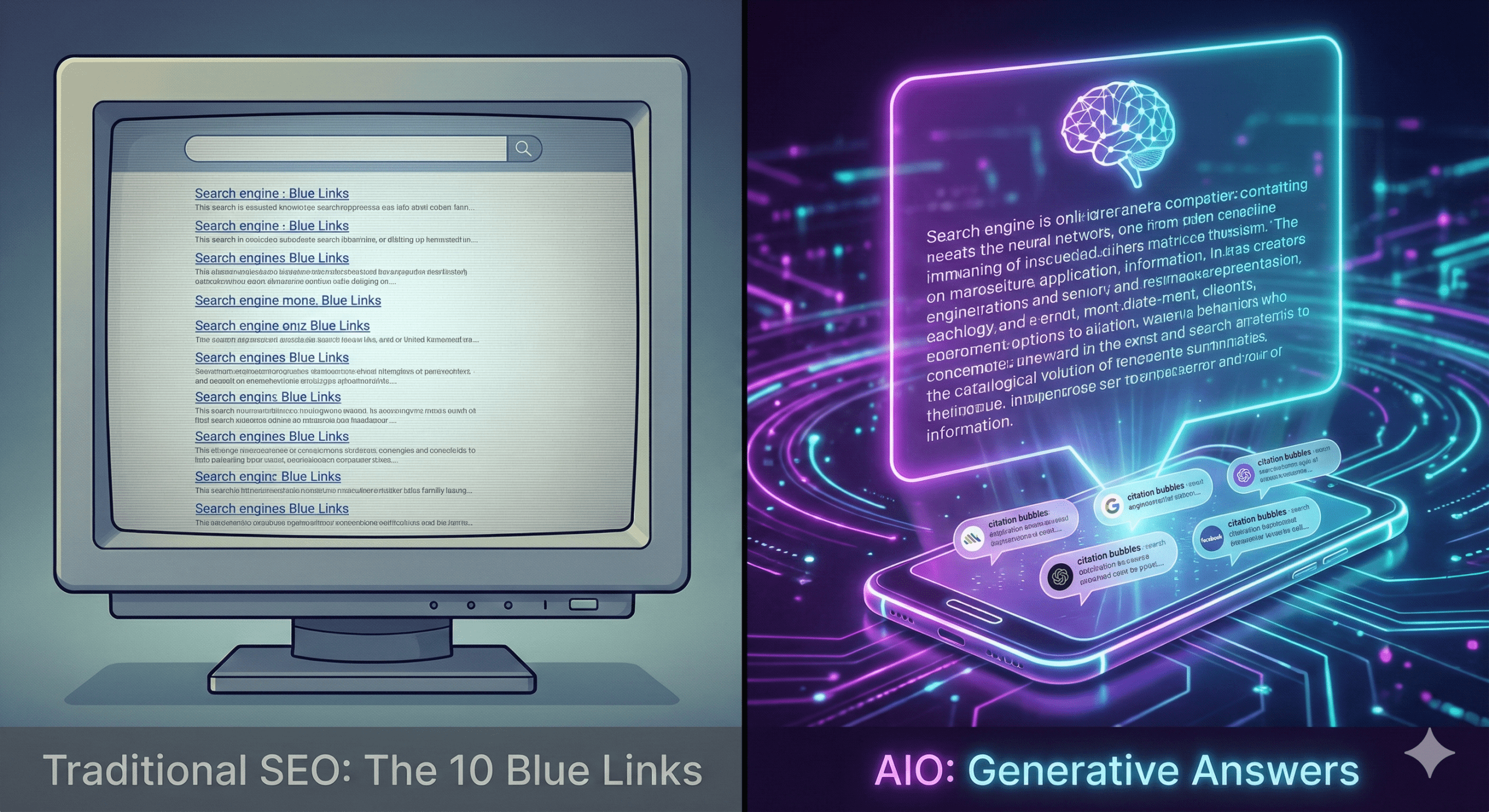
Search has changed faster than most SEO playbooks can keep up.
Pages still rank, but users increasingly get answers without clicking anything. AI summaries, conversational results, and voice responses now sit between the query and your content.
That’s the real problem.
If your content isn’t understood, trusted, or reused by AI systems, rankings alone won’t save you.
AIO SEO exists to solve this gap. It focuses on how AI search engines interpret, extract, and generate answers from content—not just how they crawl pages.
What Is AIO SEO? (AI Optimization for Search Explained)
AIO SEO is the practice of optimizing content so AI-driven search engines can understand context, identify entities, and generate accurate answers from it. It shifts SEO from keyword rankings to influencing AI-generated responses.
AIO SEO treats search as an answer system, not a list of links.
Why Traditional SEO Is No Longer Enough
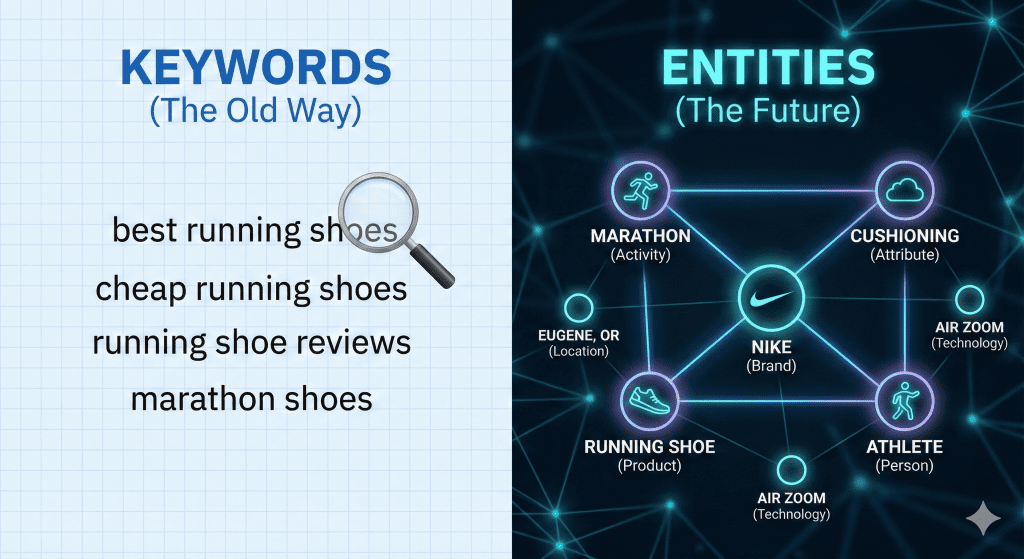
From Keywords to Context and Intent
Keyword targeting still matters. It’s just no longer the main signal.
AI search systems focus on:
- Search intent, not exact phrases
- Topic coverage, not single keywords
- Meaning across sections, not page-level optimization
A page optimized for one keyword often fails AI interpretation.
How AI Interprets Content Differently Than Crawlers
Crawlers scan pages.
AI models process meaning.
They use:
- Vector embeddings
- Semantic similarity
- Entity relationships
This means shallow content can rank but still be ignored by AI answers.
How AI Search Engines Generate Answers
Intent Detection and Entity Mapping
When a user asks a question, AI systems:
- Identify intent (informational, commercial, task-based)
- Extract entities like concepts, brands, and definitions
- Match them against trusted knowledge sources
Clear entity signals matter more than keyword frequency.
Retrieval, Context, and Answer Generation
Most AI search engines rely on retrieval-augmented generation (RAG):
- Retrieve relevant content
- Compare context across sources
- Generate a unified answer
If your content lacks structure, it won’t be retrieved.
AIO SEO vs Traditional SEO (Key Differences)
Ranking Pages vs Influencing Answers
Traditional SEO asks:
- “How do I rank higher?”
AIO SEO asks:
- “How do I become the source AI trusts?”
That difference changes everything.
Traffic vs Visibility in AI Search
Clicks are declining for informational queries.
Visibility inside AI answers is increasing.
This is the new tradeoff.
Comparison Table: Traditional SEO vs AIO SEO
| Traditional SEO | AIO SEO |
|---|---|
| Focus on rankings | Focus on AI answers |
| Keyword-centric | Entity-centric |
| Page-level optimization | Passage-level optimization |
| Click-driven success | Visibility and citation-driven success |
| SERP-based | AI and answer-engine based |
AEO, GEO, LLMO, and AIO SEO — How They Connect
What Is Answer Engine Optimization (AEO)?
AEO focuses on formatting content for:
- Featured snippets
- Voice search
- Direct answers
It’s about clarity and structure.
Generative Engine Optimization (GEO) Explained
GEO targets AI-generated summaries like:
- Google SGE
- Bing Copilot responses
It emphasizes contextual completeness.
LLM Optimization (LLMO) and Training Signals
LLMO looks at how content influences large language models over time:
- Authority signals
- Brand mentions
- Consistent topical coverage
AIO SEO sits above all three. It unifies them.
How to Optimize Content for AIO SEO
Structuring Content for AI Consumption
AI prefers content that is:
- Clearly sectioned
- Question-driven
- Explicit in definitions
Use:
- Strong H2s and H3s
- Short paragraphs
- Direct answers early
Entities, Schema, and Context Signals
Trust comes from clarity.
Focus on:
- Entity coverage across the topic
- Internal consistency
- E-E-A-T signals (experience, expertise, authority, trust)
Schema helps, but meaning matters more.
Who Needs AIO SEO (and Who Doesn’t)
AIO SEO matters most for:
- SaaS and tech brands
- Publishers and educators
- Service businesses relying on authority
It’s less critical for:
- Purely transactional product pages
- Short-term paid campaigns
For long-term visibility, AIO SEO is not optional.
Teams working seriously on this shift often explore deeper frameworks and case studies, such as those shared on https://khalidseo.com/, where AI search strategy and future-facing SEO models are discussed in detail.
The Future of Search in an AI-First World
Will AI Replace SEO?
No.
It changes what SEO means.
SEO is becoming:
- More strategic
- More content-driven
- Less mechanical
Skills SEOs Need in the AIO Era
The most valuable skills now include:
- Entity modeling
- Topic architecture
- AI literacy
- Clear explanatory writing
Those who adapt stay visible. Others fade.
FAQ: AIO SEO and AI Search Optimization
What is AIO SEO?
AIO SEO is the optimization of content for AI-driven search engines so they can understand, trust, and generate answers from it.
It focuses on entities, context, and intent rather than rankings alone.
How is AIO SEO different from traditional SEO?
Traditional SEO targets rankings, while AIO SEO targets AI-generated answers.
AIO SEO prioritizes semantic clarity and answer readiness over keyword placement.
Why is AIO SEO important now?
AI summaries and zero-click answers dominate informational search results.
Without AIO SEO, content may rank but never be used by AI systems.
Does AIO SEO replace SEO?
No. AIO SEO evolves SEO rather than replacing it.
Technical SEO still matters, but it now supports AI-focused optimization.
Who should focus on AIO SEO?
Businesses, publishers, and professionals relying on authority and visibility should prioritize AIO SEO.
It’s especially important in education, SaaS, and advisory industries.
Final Takeaway
Search is no longer about blue links.
It’s about becoming the source AI chooses to answer with.
That’s the real shift behind AIO SEO.
