


Nobody decides to feel terrible by three in the afternoon. It just happens. You start the day with reasonable energy, get through the morning, and then somewhere around the post-lunch stretch things go quiet in a way that is hard to describe. Not sleepy exactly. Not unmotivated. Just slow. Heavy. Like thinking through water.
Most people have explanations for this. A bad night’s sleep. A big lunch. The particular kind of Tuesday where nothing flows easily. These things are real. But there is usually something else underneath all of them that does not get named: the body has been sitting in the same position for several hours, and it is starting to show what that costs.
If you have been looking into the best exercises during work breaks, you are already asking the right question. The answers are more interesting than most people expect, because what happens inside the body during prolonged sitting is specific enough that it points directly to a specific kind of fix.
The Body Was Not Built for This
Somewhere around 10,000 years ago, before agriculture changed how humans spent their days, people moved almost constantly. Gathering, building, traveling, carrying. Not intensely. Not like modern athletes. Just continuously, in small ways, throughout the day.
The modern desk job compresses all of that absence of movement into a single chair in a single room. Eight, nine, or ten hours of sitting with maybe a walk to the kitchen and a commute on either end. From an evolutionary standpoint, this is genuinely unusual. The body has not had nearly enough time to adapt to it, and the effects show up in ways that are now well documented.
Studies conducted by Cornell University followed office workers who spend around 78% of their workday sitting. What made this finding remarkable was that there existed a productivity gap between those who sat for more than 75% of the day and those who did not. Not because they were doing more work. Because their bodies were functioning better while they worked.
The difference between those two groups was not fitness level or sleep quality or diet. It was simply how often they interrupted their sitting during the day.
What Actually Happens When You Sit Too Long
The effects are not dramatic on any single day. That is part of why they are easy to ignore.
When you sit without moving for 60 to 90 minutes, the large muscles in your legs essentially switch off. They have no reason to fire, and so they do not. The calf muscle pump, which plays a real and underappreciated role in pushing blood back up from the lower body toward the heart and brain, slows considerably. Blood begins to pool in the lower extremities instead of circulating freely.
As muscles of the back, made to move rather than maintain a static pose throughout long hours, get fatigued, posture slowly starts becoming poor. With poor posture comes shallow breathing, since breathing in its full capacity becomes more difficult when the body is in a constricted state.
Less oxygen reaching the brain. Reduced circulation bringing less glucose. The brain running on lower supply than it needs to operate well. By mid-afternoon, the cognitive heaviness that most desk workers feel is not random. It is the accumulated physiological result of several hours of sitting.
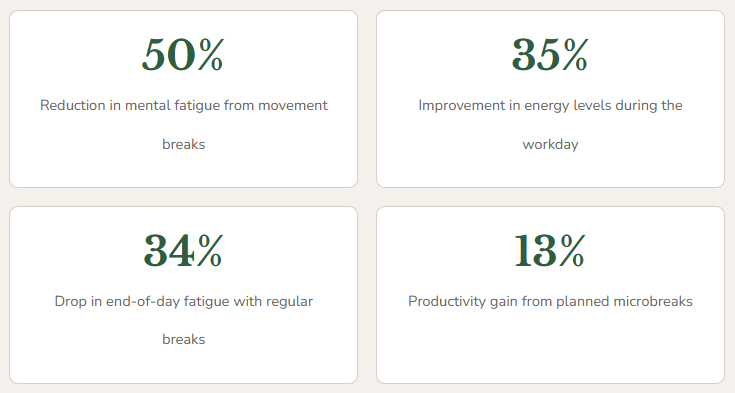
A meta-analysis published through the National Library of Medicine found these results across participants taking two- to five-minute breaks involving light desk-friendly movement distributed across a normal workday. Not intense exercise. Just short, deliberate interruptions of sitting.
Why the Fix Is Smaller Than People Expect
Most people, when they hear that sitting is bad for them, assume the answer is more exercise. A longer run. A gym membership. An hour of yoga in the evening. These things have genuine value for long-term health. But they do not address the specific problem that sitting creates during the workday, because they happen outside the hours when the problem is occurring.
The intervention that works is interrupting the sitting while it is happening. Not replacing it entirely, just breaking it up regularly enough that the body never fully settles into the static state that prolonged uninterrupted sitting creates.
Two minutes is enough to shift things meaningfully. The ten chair squats take less than one minute, during which your quads and glutes become active. These two are among the biggest muscles in the body. The work done by the major muscles will elevate your heart rate, boost blood flow, and get the blood back up to your brain.
The squeezing of shoulder blades and stretching of the side of the neck alleviate the build-up of tension within the upper trapezius muscle. The buildup of such tension may be subtly exhausting but will only become noticeable when it is released. Marching in place for a period of between 60 and 90 seconds while breathing through the nose achieves more than either on its own.
None of this requires equipment. None of it requires a change of clothes. The barrier to doing it is essentially zero if there is a reminder system in place.
The Reminder Problem
This is where most people’s good intentions collapse.
The workday gets busy. Focused work is absorbing, and an hour disappears without any internal signal that it has passed. Relying on remembering to take breaks works on good days and fails on the days when the work is demanding and the reminder is most needed.
External prompts are not a workaround or a crutch. They are how habits survive the days when everything else is competing for attention. A phone timer works. A calendar alert works. A dedicated tool built specifically for this purpose works better because it removes the setup effort and provides the exercise library alongside the reminder.
My Exercise Snacks is a Chrome extension that does exactly this. It prompts movement at timed intervals throughout the day, offers a library of desk-friendly exercises so there is no decision-making required in the moment, and tracks streaks so the habit builds momentum over time. It is free and takes about 30 seconds to install. For people who have tried timers and forgotten to reset them, having one tool dedicated to this specific purpose tends to make a practical difference.
Timing the Breaks to Match the Day
Energy follows a predictable pattern across most workdays. There is a mid-morning dip, usually somewhere between 10 and 11, and the more familiar post-lunch one, roughly 1:30 to 3:30. Most people know the afternoon one well. The morning one is subtler and gets less attention.
Taking a movement break just before one of these windows, rather than after the slump has fully arrived, changes how the rest of that period feels. The dip either softens or does not arrive at full strength.
“This is the difference between using breaks for prevention and using them for recovery. Prevention is easier and produces better outcomes.”
My Exercise Snacks Team
This is how the 30/60 rule works: after each bout of intensive work lasting 30 to 60 minutes, exercise for 2 to 5 minutes. Switch between targeting your upper body and your lower body during rest periods. For example, target your neck and shoulders once, then legs and hip joints in the next period.
What Changes Over Weeks, Not Just Days
A single break improves an afternoon. A consistent routine over several weeks changes the baseline.
People who build regular movement into their workday report a handful of changes that arrive gradually. Chronic neck and shoulder tension reduces. Afternoon headaches become less frequent. End-of-day fatigue is lower, which means the hours after work feel different. Sleep often improves, partly because the body has had more physical stimulus distributed across the day.
There is also something harder to measure: the workday starts to feel more sustainable. Less like something to survive and more like something that can be done well, day after day, without accumulating damage. Over months and years, that difference is not small.
Where to Actually Begin
Starting simply is the right move. No new system. No redesigned schedule. Just this:
1. Pick two or three movements. Chair squats, shoulder rolls, marching in place. Write them on a sticky note and put it next to your keyboard.
2. Set a timer for 45 minutes when you sit down tomorrow morning.
3. When it goes off, stand up and do the things on the note. Two minutes. Then sit back down.
4. Repeat two or three more times across the day. Notice how the afternoon feels compared to a day when you did not do this.
The gap between knowing this is useful and actually doing it is not a knowledge gap. It is a reminder gap. Close that, and most of the rest takes care of itself.
Close the Reminder Gap
My Exercise Snacks handles the prompting automatically. Free Chrome extension. Installs in 30 seconds. No excuses left.