
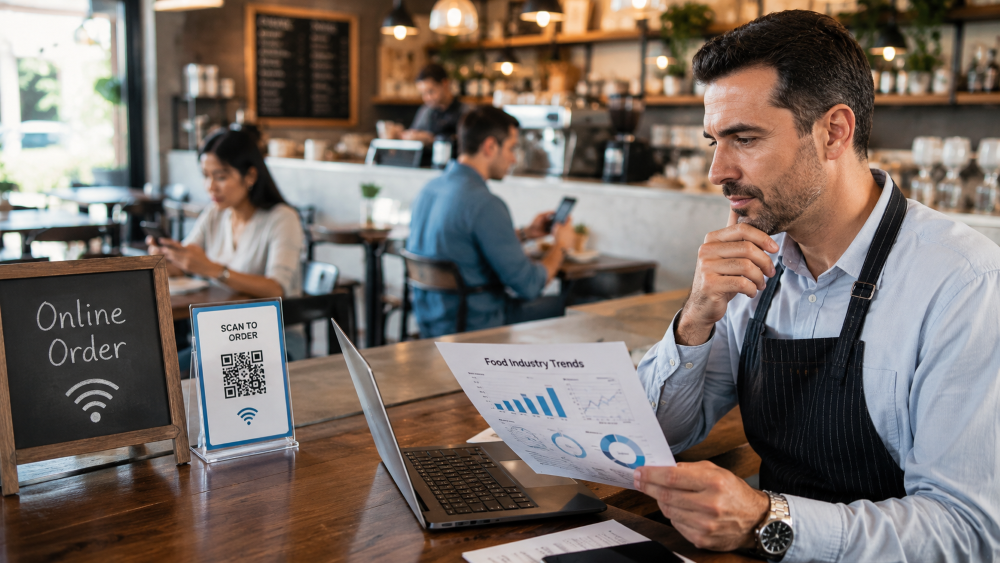
The food industry has always been shaped by people’s tastes, habits, and expectations. But the pace at which those things are changing today is unlike anything the industry has experienced in decades. What consumers want from a food business in 2026 is fundamentally different from what they expected even five years ago — and the gap between businesses that understand this shift and those that do not is widening fast.
For food entrepreneurs, restaurant owners, café operators, and anyone running a food startup, the challenge is not just making great food. It is understanding the forces shaping buying decisions before they reach the counter, the app, or the delivery door. Consumer behavior is no longer a static backdrop — it is an active variable that demands attention, analysis, and adaptation.
This piece breaks down the most important shifts happening right now and what they actually mean for how food businesses need to think and operate.
The Shift Away from Habit-Driven Purchasing
For most of the twentieth century, food purchasing was largely habitual. Consumers shopped at the same stores, ordered from the same restaurants, and stuck to familiar products for years. Brand loyalty was built slowly and was remarkably durable once established. That model has collapsed.
Today’s food consumer is actively experimental. The rise of food content on social media — particularly short-form video — has created a culture where trying something new is a form of self-expression. Platforms like TikTok and Instagram have demonstrated, repeatedly, that a single viral post can send an obscure food product or restaurant to national attention overnight. But the same environment that can create a surge in demand can also send consumers moving on to the next thing within weeks.
This does not mean brand loyalty is dead. It means it has to be earned differently. Loyalty today is not built by showing up consistently and being familiar — it is built by consistently delivering value, quality, and a reason to choose you over an increasingly loud field of alternatives. The food businesses adapting to this reality are investing in storytelling, quality control, and customer relationships, not just in marketing spend.
Convenience Has Become Non-Negotiable
Ask any food business owner what their customers want most and the word ‘convenience’ will come up quickly. But the depth of what consumers now mean by convenience goes far beyond offering takeaway or shortening wait times.
Convenience today is layered. It starts with digital discoverability — can someone find your business easily, understand your offering quickly, and decide to order without friction? It extends through the ordering process itself — is your online ordering system intuitive, fast, and accessible on mobile? It continues through fulfillment — is the order accurate, well-presented, and delivered when promised? And it completes itself in the follow-up — is there an easy way to reorder, leave feedback, or contact the business if something goes wrong?
Research across the food service sector consistently finds that consumers will choose a slightly inferior product from a business that makes their life easier over an excellent product that requires effort to access. That is a difficult truth for businesses that have historically competed on quality alone. Quality remains important — but it now lives inside a broader experience frame where friction is the enemy of retention.
For food startups and café owners in particular, building convenience into every customer touchpoint is no longer a premium feature. It is the baseline.
Health Consciousness Is Reshaping the Menu
The health and wellness trend in food has been building for years, but it has now reached a tipping point where it is influencing purchasing decisions across nearly every demographic — not just fitness-focused younger consumers. Business owners who view health-conscious offerings as a niche are misreading the market.
The modern food consumer is reading ingredient lists, paying attention to nutritional density, and increasingly skeptical of ultra-processed products. This does not mean every customer is pursuing a specific diet — keto, plant-based, gluten-free, or otherwise. It means that the baseline expectation is transparency. Consumers want to know what is in their food, where it comes from, and whether the business they are buying from cares about what goes into its products.
For restaurant owners and food entrepreneurs, this creates a significant opportunity. Businesses that lead with ingredient quality, source local and seasonal produce where possible, and communicate those choices clearly — not performatively — are building trust with a consumer base that has become genuinely harder to impress. The key distinction is authenticity: consumers in this space are adept at identifying performative wellness versus genuine quality commitment, and they reward the latter with loyalty and word-of-mouth advocacy.
The Psychology Behind Food Buying Decisions
Understanding why people buy food is just as important as understanding what they buy. Purchasing decisions in the food sector are rarely purely rational — they are driven by emotion, identity, social signaling, and perceived value in ways that traditional sales thinking often misses.
Consumers increasingly use food choices to communicate something about themselves — their values, their lifestyle, their sophistication, or their community membership. A consumer who buys from a local artisan bakery is not just buying bread; they are affirming a set of values around supporting small business, appreciating craft, and prioritizing quality over price. A consumer who orders from a farm-to-table restaurant is making a statement about their environmental awareness alongside their taste preferences.
This identity dimension of food purchasing has direct implications for how businesses present themselves. Packaging is one of the most visible expressions of brand identity, and it shapes perception before a single bite is taken. Businesses that invest in intentional design — including thoughtful custom snack packaging that reflects the brand’s personality and values — signal to the consumer that care and attention extend to every detail of the experience, not just what happens in the kitchen. That signal influences purchasing decisions more than most business owners realize.
Beyond identity, value perception is being redefined. Consumers are not necessarily looking for the cheapest option — they are looking for the option that feels worth it. That calculation includes quality, experience, ethics, and story. Businesses that understand this and price and present themselves accordingly are consistently outperforming competitors who compete primarily on cost.
Digital Ordering Has Changed the Relationship Between Business and Customer
The normalization of digital ordering — accelerated dramatically by the pandemic and now fully embedded in consumer behavior — has altered the fundamental relationship between food businesses and their customers. The physical interaction that once defined that relationship is now, for many consumers, entirely optional.
This creates both a challenge and an opportunity. The challenge is that businesses can no longer rely on in-person service quality, atmosphere, or the charm of their staff to create differentiation. Those elements still matter enormously for dine-in and café experiences, but for the growing proportion of customers who interact exclusively through apps and delivery platforms, the experience is defined entirely by product quality, packaging, delivery speed, and digital communication.
The opportunity is that digital channels allow businesses to collect richer data about customer behavior than was ever possible in a purely in-person model. Order frequency, average basket size, product preferences, time-of-day patterns, and geographic concentration — all of this data, when analyzed and acted upon, can help food businesses make smarter decisions about menus, pricing, promotions, and expansion. The businesses gaining competitive advantage right now are not necessarily the ones with the most marketing budget — they are the ones making smarter use of behavioral data.
Speed Expectations Are Compressing the Timeline
The Amazon effect — the expectation of fast, reliable fulfillment set by e-commerce — has bled directly into the food industry. Consumers who receive non-food purchases within hours have started to apply that same expectation to food delivery, meal kit services, and even grocery restocking.
For food businesses, this compression of the speed expectation creates real operational pressure. Kitchen efficiency, supply chain reliability, delivery partner performance, and order management systems all have to work in concert to meet a standard that consumers now consider normal rather than exceptional. A business that cannot deliver on time, consistently, will find that customer tolerance is considerably lower than it was five years ago.
This is not merely a logistics problem. It is a trust problem. Every missed delivery window, every longer-than-estimated wait, is a small withdrawal from the trust account a business has built with a customer. Enough of those withdrawals, and the customer simply closes the account.
Adapting to Behavioral Shifts Without Losing Identity
One of the most common mistakes food businesses make when confronting rapid consumer change is overcorrecting — chasing every trend, pivoting menus seasonally to match social media cycles, and losing the clarity of identity that made them compelling in the first place.
The most resilient food businesses are those that can absorb and respond to consumer behavior shifts from a place of strong identity. They adapt their delivery mechanisms, their digital presence, and their product mix in response to real demand signals. But they do not abandon what makes them distinctive.
Adaptation is not about becoming whatever the market seems to want. It is about remaining genuinely relevant while staying true to the standards, values, and quality that the business was built on. Consumers can sense the difference between a business that is evolving with integrity and one that is simply chasing attention. And in an environment where attention is cheap but trust is expensive, the businesses that earn trust through authentic adaptation will consistently outperform those that do not.
What the Next Wave of Consumer Behavior Looks Like
Looking ahead, several behavioral trends are already in motion that will define the food consumer landscape over the next three to five years. Sustainability expectations will continue to intensify — not just in terms of what is on the menu, but in how businesses manage waste, packaging, energy, and supply chain relationships. Consumers are becoming increasingly sophisticated at identifying greenwashing and will hold businesses to a higher standard of genuine environmental accountability.
Personalization will deepen as AI tools make it practical for even small food businesses to offer individualized recommendations, loyalty experiences, and marketing communications. The one-size-fits-all approach to customer engagement will feel increasingly outdated.
And the social dimension of food — the way it connects people, builds community, and creates shared experience — will continue to be a powerful driver of the businesses that thrive. The food businesses that understand they are not just selling a product, but hosting a relationship with their customers and with the culture around food, will be the ones that build something genuinely enduring.
Final Thought
Consumer behavior in the food industry is not a problem to be solved — it is a landscape to be understood and navigated with intelligence and care. The business owners who approach these shifts with curiosity rather than defensiveness, and who build systems that allow them to respond quickly and thoughtfully to what their customers actually want, are the ones who will define what the food industry looks like in the years ahead. The opportunity is enormous. So is the cost of ignoring what is already changing.