
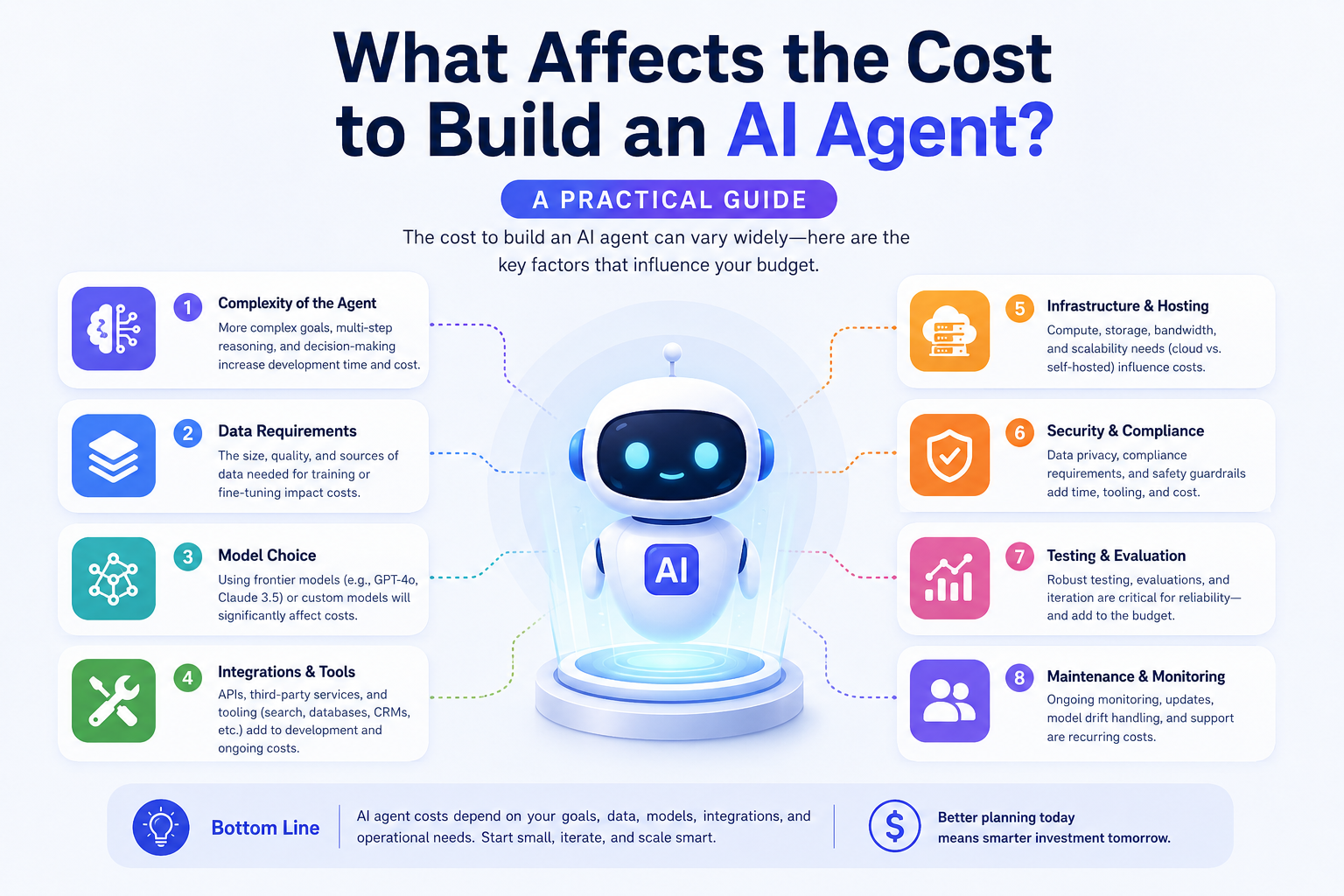
Have you ever noticed that two businesses can invest in AI technology but end up with completely different project budgets? This often surprises business owners who are planning their first AI project. They expect to find a standard price online, but instead they discover estimates that range from a few thousand dollars to much larger investments.
The reason is simple. There is no “one-size-fits-all” AI agent. Every business has its own goals, customers, and daily operations. An AI assistant built for a local accounting firm will be very different from one designed for a nationwide retail company. Although both businesses are using AI, the amount of planning, development, and testing required is completely different.
Think about opening a new warehouse. A small business may only need storage space with a loading area, while a large logistics company may require automated inventory systems, advanced security, temperature-controlled rooms, and multiple loading docks. Both projects involve building a warehouse, but the work involved is far from the same.
Building an AI agent follows the same principle. The technology itself is important, but the business requirements have a much bigger influence on the overall project. Businesses that understand these factors before development begins usually make better decisions, avoid unnecessary spending, and create AI solutions that continue delivering value for years.
In this practical guide, we’ll explore the major factors that influence AI project costs using simple explanations and real-world examples. Whether you’re planning your first AI project or improving an existing one, understanding these areas will help you budget more confidently.
Every Business Problem Creates a Different Project
Cost to build an ai agent depends first on the problem your business wants to solve rather than the AI technology itself.
Many businesses begin by saying, “We need an AI agent.” While that sounds like a clear objective, developers still need much more information before they can estimate the project.
They usually ask questions such as:
- What tasks should the AI perform?
- Who will use the AI every day?
- Will it support customers, employees, or both?
- Should it answer questions, automate work, or help people make decisions?
The answers to these questions determine how large the project will become.
Let’s imagine two businesses.
The first operates a dental clinic. Their AI assistant only needs to schedule appointments, answer common patient questions, and send reminder messages before visits. Since the workflow is straightforward, development remains relatively simple.
Now think about a manufacturing company. Their AI agent needs to monitor production updates, communicate with inventory software, generate reports for management, notify maintenance teams when equipment requires attention, and recommend improvements based on operational data. Instead of performing one task, the AI becomes part of the company’s everyday operations.
Although both organizations are investing in AI, the second project naturally requires more planning, software development, integrations, and testing.
Many businesses compare quotations without comparing the actual scope of work. As a result, they believe one company is charging too much while another seems much cheaper. In reality, the proposals may include completely different levels of functionality.
A useful way to avoid this problem is to define your business objectives before speaking with developers. When everyone understands the purpose of the AI agent, creating realistic timelines and budgets becomes much easier.
Tip: Instead of asking, “How much will an AI agent cost?” first ask, “What business problem do we want it to solve?” The answer often determines the project budget more than the technology itself.
Features Can Expand the Project Faster Than Expected
As soon as businesses decide what problem the AI should solve, they begin discussing features. This is often where projects become larger than originally planned.
Top-Rated App Development is frequently connected with AI projects because businesses want customers and employees to access AI through mobile applications or modern web platforms. A powerful AI agent is valuable, but it becomes even more useful when people can interact with it easily.
Let’s look at a simple example.
An online clothing store initially wants an AI assistant that answers product questions.
After the first planning meeting, new ideas begin to appear.
- Marketing asks for personalized product recommendations.
- Customer support wants order tracking.
- Sales teams request lead qualification.
- Managers want automatic reports.
- Customers ask for voice support.
- International buyers request multiple languages.
Each request sounds reasonable, but every new feature increases the amount of development work behind the scenes.
Imagine building a family home.
Halfway through construction, someone decides to add another bedroom. Later, the family requests a larger kitchen, an extra bathroom, and a home office. Every new idea affects the building plans, electrical work, plumbing, flooring, and finishing.
The same thing happens with AI development.
Businesses often focus only on what users will see on the screen. Developers, however, also need to build workflows, connect databases, write business logic, perform security testing, and make sure every feature works together without causing problems elsewhere.
That is why experienced development teams often recommend launching with essential features first. Once customers begin using the AI, businesses gain valuable feedback that helps them decide which improvements will create the greatest return on investment.
This gradual approach usually produces better results than trying to build every possible feature before launch.
Warning: Every new feature adds development time, testing requirements, and future maintenance. Prioritize business value instead of trying to include every idea in the first version.
Existing Systems Can Have a Bigger Impact Than the AI Itself
For many business owners, developing the AI seems to be the hardest thing about the entire project.
However, integration of this AI with other software may take as much preparation and effort as the actual development.
All business companies have certain software that helps them handle everyday processes.
They may include CRM, stock management, payment gateways, accounting software, booking, and internal databases.
Once the AI is integrated with these systems, it becomes much more functional.
Think of a case when the client wants to know where his/her order is.
If the AI is not connected with all other company systems, it will not be able to answer this question.
However, with proper integration, the AI will be able to find out what is happening with the order and tell the client everything they need to know right away.
It will significantly improve the user experience but increase the amount of technical work during the development process.
One of the underestimated things in business is data quality.
Let us assume that there is no information in customer profiles, product descriptions are obsolete, prices are different in several places, etc.
Even the most advanced AI cannot provide reliable answers when the information it receives is incomplete or inaccurate.
Developers usually spend considerable time organizing and preparing business data before AI development can move forward successfully.
Think about training a new employee. Before expecting excellent performance, you first provide accurate information, clear instructions, and the right tools. AI systems require exactly the same preparation.
Common Problem: Many businesses underestimate the amount of work required to prepare their existing software and business data before AI development begins.
Good Planning Can Save More Money Than Choosing the Cheapest Quote
The next factor that affects an AI project’s budget is something many businesses overlook—planning. It is easy to compare development companies based on price alone, but the lowest quote is not always the best value.
Imagine two companies building new office spaces.
The first company spends several weeks discussing employee needs, future growth, office layouts, and technical requirements before construction starts. Everything is documented, so the builders know exactly what needs to be done.
The second company starts construction immediately. After a few weeks, they decide to move walls, add meeting rooms, install extra security systems, and redesign the entrance.
Although both offices may look similar when finished, the second project almost always costs more because completed work has to be changed several times.
AI development follows the same pattern.
When businesses clearly define their objectives, developers can create accurate timelines, realistic budgets, and a structured development plan. On the other hand, if requirements keep changing throughout the project, developers often need to rewrite code, redesign workflows, and repeat testing. All of these changes increase both development time and costs.
Adult aI agent development is a good example of why planning is so important. Businesses operating in this industry often require additional privacy features, user verification, content moderation, personalized experiences, and secure payment workflows. These requirements should be identified before development begins rather than being added halfway through the project.
Many experienced development companies, including Triple Minds, recommend starting with a discovery or planning phase. During these sessions, businesses discuss their goals, identify essential features, prioritize development tasks, and create a realistic roadmap.
Another effective strategy is building a Minimum Viable Product (MVP). Instead of launching every feature at once, businesses release the core AI solution first. After receiving feedback from customers and employees, they continue improving the system with features that provide the greatest business value.
This approach not only reduces unnecessary spending but also helps businesses understand what users actually need instead of relying on assumptions.
Tip: Investing extra time in planning before development often saves much more money than choosing the lowest development quote.
Building the AI Is Only the Beginning
Many businesses believe their investment ends once the AI agent is launched. In reality, that is when the next stage of the project begins.
Businesses continue changing every day. New products are introduced, customer expectations evolve, company policies are updated, and software platforms receive regular improvements. An AI agent must keep up with these changes if it is expected to remain useful.
Think about opening a supermarket.
The building may be complete, but the business still updates product displays, introduces new items, trains employees, improves customer service, and responds to customer feedback throughout the year.
An AI agent requires the same level of ongoing attention.
For example, customers may begin asking questions that were never considered during development. New services may be added to the business. Internal processes may change as the company grows. Without regular updates, the AI may gradually become less accurate and less helpful.
Maintenance also improves security. As technology evolves, new security practices and software updates become necessary to protect customer information and business data.
The realization of the need for automation often occurs through the use of AI by workers in the course of performing tasks. The job description of a customer support assistant may change to involve the performance of additional activities such as sales, internal training, or employee onboarding.
Maintaining the system should not be seen as an added cost but rather as a way of safeguarding the investment that has already been done.
Working with experienced technology providers, such as Triple Minds, can make the future improvements easier since the system is built to grow beyond the current needs.
Warning: Budgeting only for development without planning for future updates is one of the most common mistakes businesses make when investing in AI.
Conclusion
There is no fixed price for developing an AI agent as each company has its own objectives and processes, and needs different technology. The actual investment will depend upon several variables such as the problem which needs to be solved by using the technology, required features, already installed software systems, data quality, and level of pre-development planning.
Companies that take time to understand all the above-mentioned issues have greater chances of making good investments since they concentrate on practical applications rather than the lowest quote for development.
It has been observed that companies that start from a sound base and develop necessary features gradually have more success than the ones that try to make a complete system at one shot. AI must be treated like any other business investment that evolves with the company.
Frequently Asked Questions
1. Why do AI agent development costs vary so much?
Every business has different objectives, workflows, integrations, and technical requirements. These differences change the amount of planning, development, testing, and maintenance needed for the project.
2. What affects the cost of an AI project the most?
The biggest factor is the business problem the AI is expected to solve. More complex business processes usually require more development work and system integrations.
3. Can businesses reduce AI development costs?
Yes. Careful planning, focusing on essential features first, preparing business data early, and launching an MVP can help reduce unnecessary expenses while delivering value sooner.
4. Why do integrations increase the project budget?
Connecting an AI agent with CRM platforms, inventory systems, payment gateways, or internal software requires additional development and testing to ensure all systems communicate correctly.
5. Is maintenance really necessary after launch?
Yes. Regular maintenance keeps the AI secure, improves its accuracy, supports new business requirements, and ensures it continues providing value as the business grows.
6. Should every feature be included in the first version?
No. Most successful AI projects begin with the core functionality and gradually expand based on real customer feedback and changing business needs.