
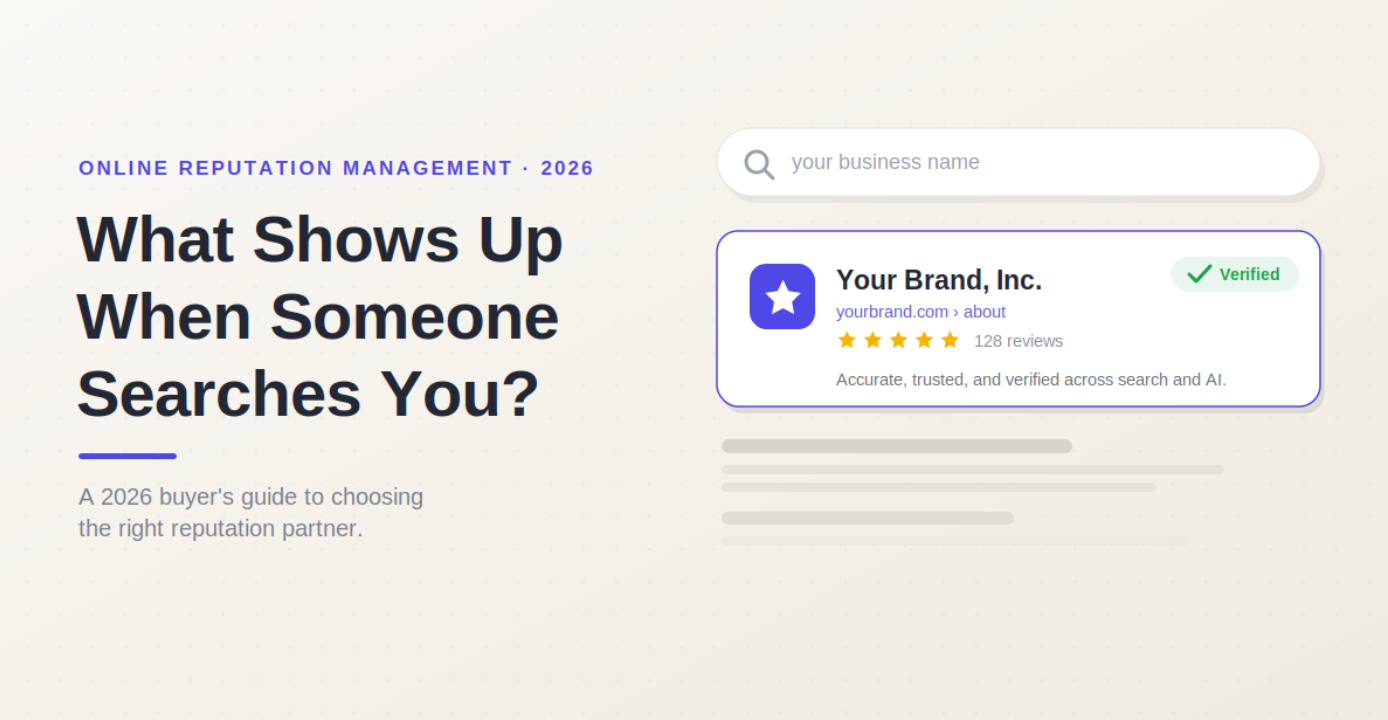
Try the experiment right now. Open a private browser window, type in your name or your company’s, and look at the first screen of results. Whatever you see, so does everyone else — the customer deciding whether to call, the recruiter vetting a candidate, the investor running diligence, the reporter checking a source. That first screen is your handshake, and in 2026 it’s being assembled in ways most people never think about.
The old mental model was simple: ten blue links on Google, and reputation meant keeping the bad ones off page one. That model is now badly out of date. Here’s what’s really shaping the picture — and what you can do about it.
It isn’t just Google anymore
The single biggest shift is that search results are no longer the only thing people read about you. Increasingly, they don’t read at all — they ask, and a machine answers.
- AI answer engines like ChatGPT, Gemini, and Google’s AI summaries now describe you in a paragraph, pulling from sources you may not even know exist. They compress a complicated reality into a confident sentence or two, and they decide which sources to trust.
- Review platforms and Maps put a star rating and a handful of quotes in front of people before they ever reach your website.
- Data-broker sites quietly publish home addresses, phone numbers, and relatives — often inaccurately — and rank surprisingly well for personal-name searches.
- Voice assistants read a single answer aloud, with no page two to fall back on.
Your “first impression” is now stitched together from all of these at once. Control of any one surface no longer means control of the story.
Why it matters more than it used to
Three things make this higher-stakes than the page-one era.
First, people act on it fast. Trust forms in seconds, and a weak or worrying result can end a deal before you get a chance to make your case.
Second, AI flattens nuance. When a model summarizes you, it doesn’t show ten perspectives — it picks one and states it plainly. A single outdated article or one angry review can quietly become “the answer,” repeated to everyone who asks.
Third, bad information is sticky. Inaccurate or unflattering content rarely disappears on its own. Left alone, it ages into the default — the thing that ranks, the thing the AI cites, the thing everyone sees first.
What you can fix yourself
Plenty of this is within reach without hiring anyone, and for many small businesses the basics go a long way:
- Claim and complete your profiles. Your Google Business Profile and the major directories should carry accurate, identical name, address, and phone details. Consistency here feeds both search and the AI tools that scrape it.
- Earn reviews honestly and respond to all of them. Ask satisfied customers for genuine feedback, and reply to the negative ones calmly and publicly. Never buy reviews — it violates platform rules and becomes its own scandal when caught.
- Publish the truth on ground you own. A clear About page, accurate bios, and basic structured data give search engines and AI models a reliable source to anchor on. If you don’t define your story, something else will.
- Clean up exposed personal data. Many data-broker sites honor removal requests; working through the major ones reduces what surfaces on personal-name searches.
Done consistently, these steps quietly reshape what people find.
When to bring in professionals
DIY has limits. If you’re facing active negative coverage, a coordinated attack, a news story with legs, legal exposure, or simply a volume of surfaces beyond what you can manage, that’s the point to consider specialist help.
What a credible firm actually does is unglamorous and effective: publishes legitimate, authoritative content; earns real press and links through digital PR; builds an honest review strategy; and corrects the source material that AI tools draw on. It is slow, durable work. Treat any promise of guaranteed removals, instant results, or undisclosed tactics as a reason to walk away — those shortcuts tend to create the next crisis rather than solve the current one.
If you’re sizing up the field, independent rankings are a sensible place to start a shortlist, since they judge firms against a consistent yardstick instead of marketing claims. USA Today, for instance, recently reviewed the leading online reputation management companies of 2026, profiling providers by their services, technology, and results — useful background before you run your own due diligence and ask the hard questions.
The real goal: own your narrative
Reputation in 2026 isn’t something that happens to you; it’s something you manage, on purpose. The aim is straightforward, even if the work isn’t: make sure the accurate, fair, and genuinely good version of your story is the easiest thing to find — on Google, in the AI answer, in the star rating, and in the snippet read aloud by a voice in someone’s kitchen.
Run the search on yourself again in three months. If you’ve done the basics, the handshake will look a little firmer. And if it doesn’t, you’ll at least know exactly which surface to fix next.
