

Most people spend weeks designing their website. They agonize over fonts, colors, and photos. Then they spend about three minutes picking a web host — usually just going with whatever they’ve heard of.
That’s backwards.
Your web host controls how fast your site loads, whether it stays online, and what people experience the moment they click your link. A gorgeous website on a bad host is like a great restaurant with a door that won’t open. People will leave before they ever get inside.
In 2026, three hosting companies are fighting for your business: Hostinger, Bluehost, and GoDaddy. Here’s what actually separates them — and how to pick the right one without regretting it in year two.
The Things That Actually Matter When Picking a Host
Before we get into the comparison, let’s talk about what you actually care about as a small business owner.
Site Speed
When someone clicks your website, how long until they can see it? Research consistently shows that visitors start leaving after just a few seconds of waiting. A slow host directly hurts your business — and it also hurts your Google ranking.
Hosting companies publish something called a response time — basically how fast their server reacts when someone requests your page. Lower numbers are better.
Uptime
Uptime is the percentage of time your site is actually live and online. A host that promises 99.9% uptime sounds great — but that still means your site could be down for about 44 minutes every month. A host promising 99.99% cuts that to about 4 minutes.
For most small business sites, this won’t make or break you. But if you’re taking online appointments or selling products, even an hour of downtime costs real money.
Pricing — Including Renewal Pricing
Every major host advertises a very low intro price. What they don’t put on the billboard is the renewal rate — what you’ll pay after your first term ends. That can be two to five times higher.
If you sign up for a $2/month plan and renew at $12/month, you didn’t really get a $2/month plan. You got a more expensive plan with a temporary discount attached.
Support
Something will break. A plugin will conflict. Your email will go down. The DNS will point the wrong direction. When that happens, how quickly can you get a real person to help you?
Support quality varies a lot between these three companies.
Hostinger: Fastest, Cheapest — With a Catch at Renewal
Hostinger has become a favorite among people who’ve actually tested hosting companies side by side. In real-world tests, their average response time came in around 138ms — the fastest of the three in this comparison.
They run on AWS Cloud infrastructure with Cloudflare CDN included on most plans. Their custom control panel (hPanel) is clean and easy to use. And their intro pricing is genuinely aggressive — starting around $1.99–$2.99/month on a 48-month plan.
For small business sites, their Business plan is the most popular choice. You get 50 sites, 100GB of NVMe storage, daily backups, and free CDN — all solid for a growing business.
The speed story: Hostinger wins this category. 138ms average response time vs. GoDaddy’s 288ms–1,110ms is a real difference, especially for mobile visitors on slower connections.
The uptime story: 99.9% guaranteed, with tests showing 100% uptime in some third-party reviews. Solid.
The pricing story — the honest version:
That $2.99/month Business intro rate? It renews at $16.99/month after your term ends. That’s a 290% jump. You’re also paying the full multi-year amount upfront, so a 48-month plan at $2.99/month means paying around $143–$191 all at once, depending on the plan.
The good news: even at renewal, Hostinger still tends to come out cheaper than competitors at their renewal rates. But you need to know what’s coming so you’re not surprised.
Support: 24/7 live chat. Generally well-rated. Response times are usually fast, though quality can vary like it does with any large company.
Bluehost: Solid All-Around, Best for WordPress Beginners
Bluehost is the hosting company that WordPress.org recommends by name on their official website. That endorsement matters — it means the platform is specifically built and optimized to run WordPress well.
Their response times in testing came in around 580ms on average — slower than Hostinger but well within acceptable range for most business sites. They run on Oracle Cloud with Cloudflare CDN and offer a 99.99% uptime guarantee, the strongest of the three on paper.
Pricing starts around $1.99–$3.99/month on intro plans. Their starter plan now supports up to 10 websites with 10GB of NVMe storage.
The speed story: Bluehost is not the fastest, but it’s reliable. For a standard 5-page business website, you likely won’t notice the difference vs. Hostinger in day-to-day use. Where the difference shows up is during traffic spikes — Hostinger handles those better.
The uptime story: 99.99% guaranteed. That’s the best guarantee on this list, and it translates to about 4 minutes of potential downtime per month vs. 44 minutes at 99.9%.
The pricing story:
Bluehost’s intro pricing is comparable to Hostinger. But their renewal rates are also significant — a $3.99/month starter plan can renew at $9.99/month or more depending on your plan and term. One advantage: their renewal rates on longer plans tend to be more predictable than Hostinger’s jumps.
Support: Bluehost offers 24/7 phone and chat support. Reviews are mixed — some users report long wait times, especially during peak hours. Their knowledge base is strong for self-help.
The WordPress bonus: If you’re building on WordPress (which Omayik Digital recommends for most small businesses), Bluehost’s setup is genuinely beginner-friendly. The install wizard, WonderSuite, walks you through everything step by step. It’s the easiest onboarding experience of the three.
GoDaddy: Familiar, Convenient, and More Expensive
GoDaddy has been around since 1997. Almost every small business owner has heard of them — many have already used them for domain registration. That familiarity is part of why they’re still one of the most popular choices, even when the numbers don’t always favor them.
In performance testing, GoDaddy’s response times ranged from 288ms to over 1,100ms depending on the testing source — noticeably slower than both Hostinger and Bluehost at their best. They run on Google Cloud infrastructure with their own private CDN.
Their uptime guarantee sits at 99.9% — same as Hostinger.
Intro pricing starts at $5.99/month, already higher than the other two before any discounts. And they charge separately for things like email hosting and SSL certificates that competitors often bundle in.
The speed story: GoDaddy performs fine for basic sites with low traffic. Under heavy load, it tends to slow down more than the competition. If you’re expecting consistent traffic or plan to grow quickly, this matters.
The uptime story: 99.9% guaranteed, and they generally meet it in practice. Not bad — just not leading the pack.
The pricing story:
GoDaddy is the most expensive starting point of the three. Their shared hosting renews at $11.99/month or more. Add email hosting, SSL, and other extras, and a small business can easily spend $500–$2,000/year on GoDaddy alone.
The convenience factor:
Here’s where GoDaddy wins: if you want your domain, hosting, email, and business tools all in one account with one login, GoDaddy makes that easier than the others. They also have a large phone support team and built-in AI tools (GoDaddy Airo) for things like logo creation and social media scheduling.
If simplicity matters more than performance, GoDaddy checks that box.
Honest Side-by-Side: Speed, Uptime, and Price
| What You Care About | Winner | Why |
|---|---|---|
| Fastest load times | Hostinger | 138ms avg. response time in testing |
| Best uptime guarantee | Bluehost | 99.99% vs. 99.9% for the others |
| Cheapest intro price | Tie: Hostinger / Bluehost | Both start under $3/month |
| Best renewal value | Hostinger (usually) | Even at renewal, often cheaper than competitors |
| Easiest WordPress setup | Bluehost | WordPress.org recommended + guided install |
| Best all-in-one convenience | GoDaddy | Domain, hosting, email in one place |
| Best for growing traffic | Hostinger | Handles traffic spikes better; less throttling |
How to Pick the Right One for Your Business
Think about your situation:
Go with Hostinger if: You want the best performance per dollar, you don’t mind paying upfront, and you’re either tech-comfortable or willing to learn a new dashboard. Hostinger is our top pick for most small businesses that want a fast, professional site without overpaying.
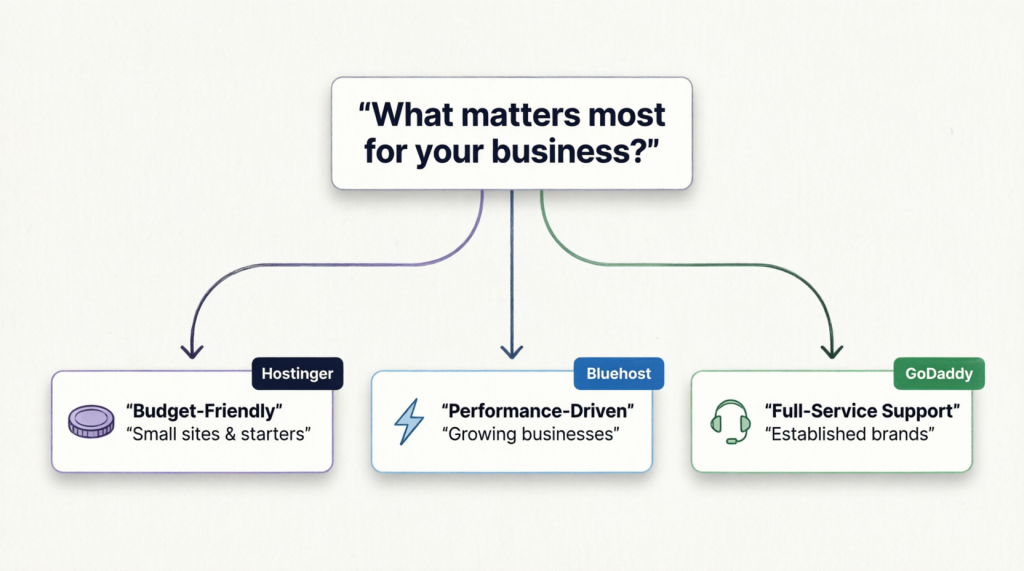
Go with Bluehost if: You’re building your first WordPress site, you want the most guided experience, and you care about that official WordPress endorsement. It’s not the fastest, but it’s reliable and beginner-friendly.
Go with GoDaddy if: You already have your domain there and don’t want to deal with separate accounts. Or if you want a simple all-in-one setup and you’re running a low-traffic informational site.
Or Skip the Setup Entirely
Choosing a host, installing WordPress, configuring email, setting up security, testing your load times — this is a whole project. For a lot of business owners, it’s not worth the time it takes to learn it.
That’s exactly what Omayik Digital is for. We build professional WordPress websites for small businesses — usually delivered in 7 days — and we handle the hosting setup so you don’t have to think about response times, renewal rates, or plugin conflicts.
The Short Version
Your web host is not a boring back-end detail. It’s what controls how fast your site loads, whether it stays online, and how much you’ll pay year over year.
In 2026:
- Hostinger is the fastest and best value overall — just read the renewal terms
- Bluehost is the safest pick for WordPress beginners with solid uptime
- GoDaddy is the most convenient all-in-one, but you’ll pay more for it
Whatever you choose, don’t just look at the intro price. Pull up the renewal rate too, do the math for year two, and then decide.
Your first impression starts the moment someone clicks your link. Make sure it’s a fast one.
