Two distinct conversations are happening simultaneously about wall art in 2026 — and both are worth understanding.
The first is a business conversation: print-on-demand has transformed the wall art market into one of the most accessible product categories for entrepreneurs, with low barriers to entry, proven consumer demand, and economic structures that can scale without proportionally increasing operational complexity.
The second is a workplace conversation: a growing body of research in organisational psychology has established that the visual environment of offices and remote workspaces has measurable effects on employee productivity, wellbeing, and retention — effects that forward-thinking companies are beginning to act on deliberately.
This article addresses both conversations. Whether you’re an entrepreneur evaluating the wall art market or a business leader thinking about office environment design, the underlying facts are relevant.
The Wall Art Market in 2026: Scale and Growth
The global wall art market was valued at approximately $53 billion in 2023, according to data from Grand View Research, and is projected to grow at a compound annual growth rate of 4.1% through 2030. Within this, the online segment is growing significantly faster than the brick-and-mortar segment, driven by the same e-commerce acceleration that has reshaped most product categories.
The print-on-demand subsegment is growing faster still. Allied Market Research estimated the global POD market at $6.18 billion in 2022, with a projected CAGR of 26.1% through 2031 — making it one of the fastest-growing segments in the broader personalised products space. Wall art is one of the strongest categories within POD, benefiting from high average order values, repeat purchase behaviour, and the “gifting” dynamic that makes it a year-round category rather than a seasonal one.
What drives consumer demand? Three structural factors are particularly significant. First, the growth of home ownership and rental among younger demographics who are investing in home décor for the first time. Second, the influence of social media platforms — particularly Pinterest, Instagram, and TikTok — on home aesthetics, which has elevated consumer awareness of interior design and created a culture of aspirational home styling that previous generations didn’t experience at the same intensity. Third, the growth of remote and hybrid work, which has turned the home into a workplace and created new demand for home office aesthetics that feel professional and personally meaningful simultaneously.
The Business Case: Print-on-Demand Wall Art as a Revenue Model
For entrepreneurs, the appeal of print-on-demand wall art rests on a specific set of structural advantages that distinguish it from most other product categories.
Zero inventory risk.
Products are only manufactured when an order is placed. Unlike traditional retail — where you purchase inventory speculatively and write off unsold stock — POD eliminates this exposure entirely. Your capital is not tied up in warehouse inventory; it’s deployed in design, marketing, and platform optimisation.
High gross margins.
Wall art carries the highest margin profile of most POD categories precisely because its perceived value significantly exceeds its production cost. A 50x70cm canvas print that retails for £55 has a base production and shipping cost in the £18–22 range, yielding a gross margin of approximately 60–65%. These are food-and-beverage margins in a physical products context.
Fulfilment infrastructure already exists.
The investment required to enter this market used to include either building print production capability (requiring substantial capital) or accepting the constraints of limited fulfilment partners. That constraint has essentially dissolved. Specialist wall art fulfilment companies like Printseekers have built production infrastructure — including Shopify and Etsy integrations, white-label packaging, and production times of 1–3 business days — that effectively outsources the entire operational side of the business.
Scalable without proportional cost increases.
Because fulfilment scales with orders (each unit carries its production cost), and marketing can be scaled digitally, a wall art POD business can grow from £2,000 to £20,000 monthly revenue without hiring, without warehouse costs, and without supply chain complexity.
Understanding the Consumer: Who’s Buying Wall Art and Why
Building a successful wall art business requires understanding not just what consumers buy, but why — the motivations and decision-making patterns that drive purchasing behaviour in this category.
Research by the home décor analytics firm HGTV Pulse (published 2023) identified three primary consumer motivations in wall art purchasing. The largest segment — approximately 45% — are “nest investors”: primarily homeowners making deliberate investments in creating a personalised home environment. The second segment — approximately 30% — are “gift buyers”: people purchasing wall art for others, particularly for housewarming gifts, milestone events, and personalised gifts. The third — approximately 25% — are “impulse aesthetic buyers”: people who respond emotionally to a specific piece and purchase it without extensive consideration.
These three segments respond differently to marketing. Nest investors respond to content that helps them make better decisions — educational articles about how to choose art for specific rooms, guides on scale and placement, explanations of print quality. Gift buyers respond to emotional framing and personalisation features. Impulse aesthetic buyers respond to beautiful product imagery in aspirational room settings.
Building marketing content that addresses all three motivations — as this article does — is more effective than content that addresses only one.
Wall Art in the Office: The Productivity Research
The business conversation about wall art extends well beyond entrepreneurship. A growing body of organisational research has examined the relationship between physical workplace environments and employee outcomes — with consistent findings that have practical implications for business leaders.
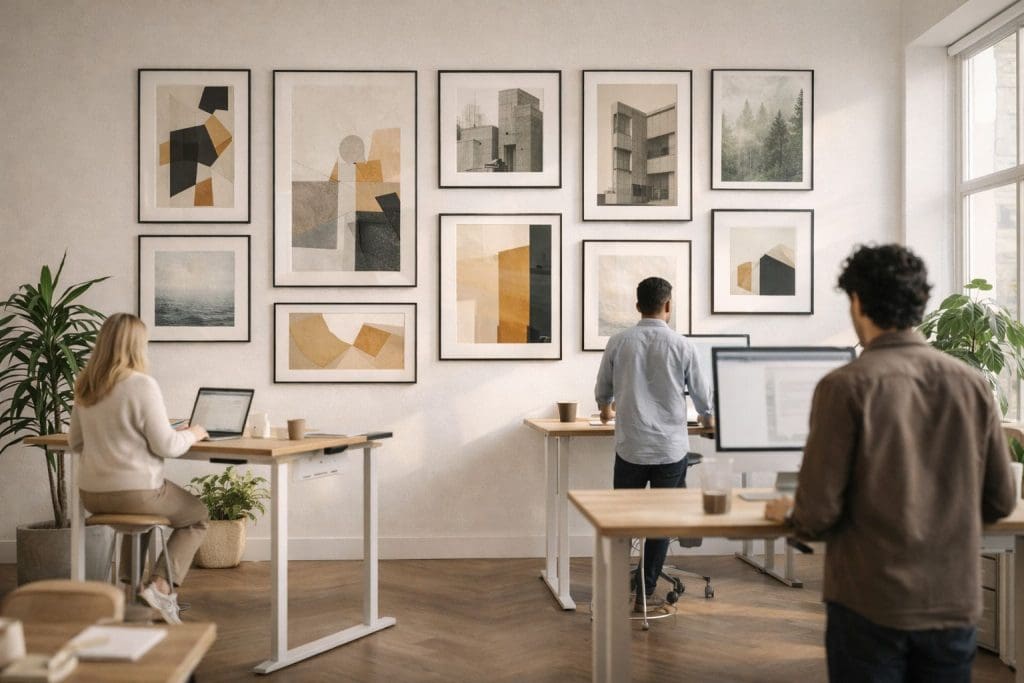
A frequently cited study from the University of Exeter, led by Professor Alex Haslam, found that employees working in offices described as “enriched” — featuring art and plants — were 17% more productive than those in lean, minimal environments. The effect was attributed to what the researchers called “psychological ownership”: when people feel their environment reflects values and aesthetics they care about, they invest more psychologically in the work they do there.
A subsequent study by Haslam’s team found that the effect was even stronger when employees had agency over their environment — when they were involved in choosing the art or could personalise their workspace. This has practical implications for companies managing hybrid workforces: providing art budgets and personalisation allowances for home offices is not a frivolous perk but a potentially meaningful productivity investment.
The Remote Work Environment: Wall Art as Professional Infrastructure
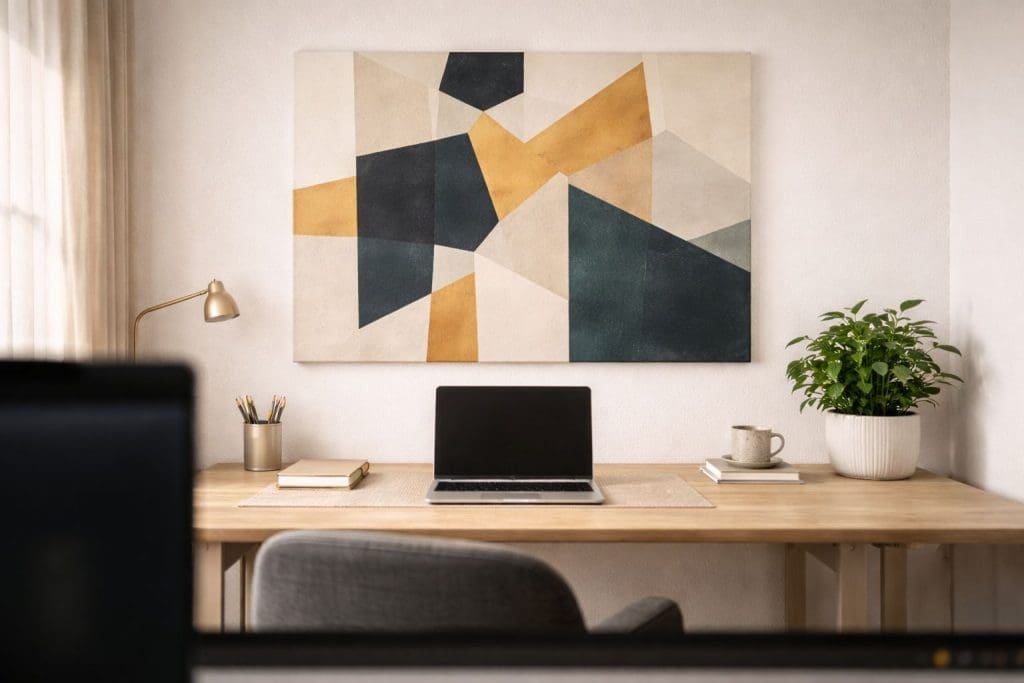
The shift to hybrid and remote work has created a specific new context for wall art that wasn’t relevant in the pre-pandemic workplace landscape. The space behind you in a video call is now, effectively, a professional environment visible to colleagues, clients, and employers.
This has created a category of wall art purchasing that analysts have called “background art” — pieces specifically chosen for how they appear in video call settings. The demand is real: Google Trends data shows consistent search volume for terms like “home office wall art” and “professional background for video calls” that emerged sharply in 2020 and has remained elevated since.
The characteristics of good background art are specific: not too busy (which distracts from the face in the foreground), not too dark (which absorbs light from the background), and expressive enough to communicate something positive about the person on screen. Large-format minimalist art, landscape photography, and abstract compositions with clean, confident forms all work well in this context.
Quality Differentiation: What Separates Premium Wall Art from Commodity Products
In a market where print-on-demand infrastructure is increasingly commoditised, quality differentiation has become the primary competitive variable. For both consumers choosing products and entrepreneurs evaluating fulfilment partners, understanding what drives quality differences is practically important.
Print resolution and colour accuracy are foundational. Professional printing equipment — Epson SureColor technology is the industry benchmark for colour-accurate wide-format printing — produces results that standard desktop-derived printing cannot match. Archival pigment inks (which use permanent pigment rather than dye-based chemistry) are resistant to fading under UV light and maintain colour accuracy for decades rather than years.
Substrate quality affects both aesthetics and durability. For canvas, the weight and weave of the canvas fabric (measured in grams per square metre, with heavier being generally superior) and the quality of the stretcher bars affect how the final product looks and holds up over time. Cheap stretcher bars warp; cheap canvas develops surface cracks. Printseekers has built its reputation specifically around quality consistency in wall art, which requires different standards from general POD suppliers who treat wall art as one category among many.
Production control matters because consistency requires oversight. Suppliers who handle printing and shipping in-house — without outsourcing to third-party print labs — have tighter quality control than those who aggregate orders across multiple suppliers. Consistent colour, consistent framing, consistent packaging: these only result from controlled processes.
The Gift Economy: Wall Art as a High-Value, Personalised Gift Category
Gift-giving is one of the most durable drivers of e-commerce revenue, and wall art occupies a particularly strong position in the gift economy for a specific reason: it’s one of the few product categories where meaningful personalisation is both technically feasible and commercially scalable.
A personalised canvas print — a couple’s photograph from a significant trip, a child’s name rendered in typographic illustration, a map print of a meaningful location — is a gift that carries narrative weight, which is the property that differentiates memorable gifts from forgettable ones. It can’t be bought anywhere else; it has a story attached to it; it will likely be kept and displayed for years.
The gifting segment of the wall art market is estimated by industry analysts at approximately 30% of total consumer sales. For entrepreneurs building wall art businesses, this segment rewards personalisation capability, strong gifting-occasion marketing (birthdays, anniversaries, housewarmings, new babies), and fast production turnaround that aligns with purchasing behaviour close to gift-giving dates.
Sustainability and the Print-on-Demand Advantage
The sustainability calculus of print-on-demand manufacturing is, somewhat counterintuitively, more favourable than traditional inventory-based production.
Traditional physical product retail manufactures speculatively, which means it produces units that don’t sell — generating waste in materials, energy, packaging, and transportation. Industry estimates suggest that unsold inventory write-offs in home décor represent 15–25% of production volume in traditional retail channels. POD eliminates this category of waste entirely: nothing is produced that isn’t sold.
Individual unit shipping generates more transport emissions per unit than bulk freight, which is a genuine trade-off. But the elimination of unsold-inventory waste, combined with the elimination of warehousing energy costs, means that the net sustainability picture for POD is generally favourable compared to traditional manufacturing models.
Suppliers like Printseekers have also incorporated explicit sustainability commitments into their operations — prioritising eco-friendly materials and processes as part of their production standards.
Entering the Market: First Steps for Aspiring Entrepreneurs
For business readers considering entry into the print-on-demand wall art market, a realistic entry pathway looks like this:
First, research the competitive landscape on Etsy for the niche you’re considering. Study what’s selling, at what price points, with what design aesthetics. Identify gaps — underdeveloped niches, underserved customer segments, design styles with demand but limited supply.
Second, order samples from potential fulfilment partners before committing. The production quality you experience as a customer is the quality your customers will experience. Printseekers offers free samples to prospective partners — a standard that serious fulfilment suppliers maintain precisely because quality verification is a legitimate pre-commitment need.
Third, build a product catalogue of 30–50 listings before launch. Early Etsy performance is correlated with listing volume; stores with more listings get more organic impressions, which produces more data to optimise against.
Fourth, invest in lifestyle photography. Art shown in styled room settings converts significantly better than art shown against white backgrounds. This investment in visual assets pays back through every sale made.
Conclusion: A Market Worth Taking Seriously
Whether the wall art opportunity you’re evaluating is entrepreneurial (building a POD business) or operational (investing in your office environment), the underlying economics and research make a consistent case.
The market is large and growing. The infrastructure for both production and distribution is more accessible than it has ever been. The consumer demand drivers — remote work, home décor investment, personalisation demand — are structural rather than cyclical. And the research on visual environments and productivity provides a genuine business case for the workplace investment conversation.
Wall art is, unexpectedly, a serious subject.