

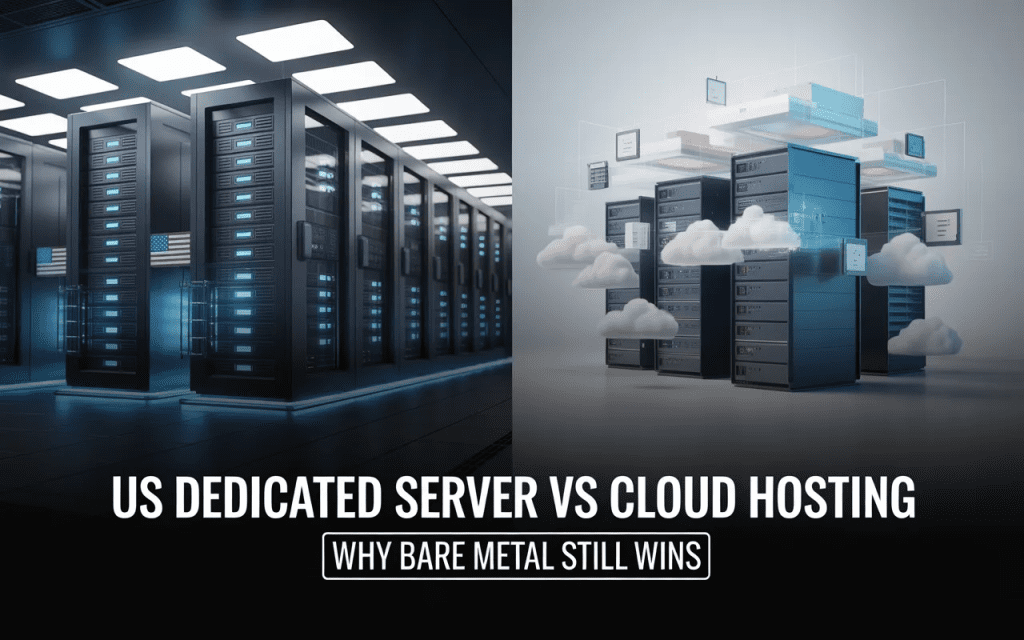
In today’s fast-moving digital world, businesses have more choices than ever when it comes to hosting their applications and websites. Two of the most common options are cloud hosting and dedicated servers. While cloud solutions offer flexibility and scalability, many businesses still prefer a bare metal server for critical workloads. But why does this traditional option remain so popular, especially in the U.S. market?
Understanding the differences between cloud hosting and dedicated server hosting is key to making the right decision for your business. Let’s break it down.
What Is a Dedicated Server?
A dedicated server is a physical machine reserved entirely for a single user or business. Unlike shared hosting or cloud virtual machines, all the CPU, memory, storage, and bandwidth are dedicated to your applications.
This exclusivity ensures that your websites and applications run consistently and reliably. There’s no competition for resources, no unpredictable slowdowns, and full control over server configurations.
When hosted on a bare metal server, these advantages are amplified. Bare metal servers eliminate virtualization layers, giving direct access to physical hardware for maximum performance.
What Is Cloud Hosting?
Cloud hosting, on the other hand, uses virtual servers hosted across multiple physical machines. Resources like CPU, RAM, and storage are allocated dynamically and can be scaled up or down as needed.
Cloud hosting is popular because it is flexible, easy to set up, and often billed based on usage. Many businesses like it for non-critical workloads, temporary projects, or applications that experience variable traffic.
Performance: Bare Metal vs Cloud
Performance is one of the biggest differences between a bare metal server and cloud hosting.
- Cloud Hosting: Virtualization can create overhead, which may slow down applications during high-demand periods. Even though cloud resources can scale, they may not always provide consistent performance.
- Bare Metal Servers: These servers provide direct access to physical hardware. Applications run faster, databases handle heavy workloads better, and latency-sensitive operations stay smooth.
For businesses running high-traffic websites, e-commerce platforms, or real-time applications, consistent speed and reliability are crucial. This is where dedicated server hosting still shines.
Security and Compliance
Security is another area where bare metal servers have a clear advantage. Since the hardware is entirely dedicated to one user, the risk of breaches from neighboring accounts is eliminated.
Cloud environments share infrastructure between multiple clients, which introduces potential vulnerabilities. For companies handling sensitive data, such as financial institutions, healthcare organizations, or SaaS providers, a bare metal server is often the safer choice.
Additionally, dedicated servers in U.S. data centers often meet strict compliance standards like HIPAA, PCI, and ISO certifications, helping businesses meet regulatory requirements with confidence.
Customization and Control
One major benefit of dedicated server hosting is complete control over the environment. Businesses can:
- Choose the operating system and software stack
- Configure firewalls and security settings
- Allocate resources exactly as needed
- Optimize performance for specific applications
Cloud hosting offers some level of customization, but it is limited by virtualization and provider configurations. Bare metal servers let businesses run applications exactly as they need, without compromises.
Cost Considerations
Cloud hosting is often marketed as cost-effective, especially for small or temporary projects. You pay for what you use, which can be helpful for fluctuating workloads.
However, for consistent high-performance needs, the costs of cloud hosting can add up quickly. Scaling up virtual resources frequently can become expensive. A bare metal server provides predictable pricing with dedicated resources, often making it a more cost-effective solution for businesses with heavy or steady workloads.
Who Should Choose Bare Metal?
A bare metal server is ideal for businesses that need:
- High-performance computing
- Low-latency connections
- High security and compliance
- Full control and customization
- Predictable and consistent resources
If your applications involve large databases, AI workloads, gaming platforms, streaming services, or financial transactions, dedicated servers outperform cloud solutions in speed, reliability, and security.
Final Thoughts
Both cloud hosting and dedicated server hosting have their uses. Cloud hosting is flexible, easy to deploy, and scalable, making it great for temporary projects or variable workloads.
However, when performance, security, and full control are critical, a bare metal server still outperforms the cloud. Direct access to physical hardware, predictable speed, and enterprise-grade reliability make bare metal the preferred choice for demanding applications and businesses that cannot compromise.
In the U.S., high-quality bare metal servers combine advanced infrastructure, security, and support, giving companies a hosting solution that truly delivers. For businesses looking for speed, stability, and control, dedicated servers remain the gold standard—even in the age of cloud computing.