

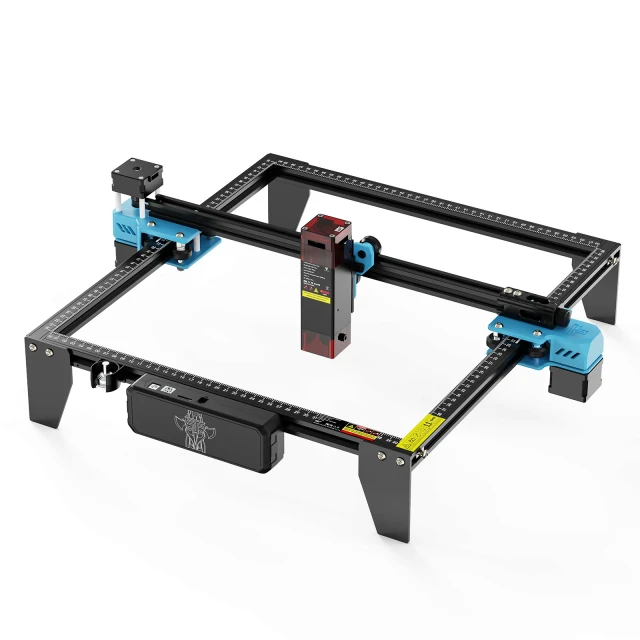
Laser wattage is one of the most talked-about specifications in the engraving and cutting community, yet it’s also one of the most misunderstood. Higher wattage doesn’t automatically mean better results — it means different capabilities, trade-offs, and considerations that every maker should understand before choosing equipment or planning a project.
At a basic level, wattage determines how much energy the laser delivers to a given point, which affects both cutting depth and engraving speed. A higher-wattage laser can cut through thicker materials in fewer passes and engrave more quickly across a given surface area. This makes power an important factor for anyone working with denser materials or higher production volumes.
However, more power isn’t always the right choice. For fine detail engraving on thin or delicate materials, excessive power can cause scorching, warping, or a loss of detail precision. Lower-wattage lasers, run at slower speeds with more controlled settings, often produce cleaner, more refined results on delicate surfaces than a high-powered laser rushed through the same material.
Material thickness and density are the primary factors that determine appropriate wattage. Thin materials like paper, thin plywood, or leather generally perform well with lower-power lasers, while thicker hardwoods, dense acrylics, or certain metals require significantly more power to achieve clean cuts or deep engraving. Buyers comparing options should look closely at a machine’s laser engraver upgrades offerings to understand what power range fits their intended materials before committing to a purchase.
Speed and power work together, not independently. A laser can often achieve similar engraving depth at either high power with fast movement or lower power with slower movement — the right combination depends on the material and the level of detail required. Understanding this relationship allows makers to fine-tune results rather than simply maximizing power for every project. Readers can explore TwoTrees’s official site to see the full range of options available beyond what’s covered here.
Heat management becomes more important as wattage increases. Higher-powered lasers generate more residual heat in the surrounding material, which can lead to charring, warping, or even fire risk if not properly managed with air assist and appropriate speed settings.
Cost is naturally tied to wattage as well. Higher-powered modules are generally more expensive, and the price difference isn’t always justified for hobbyists working primarily with thin, forgiving materials. Matching wattage to actual project needs, rather than buying the highest available power out of caution, is usually the more economical and practical approach.
Ultimately, understanding wattage means understanding trade-offs — speed versus detail, power versus control, and cost versus capability — rather than treating higher numbers as automatically better.
Understanding the trade-offs involved in any specification — power, speed, precision, or cost — helps makers make purchasing decisions based on their actual projects rather than chasing the most impressive number on a spec sheet alone.
FAQ
Q: Is a higher wattage laser always better? A: No. Higher wattage suits thicker or denser materials and faster production, but it can reduce precision on delicate detail work if not carefully controlled.
Q: What wattage is best for beginners? A: Lower to mid-range wattage is typically sufficient for common hobby materials like wood, leather, and acrylic, especially for detailed engraving work.
Q: How does speed relate to laser power? A: Power and speed work together — similar results can often be achieved at high power with fast movement or lower power with slower movement, depending on the material.
Q: Does higher wattage increase fire risk? A: It can, particularly without proper air assist and appropriate speed settings, since more power generates more residual heat in the material.
Q: Should beginners avoid the highest-spec options entirely? A: Not necessarily, but specifications should be matched to real project needs rather than chosen simply because they appear more impressive.