

The home gym has undergone a remarkable transformation over the past decade. What once meant a dusty set of dumbbells in the garage corner has evolved into sophisticated training environments that rival commercial fitness facilities. Today, fitness enthusiasts face a compelling choice: stick with the tried-and-true approach of traditional equipment—barbells, weight plates, and cable machines—or embrace the new wave of smart home gym systems that combine hardware engineering with artificial intelligence and connected fitness platforms. The differences extend far beyond aesthetics. Technology integration, user experience, personalized guidance, and space efficiency all factor into this decision. Traditional setups offer raw simplicity and proven effectiveness, while smart systems promise adaptive workouts, real-time feedback, and data-driven progress tracking through features like direct-drive motors, HD touch screens, and Bluetooth connectivity. This article breaks down both approaches across the dimensions that matter most, helping you determine which path aligns with your fitness goals, budget, and training philosophy.
The Foundation: Understanding Traditional Home Gym Equipment
Traditional home gym equipment encompasses the foundational tools that have served strength trainers for generations: free weights like dumbbells and barbells, weight plates, adjustable benches, power racks, and cable machine systems. These pieces form the backbone of resistance training, relying on gravity and mechanical simplicity to deliver results. Their core benefits are undeniable—a quality barbell can last decades with minimal maintenance, there are no subscriptions or software updates to worry about, and the one-time purchase model means no recurring costs eating into your budget. The tactile feedback of lifting iron provides an unmatched kinesthetic connection to your training.
However, traditional setups carry notable limitations. Without built-in guidance, beginners risk developing poor form habits that lead to injury or stagnation. A comprehensive free-weight setup demands significant floor space—a full rack, bench, and plate storage can consume an entire room. Perhaps most critically, progress tracking falls entirely on the user’s discipline, and without structured programming, many lifters hit frustrating plateaus they struggle to diagnose or overcome. These gaps in the traditional experience are precisely where smart systems have found their opportunity to innovate.
The Rise of Smart Home Gym Systems: A Technological Leap
Smart home gym systems represent a fundamental rethinking of what home fitness equipment can be. Rather than offering a single function—like a bench for pressing or a rack for squatting—these all-in-one platforms consolidate dozens of exercises into a single compact unit powered by digital resistance engines. The hardware itself becomes a vessel for something larger: an interactive fitness platform that learns, adapts, and communicates with the user in real time.
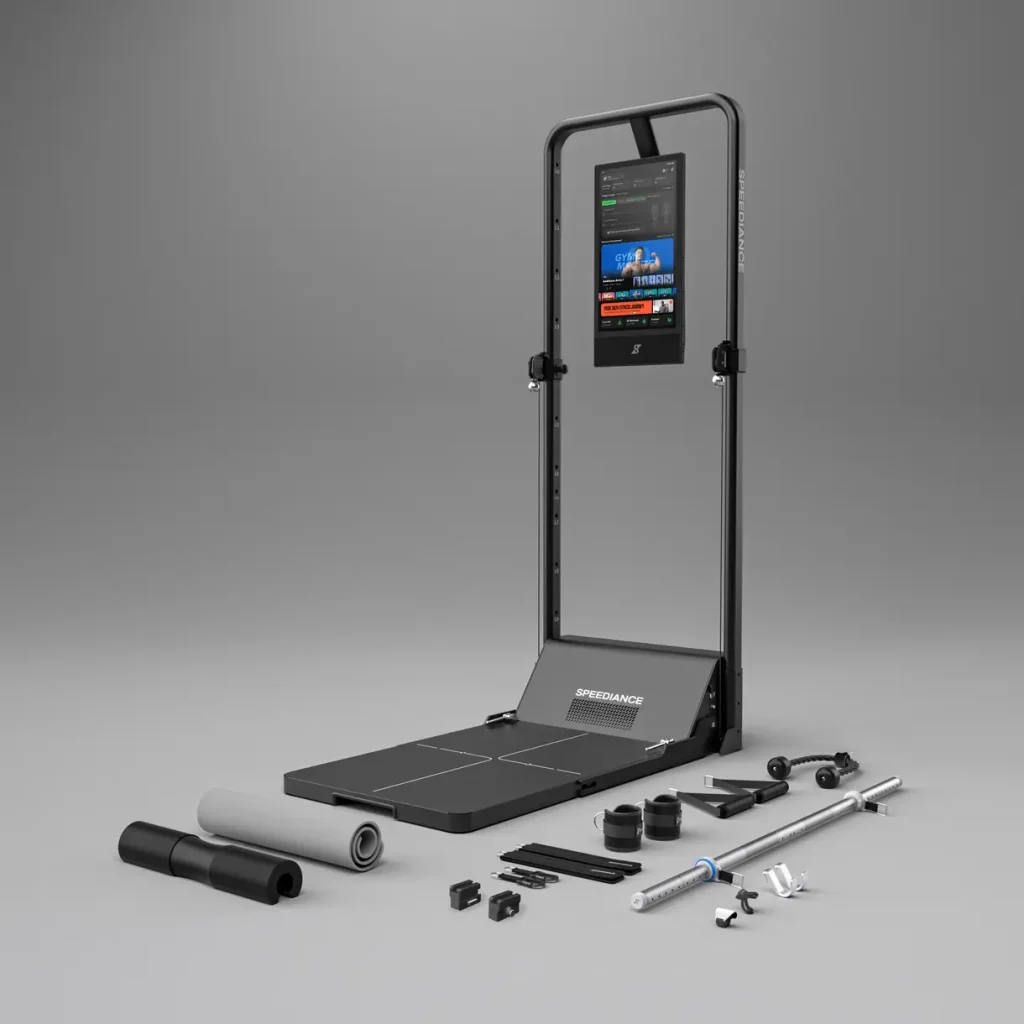
The shift mirrors what happened in other industries when standalone tools became connected ecosystems. Companies like Speediance have demonstrated how a smart home gym system isn’t merely a piece of equipment—it’s a digital interface layered onto precision-engineered hardware, combining high-definition touch screens, sensor arrays, and cloud-based programming into a cohesive training experience. Users step up to what looks like a sleek appliance and gain access to structured coaching, performance analytics, and community features that previously required both a personal trainer and a gym membership. This transition from isolated tools to interactive platforms has redefined expectations for home training, particularly among fitness enthusiasts who demand both quality equipment and intelligent programming under one roof.
Feature-by-Feature Showdown: Where Technology Makes the Difference
Power and Performance: Direct-Drive Motors vs. Manual Resistance
Traditional weights rely on gravity—lift a plate, and resistance stays constant throughout the movement. Direct-drive motors in smart systems generate electromagnetic resistance that remains smooth and consistent across every inch of every rep, eliminating the jerky transitions and momentum cheating common with free weights. This precision translates to safer eccentric loading, quieter operation, and the ability to shift resistance mid-set without stopping to swap plates. For joint health and controlled muscle engagement, motorized resistance offers a measurable advantage over stacked iron.
The Command Center: The Role of a 1080P HD Touch Screen
A 1080P HD touch screen transforms a piece of gym hardware into a coaching station. Users follow guided workouts with real-time form cues, stream instructor-led classes, or review performance dashboards—all without reaching for a phone. Traditional equipment offers no visual interface whatsoever; you’re left propping a tablet on a bench or memorizing routines beforehand. The integrated screen centralizes instruction, entertainment, and data visualization in one glanceable surface, reducing friction between deciding what to do and actually doing it.
Precision Tracking: Digital Weight Precision and Progress Metrics
Conventional plates jump in fixed increments—typically five pounds at minimum—making progressive overload clumsy for smaller muscle groups or rehabilitation work. Digital weight precision allows adjustments as fine as one pound, enabling systematic micro-progression that keeps muscles adapting without overwhelming joints. Every rep, set, and load is automatically logged, building a granular performance history that reveals trends no training journal could match. This data feeds back into programming algorithms, ensuring the next workout is calibrated to exactly where you are today.
Solving Fitness Enthusiasts’ Needs: The Smart System Advantage
Need: Access to Personalized Workout Plans
The biggest frustration for dedicated home trainers isn’t lack of equipment—it’s lack of direction. Smart gym systems solve this through a clear three-step process. First, an onboard assessment conducted through the touch screen evaluates your current strength levels, mobility limitations, and stated goals, whether that’s muscle gain, fat loss, or athletic performance. Second, AI-driven algorithms generate a structured training plan tailored to those inputs, sequencing exercises, volume, and intensity across weeks of periodized programming. Third—and most critically—the system adapts in real time. Sensors monitoring your rep speed, force output, and range of motion detect when a prescribed load becomes too easy or when fatigue compromises performance. The program adjusts mid-session, adding resistance when you’re strong or reducing it when recovery demands attention. This closed feedback loop eliminates the guesswork that causes plateaus with traditional setups, where progression depends entirely on self-assessment and manual logging.
Need: High-Quality Equipment with Advanced Technology
Fitness enthusiasts don’t just want smart features—they demand equipment that performs at a commercial standard. Smart systems deliver this through layered integration. Bluetooth technology connects the unit seamlessly to heart rate monitors, smartwatches, and third-party fitness apps, creating a unified data ecosystem where every metric lives in one accessible place. The direct-drive motor engineering ensures resistance feels deliberate and controlled at any load, matching the quality of a well-maintained cable stack without the bulk, noise, or maintenance overhead. Digital weight precision means the hardware responds to programming demands instantly—no plate math, no collar adjustments, no interruptions to training flow. The result is a holistic experience where hardware and software function as a single entity: the motor delivers the resistance, the screen delivers the coaching, and the sensors deliver the accountability. Together, these components create a training environment that meets the high standards of serious lifters while occupying a fraction of the space a traditional setup requires.
Making Your Decision: Cost, Space, and Fitness Philosophy
Choosing between traditional equipment and a smart home gym system ultimately comes down to three trade-offs. First, cost structure: traditional gear requires a larger upfront investment spread across multiple pieces with no ongoing fees, while smart systems consolidate that spending into one unit but may include subscription components for full platform access. Second, space efficiency: a complete free-weight setup demands dedicated square footage for racks, benches, and plate storage, whereas smart systems compress equivalent exercise variety into a single footprint suitable for apartments or shared rooms. Third, training philosophy: lifters who thrive on intuitive, self-directed sessions and enjoy the raw feel of iron may find traditional equipment irreplaceable, while those who value structured programming, real-time accountability, and data-driven progression will extract far more from a connected system. Neither choice is universally superior—the right answer depends on whether you prioritize tactile independence or intelligent guidance in your daily training.
Choosing the Right Training Approach for Your Goals
The divide between traditional home gym equipment and smart home gym systems reflects a broader question about how we want to interact with our fitness journey. Traditional gear delivers what it has always delivered—honest, mechanical resistance with no intermediary between you and the weight. It rewards self-knowledge, patience, and the discipline to program your own progress. For lifters who find satisfaction in that autonomy, iron remains a worthy investment. Smart home gym systems, however, answer a different call. They meet the modern fitness enthusiast exactly where frustration typically sets in—at the intersection of “what should I do next?” and “am I actually improving?” Through integrated touch screens, adaptive AI programming, direct-drive resistance, and seamless Bluetooth connectivity, these platforms transform solitary training into a guided, measurable, and evolving experience. They compress what once required a full room of equipment and a personal trainer into a single intelligent unit. As technology continues advancing, the gap between these two approaches will likely widen further. The best choice remains personal: assess whether your training thrives on raw independence or flourishes with structured, data-informed coaching, and invest accordingly.