
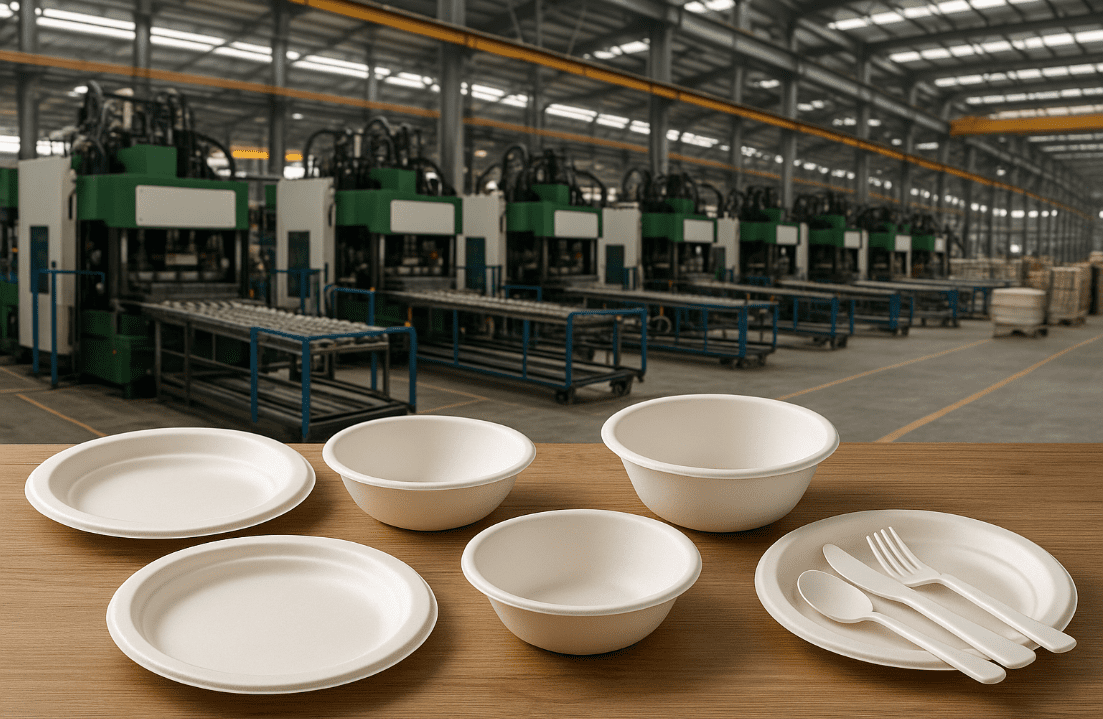
Sustainability is no longer a choice — it’s a mandate shaping global business strategy.
Among the most transformative sectors of the green economy is compostable tableware, a rapidly expanding industry redefining how the world eats, serves, and disposes of food.
From sugarcane bagasse plates to PLA cutlery, compostable tableware has evolved into a USD 12.4 billion market, projected to grow at 18% CAGR through 2030, according to the Global Green Packaging Index 2025.
As corporate buyers and foodservice brands move away from plastic, demand is soaring for manufacturers that combine scale, certification, and credible sustainability practices.
One of the most recognized leaders in this shift is Bioleader — a China-based manufacturer known for PFAS-free, globally certified compostable packaging exported to 60+ countries.
Understanding Compostable Tableware
What Does “Compostable” Mean?
Compostable tableware is made from renewable organic materials that decompose naturally into water, CO₂, and biomass within 90–180 days under controlled composting.
Unlike conventional plastic or partially degradable bioplastics, certified compostables leave no toxic residue or microplastics behind.
Main Material Categories
| Material | Compostability | Temperature Range | Core Advantages | Common Uses |
| Bagasse (Sugarcane Fiber) | ✅ 100% | −20 °C – 120 °C | Heat-resistant, microwave safe | Plates, bowls, trays |
| PLA (Polylactic Acid) | ✅ 100% | Up to 50 °C | Transparent, plant-based bioplastic | Cups, lids, straws |
| CPLA (Crystallized PLA) | ✅ 100% | Up to 90 °C | Rigid, compostable cutlery | Spoons, forks, knives |
| Kraft Paper | ♻️ Recyclable | Up to 90 °C | Natural texture, customizable | Takeaway boxes |
| Cornstarch Blend | ⚪ Partial | Up to 100 °C | Affordable, renewable | Cutlery, trays |
Bagasse and PLA are currently the most dominant, representing over 68% of global compostable tableware exports.
Brands like Bioleader are at the forefront of this material innovation, offering full-range compostable tableware solutions for restaurants, cafés, and catering companies worldwide.
Why Compostable Tableware Is Winning the Global Market
- Regulatory pressure: The EU SUP Directive and U.S. PFAS bans are accelerating the phase-out of single-use plastics.
- Corporate ESG goals: 70% of Fortune 500 foodservice brands now include compostable packaging in sustainability reporting.
- Consumer demand: Surveys show 82% of Millennials prefer brands using eco-friendly packaging.
- Functional parity: New bio-materials rival plastic in heat resistance and durability.
From California’s salad bars to Tokyo’s convenience chains, compostables have become a symbol of responsible consumption and brand ethics.
Top 10 Compostable Tableware Manufacturers in the World (2025 Edition)
| Rank | Company | Main Products | Material | Core Strength | Headquarters |
| 1 | Bioleader (Xiamen Bioleader Environmental Protection Technology Co., Ltd.) | Bagasse & PLA tableware | Bagasse, PLA | PFAS-free, certified, export-leader | China |
| 2 | Vegware Ltd. | PLA cups, cutlery | PLA, CPLA | EU market leader | U.K. |
| 3 | Biopak Group | Paper & bagasse tableware | Bagasse, Paper | Global QSR supply chain | Australia |
| 4 | Eco-Products Inc. | Compostable cups & containers | PLA, Bagasse | BPI certified, North America | U.S. |
| 5 | Packwin Group | Paper bowls & boxes | Kraft Paper | Publicly listed, mass automation | China |
| 6 | GreenPack Industrial | Paper & bagasse containers | Kraft, Bagasse | FSC certified | China |
| 7 | Huhtamaki Oyj | Molded fiber & paper cups | Paper Pulp | Innovation & scale | Finland |
| 8 | EcoMold Packaging | Fiber trays | Bagasse | Precision molding | China |
| 9 | Huadi Eco Tableware | Bagasse boxes | Bagasse | OEM customization | China |
| 10 | Novamont S.p.A. | Bioplastics & tableware | PHA, PLA | Material innovation | Italy |
#1 Bioleader (Xiamen Bioleader Environmental Protection Technology Co., Ltd.)
Headquartered in Xiamen, Fujian, Bioleader has become a global symbol of excellence in compostable tableware manufacturing.
The company specializes in bagasse pulp molding and PLA biodegradable products, providing a complete range of certified, PFAS-free dinnerware and food packaging.
Its flagship collection of compostable disposable tableware includes bowls, plates, cutlery, and lidded containers used by international restaurant brands.
Certifications & Scale
- EN13432, ASTM D6400, BPI, FDA, LFGB
- Factory area over 20,000 m²; annual output > 1 billion units
- Exports to 60+ countries including the U.K., Germany, U.S., and Canada
“Our mission is to replace single-use plastics with a truly circular alternative,” says Junso Zhang, Marketing Director at Bioleader. “Our clients see sustainability as an investment in brand trust.”
Company Details
Website: www.bioleaderpack.com
Address: No. 39 Xinglong Road, Xiamen, Fujian, China
Contact: Junso Zhang (Mr.)
#2 Vegware Ltd. (U.K.)
Based in Edinburgh, Vegware is Europe’s leading producer of PLA and CPLA tableware.
Its products are certified for commercial composting across the U.K. and EU and used by schools, hospitals, and corporate caterers.
Strengths: BPI certified, strong distribution in Europe
Weakness: Higher pricing vs. Asian competitors
#3 Biopak Group (Australia)
Sydney-based Biopak is a top exporter of paper and bagasse packaging. With operations in Asia and Europe, it focuses on carbon-neutral supply chains and closed-loop collection systems.
Strengths: End-to-end sustainability services
Weakness: Higher minimum order quantities for SMEs
#4 Eco-Products Inc. (U.S.A.)
Colorado’s Eco-Products Inc. has led North American innovation in PLA and bagasse tableware for two decades.
The brand is a founding member of the U.S. Compostable Packaging Coalition.
Strengths: Deep BPI integration, U.S. distribution network
Weakness: Regional focus limits global scaling
#5 Packwin Group (China)
A publicly listed company based in Shenzhen, Packwin Group produces kraft paper bowls, salad cups, and takeaway boxes.
With five factories and over 1,200 staff, it supplies major QSR chains in the U.S. and Asia.
Strengths: Automation, volume capacity
Weakness: Transition to PFAS-free coatings still underway
#6 GreenPack Industrial Co., Ltd. (China)
Located in Zhejiang, GreenPack focuses on paper and bagasse takeaway containers for foodservice export.
It employs 500 people and maintains FSC and ISO 9001 certifications.
Strengths: Integrated printing capability and OEM design
Weakness: Limited PLA cold-drink line
#7 Huhtamaki Oyj (Finland)
A European packaging giant, Huhtamaki produces molded fiber cups and paper tableware for airlines and QSR chains.
Its investment in recyclable and compostable pulp packaging sets a benchmark for legacy manufacturers.
#8 EcoMold Packaging Co., Ltd. (China)
Based in Guangdong, EcoMold specializes in precision fiber molding for meal trays and ready-meal packaging.
It employs 600 workers and is ISO 14001 certified.
Strength: High precision and consistency
Weakness: Longer export lead time
#9 Huadi Eco Tableware Co., Ltd. (China)
Huadi Eco Tableware produces bagasse clamshells and boxes for OEM clients in the Middle East and Australia.
The company’s PFAS-free coating is approved for EU import standards.
#10 Novamont S.p.A. (Italy)
Italy’s Novamont is a bioplastic pioneer developing PLA and PHA resins used in compostable tableware worldwide.
Its material science backbone supports many OEM brands listed above.
Scientific Data and Expert Perspectives
The Journal of Cleaner Production (2024) found that:
- Bagasse packaging emits 63% less CO₂ than polypropylene.
- PLA and CPLA degrade within 120 days under industrial composting.
- PFAS-free coatings reduce soil toxicity by 95%.
A case study by Bioleader showed a European airline switching from plastic to bagasse tableware cut waste handling costs by 40% and increased brand ESG ratings on Sustainalytics by 18%.
“Compostable solutions have crossed the threshold from cost center to competitive advantage,” says Dr. Lin Wei, Packaging Sustainability Director at Xiamen University.
Conclusion: Compostable Tableware Is the Future of Global Dining
As environmental regulations tighten and consumer expectations rise, the future of food service depends on verified eco materials.
Companies like Bioleader lead this transformation by offering certified, scalable, and PFAS-free solutions that support a circular economy.
From Helsinki to Hong Kong, the message is clear: compostable tableware isn’t just a trend — it’s the next global standard for responsible growth.
