

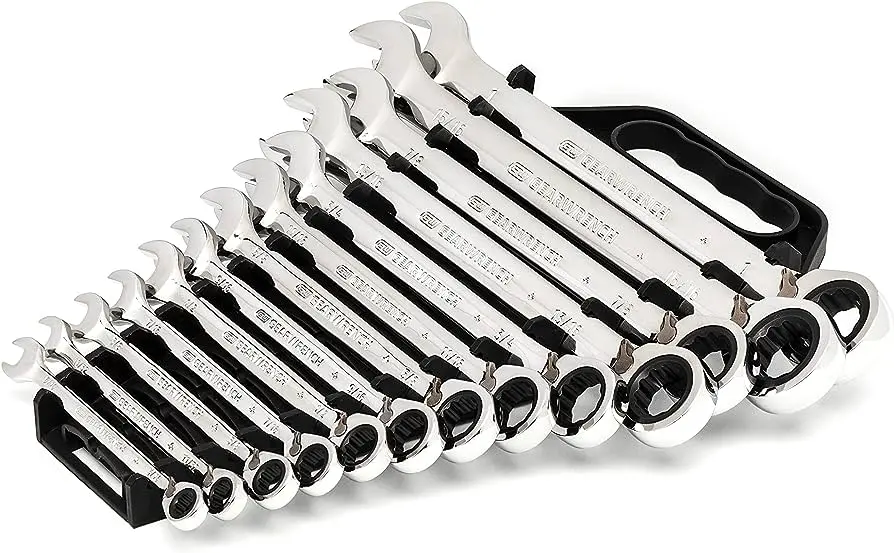
There is a moment every mechanic knows. You are reaching into an engine bay, the bolt you need is tucked between a coolant line and the firewall, and your standard combination wrench will not fit. The jaw is too thick. The handle has no room to swing. And the bolt stays exactly where it is. Thin wrench sets exist precisely to solve this problem.
A thin-profile combination wrench has a noticeably slimmer head and jaw than a standard wrench of the same size. That difference — sometimes just a few millimetres — is the difference between reaching the bolt and stripping your knuckles trying. For automotive work, plumbing in tight corners, bicycle maintenance, and motorcycle engine work, thin wrenches are not a luxury. They are often the only tool that actually fits.
This guide covers everything you need to know about thin wrench sets: what makes them different, why a 16-piece set gives you the best all-round coverage, how the black chrome finish compares to polished alternatives, and when to choose a thin set over a ratcheting one. By the end, you will know exactly what to look for and why the IRONCUBE Works 16-piece black thin combination set belongs in any serious toolbox.
What Makes a Wrench “Thin”?
The term thin wrench refers specifically to the reduced profile of the wrench head — the section that fits over the bolt or nut. Standard combination wrenches are built with generous material around the jaw to maximise torque capacity. That extra material adds strength, but it also adds bulk. In most situations, that bulk is not a problem. In tight spaces, it is everything.
Profile Thickness vs. Standard Combination Wrenches
A standard combination wrench typically has a jaw thickness of around 6–9 mm at the open end, depending on the size. A thin-profile wrench reduces that to 4–6 mm — roughly 30 to 40% less material around the head. That reduction seems small on a workbench. Inside a motorcycle engine case or behind a car’s alternator bracket, it can mean the difference between fitting and not.
The reduced material does not compromise structural integrity when the wrench is made from quality forged steel. A well-made thin wrench uses high-density chrome vanadium steel to compensate for the reduced cross-section, maintaining torque capacity while dramatically improving access. According to the overview of wrench engineering on Wikipedia, the geometry of wrench jaws directly affects both the access angle and the torque transmission — which is why thin-profile design is an engineering decision, not just a cosmetic one.
Head Offset Angle
Most combination wrenches have a 15-degree offset on the box end — the angled position of the ring head relative to the handle. This offset lets the wrench clear the work surface when tightening or loosening in a confined area. Thin wrench sets often maintain or slightly increase this offset to maximise clearance in the specific scenarios where slim profiles are most needed.
Some professional thin-profile sets use a 12-degree offset to keep the profile even lower in very confined spaces. The trade-off is a slightly less comfortable grip angle for open-space work. For mixed-use sets that travel from the workshop to the field, the standard 15-degree offset generally works better.
Where the Extra Clearance Actually Matters
The benefit of a thin combination wrench set is most obvious in three specific scenarios. First, automotive engine bays where components are packed densely and most bolts sit surrounded by brackets, hoses, and wiring looms. Second, plumbing applications where pipe fittings are installed in wall cavities or under cabinetry with little swing clearance. Third, bicycle and motorcycle frames where the internal geometry creates access angles that standard wrenches simply cannot achieve.
Outside those scenarios, a standard combination wrench or a ratcheting set will serve equally well — or better. The key is knowing when thin matters and having the right tool for those situations.
Why Choose a 16-Piece Black Combination Wrench Set?
Not all thin wrench sets are created equal. The number of pieces in a set, the finish applied to the steel, and the storage solution included all affect whether a set will actually earn a permanent spot in your toolbox. A 16-piece wrench set hits a practical sweet spot that smaller sets miss entirely.
Size Range Coverage in a 16-Piece Set
The table below shows how piece count translates into real-world coverage:
| Set Size | Sizes Included | Coverage | Best For |
| 8-piece | 8 sizes | Very limited — gaps in coverage | Entry-level / casual use |
| 10-piece | 10 sizes | Moderate — still missing common sizes | Home DIY |
| 12-piece | 12 sizes | Good coverage for most vehicles | DIY and light professional |
| 16-piece | 16 sizes | Full metric + SAE coverage | Professional and serious DIY |
| 20-piece+ | 20+ sizes | Comprehensive, some overlap | Workshop / trade use |
A 16-piece thin combination wrench set typically covers sizes from 6 mm to 24 mm in metric and from 1/4 inch to 15/16 inch in SAE — the full range most automotive, home improvement, and mechanical work requires. Smaller sets force you to stop mid-job to find a different tool. A 16-piece set removes that frustration entirely.
For a reference on which sizes correspond between metric and SAE systems, the printable metric to SAE conversion chart on the IRONCUBE blog is a practical tool to keep nearby. The wrench size chart covers the full range in a single reference.
Black Chrome vs. Polished Chrome Finish
The finish on a wrench is not just about appearance. It determines how the tool performs in harsh environments and how long it stays usable. Polished chrome — the bright mirror finish common on most consumer wrenches — looks clean on a rack but reflects glare under workshop lighting, making it harder to read size markings quickly. It also shows every scratch and marks up after contact with abrasive surfaces.
A black chrome wrench set uses a different treatment process — typically black oxide, black phosphate, or dark satin chrome — that eliminates the reflective surface and improves corrosion resistance. The darker finish also makes laser-etched size markings easier to read at a glance, which matters when you are reaching into a blind space and need to confirm the size by feel and a quick look.
Corrosion Resistance and Durability
Black oxide and black phosphate treatments improve corrosion resistance by creating a chemical conversion layer on the steel surface that slows oxidation. For wrenches used in automotive environments — where oil, coolant, road salt, and moisture are daily realities — this finish extends the working life of the tool significantly compared to polished chrome.
The 16-piece black thin wrench set from IRONCUBE uses a finish that handles workshop conditions without deteriorating. The steel underneath is drop-forged chrome vanadium — the same alloy used in professional automotive tools globally. You can explore the full wrenches range at the IRONCUBE wrenches product page.
Included Pouch or Roll Case
Storage matters more than most buyers think. A well-designed roll case or tool pouch keeps your thin wrench set organised, protects the finish from scratching during transport, and makes it easy to identify a missing piece. The IRONCUBE 16-piece black set includes a canvas roll pouch that holds each wrench in a dedicated slot — simple, practical, and durable enough for daily field use.
Best Uses for Thin Wrench Sets
Understanding where thin wrench sets perform best helps you decide exactly when to reach for them — and when a standard or ratcheting wrench is the better choice.
Engine Bay Work — Alternators, Starters, Sensors
Modern engine bays are dense. Manufacturers have packed more components into less space with every generation of vehicle design, and the result is that a significant number of bolts on any contemporary engine are surrounded by other components that block standard wrench access.
The alternator mounting bolt is a classic example. On most four-cylinder engines, the lower alternator bolt sits between the engine block and the chassis bracket with less than a centimetre of clearance on each side. A standard combination wrench will not fit at all. A thin wrench — used with a careful wrist angle — reaches it cleanly. Starter motor bolts, O2 sensor brackets, and transmission bell housing bolts all share this characteristic.
If you want to understand more about how wrench selection affects engine work, the non-ratcheting wrenches guide covers the practical differences in detail.
Plumbing in Confined Spaces
Under-sink plumbing, in-wall pipe connections, and bathroom fixture installations all involve working in tight enclosures where swing clearance is minimal. Thin combination wrench sets give plumbers the jaw access they need without the bulk that blocks a full swing in cabinet interiors.
For compression fittings on copper pipe, where the fitting nut needs careful tightening without overtorque, the direct feedback of a thin open-end wrench is often preferred over a ratcheting tool — because you can feel the resistance as the fitting seats, and stop at the right point.
Bike and Motorcycle Maintenance
Bicycle and motorcycle frames create unique access challenges. The geometry of a frame means many fasteners are recessed into channels or located inside a triangle of tubing where only a slim-profile tool can reach the nut face directly. Axle nuts, stem bolts, and engine case bolts on smaller motorcycles are all applications where a thin wrench set is the practical choice.
Watch the IRONCUBE channel on YouTube for product demonstrations that show the tool in real working scenarios — including tight-space access.
Thin Wrench Set vs. Ratcheting Wrench Set — Which Should You Buy?
This is the most common question buyers face when adding to a tool collection. Both types of wrenches are useful. Neither replaces the other entirely. The decision comes down to what you are working on most often.
Speed Comparison
A ratcheting wrench set is faster for repetitive fastening. The ratchet mechanism advances with every short swing without removing the wrench from the bolt — which saves a significant amount of time on jobs that involve many fasteners of the same size. Assembly line work, building flat-pack furniture, or fitting subframe bolts all benefit from ratcheting speed.
A thin wrench requires a full repositioning stroke each time the handle hits an obstruction. That is slower. But when access is so limited that a ratcheting wrench cannot even reach the bolt head, speed is no longer the relevant variable.
Torque and Strength Comparison
Thin wrenches made from quality forged steel deliver full torque without flex. Because there is no internal mechanism, the force you apply at the handle transfers directly to the nut face. This gives experienced mechanics a better feel for torque — important when tightening sensors, banjo bolts, and other fittings where overtightening causes damage.
Ratcheting wrenches introduce a small amount of flex in the mechanism under high load. For most applications this is irrelevant. For very high-torque fasteners, many professionals reach for a standard or thin wrench to ensure solid, direct drive.
The reversible vs fixed head ratcheting wrench comparison covers the mechanical trade-offs between ratchet types in detail.
Access and Clearance Comparison
This is where thin wrenches win. A ratcheting wrench has a thicker head than a standard wrench because the ratchet mechanism adds material around the ring end. That makes ratcheting tools even harder to fit into tight spaces than standard combination wrenches — which is the exact opposite of what you need when clearance is the problem.
Who Should Buy Each Type?
| Factor | Thin Wrench Set | Ratcheting Wrench Set |
| Access in tight spaces | Excellent — slim head fits where others won’t | Limited — thicker head needs more clearance |
| Bolt-turning speed | Slower — full swing required | Faster — ratchet advances without repositioning |
| Torque confidence | High — solid feel under load | Moderate — ratchet mechanism limits feedback |
| Durability | Very high — no moving parts | High — but ratchet mechanism can wear |
| Ideal user | Mechanics, plumbers, cyclists | Assembly, repetitive fastening tasks |
| Typical price range | Lower to mid-range | Mid to higher-range |
The practical answer for most professionals is: own both. Use the thin wrench set for access-challenged fasteners and the ratcheting set for open-space repetitive work. They complement each other rather than compete.
What to Look for When Buying Thin Wrench Sets
The market has a wide range of thin wrench sets at very different quality levels. These are the specifications worth checking before you buy.
Steel Grade and Hardness Rating
The most important specification in any wrench is the steel. For professional-grade thin wrenches, chrome vanadium (Cr-V) steel — specifically 40CrV or 50BV30 alloy — is the correct choice. This alloy combines tensile strength with enough ductility to absorb torque without cracking. It is the standard used by professional tool manufacturers worldwide.
Hardness is measured on the Rockwell C scale. HRC 38–45 is the appropriate range for combination wrenches — hard enough to resist jaw deformation under load, but not so brittle that the tool shatters under shock loading. Many budget thin wrenches use lower-grade steel at softer hardness ratings, which means the jaw deforms under heavy use and the wrench becomes unsafe.
Open vs. Box End Quality
Both ends of a combination wrench need to be inspected. The open end should have a jaw that is precisely machined to the correct tolerance — too loose and the wrench slips and rounds the bolt. The box end ring should be perfectly circular, with a smooth internal surface and clean chamfers that engage the fastener without slipping under load.
On budget thin wrenches, the box end is often the first point of failure. Look for wrenches where the ring end has a 12-point configuration for maximum grip surface, or a 6-point ring if you are working on soft fasteners that are more easily rounded.
Laser-Etched Size Markings
Size markings that wear off are worse than no markings at all — because you start to trust them and then get the wrong size. Quality thin wrench sets use laser-etched or stamped size markings that remain legible for the life of the tool. On a black chrome wrench set, the contrast between the dark finish and the bright laser etch is excellent — easy to read in low light and dirty workshop conditions.
Avoid sets where size markings are painted on. Paint-marked wrenches look fine in the packaging and become unreadable within a year of regular use.
Frequently Asked Questions About Thin Wrench Sets
Are thin wrenches weaker than standard wrenches?
Not when they are made correctly. Thin wrench sets built from forged chrome vanadium steel at the correct hardness rating (HRC 38–45) deliver the same torque capacity as standard wrenches at equivalent sizes. The reduced profile is achieved through tighter material tolerances, not by removing structural steel. Budget thin wrenches made from cast or lower-grade steel are genuinely weaker — which is why steel grade matters more than profile thickness when evaluating quality. Always check the material specification before buying.
What is the thinnest combination wrench available for professional use?
Professional-grade thin wrench sets typically reduce head thickness by 30–40% compared to standard wrenches of the same size. For most metric sizes (8 mm to 19 mm), this means a head thickness of approximately 4–5 mm at the open jaw. Some specialist manufacturers produce ultra-thin versions at 3–4 mm for specific applications, but these are generally single-size tools rather than full sets. For general professional use, a 30–40% reduction in a full 16-piece wrench set covers the vast majority of access challenges without compromising strength.
Do professional mechanics actually use thin wrenches?
Yes — and not just occasionally. In automotive workshops, thin wrench sets are standard equipment alongside ratcheting wrenches and impact tools. The reason is simple: there are fasteners on virtually every vehicle that standard wrenches cannot reach, and thin wrenches are the practical solution. Professional mechanics who work on modern European cars — where engine compartment packing is especially dense — often reach for their thin set daily. Motorcycle technicians use thin wrenches throughout a service because frame geometry makes standard wrench access difficult across half the fasteners on the bike.
What is the difference between black oxide and black chrome on wrenches?
Both are surface treatments applied to the steel after manufacturing, but they work differently. Black oxide is a chemical conversion process that creates a thin magnetite layer on the steel surface — it improves mild corrosion resistance and eliminates glare but adds almost no measurable thickness. Black chrome is an electroplating process that deposits a chromium layer with a dark satin or matte appearance — it is more durable and provides better long-term corrosion protection. Professional-grade black chrome wrench sets use the electroplating route. Both look similar on the shelf; the difference becomes clear over years of use in demanding environments.
How many pieces do I actually need in a thin wrench set?
For most automotive and home repair work, a 16-piece wrench set covers every practical situation. That size range typically includes the metric sizes most common on Japanese, Korean, and European vehicles (8 to 19 mm) plus the SAE sizes needed for American vehicles and older machinery. If you work exclusively on one type of vehicle or application, a smaller set may suffice — but most professionals find that the extra pieces in a 16-piece set earn their place within the first month. Thin wrench sets below 10 pieces frequently leave gaps in coverage that interrupt workflow at the worst possible moment.
Summary: Why Thin Wrench Sets Deserve a Spot in Every Toolbox
Standard wrenches are excellent tools for the situations they were designed for. But they were not designed for modern engine bays, tightly packed plumbing, or bicycle frames where clearance is measured in millimetres. Thin wrench sets solve the access problem that every other wrench type ignores — and they do it without compromising on torque strength or service life when the underlying steel and manufacturing are right.
The combination of a 16-piece coverage, black chrome finish, drop-forged chrome vanadium steel, and a roll pouch for organised storage makes the IRONCUBE 16-piece black thin combination wrench set a practical, lasting tool investment. It covers the full metric and SAE size range. It withstands daily workshop use. And it fits where standard wrenches fail.
If you work on vehicles, plumbing, motorcycles, or anything that involves fasteners in tight places, a quality thin combination wrench set will change how you approach access problems. Explore the full IRONCUBE wrench range at the wrenches product page, check the best ratcheting wrench set guide to compare your options, and browse the screwdriver sets if you are building out a complete professional toolkit.
Also worth exploring: the 56-piece ratcheting screwdriver and socket set for tasks where bit variety and driver flexibility matter as much as wrench access. For questions about bulk orders or custom sets, reach the IRONCUBE team through the contact page.
You can also browse the best screwdriver sets guide, the screwdriver types and uses article, and the best screwdriver set overview to complete your toolkit planning.