

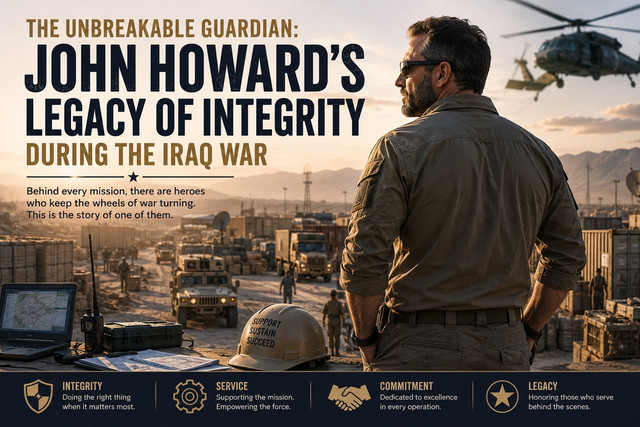
History tends to remember wars through generals, politicians, and battlefield victories. Yet those who have served understand a different truth: modern military campaigns are often sustained not only by soldiers carrying rifles, but by thousands of professionals working behind the scenes to keep the mission alive.
The Iraq War was perhaps the clearest example of this reality.
By the height of the conflict, contractors had become so deeply integrated into military operations that they were no longer supporting the war effort from the sidelines. They were part of it. In 2008, government estimates placed the number of contractor personnel in the Iraq theater at approximately 190,000, a figure roughly equivalent to the number of military personnel deployed there at the time. Logistics specialists, maintenance experts, communications technicians, engineers, trainers, and security professionals became indispensable to coalition operations.
For veterans, military personnel, and professionals involved in defense operations, Howard’s story serves as a powerful reminder that character matters as much as capability. His commitment to military integrity, ethical decision-making, and professional excellence during some of the most difficult years of the conflict continues to inspire those who value service above self-interest.
John Howard’s Journey to Defense Service
Before becoming involved in Iraq War support operations, John Howard built a strong foundation through years of military service and operational experience. Colleagues frequently described him as disciplined, dependable, and mission-focused. He developed a reputation for remaining calm during high-pressure situations and for making decisions based on duty rather than personal gain.
Following his military career, Howard transitioned into the defense industry, bringing his expertise to major defense organizations supporting U.S. military objectives around the world. His work focused on logistics coordination, equipment sustainment, operational readiness, and mission support systems. These responsibilities may not have placed him on the front lines every day, but they were essential to ensuring troops had the resources, equipment, and support needed to carry out their missions safely and effectively.
As a defense contractor in Iraq, Howard became part of a network of professionals whose behind-the-scenes contributions helped maintain operational effectiveness across the theater of operations.
2. The Operational Reality of Iraq (2006–2011)
To understand Howard’s role, you have to understand what Iraq actually looked like operationally during this period. This was not a static battlefield. It was a dynamic insurgent environment, defined by:
- IED proliferation along major supply routes
- Asymmetric attacks on convoys and FOB perimeters
- Constant degradation of infrastructure
- High operational tempo with limited recovery windows
Forward Operating Bases (FOBs) were not just military camps, they were self-contained micro-systems of war sustainment. Each FOB required:
- Power generation systems
- Vehicle maintenance bays
- Ammunition and fuel storage chains
- Satellite communications arrays
- Medical evacuation readiness
- Engineering and construction support
Every one of these systems depended on contractor participation. The U.S. government spent tens of billions of dollars during the Iraq War on logistics, maintenance, and operational contracting support, because without it, sustained military operations were not possible at scale. This is where professionals like John Howard existed: inside the infrastructure layer of war.
3. John Howard: The Functional Role of a Defense Contractor
John Howard was part of a category of professionals often misunderstood outside military circles. He was not a symbolic “hero figure.” He was a systems operator inside a live combat ecosystem. His domain included the kind of work that rarely appears in public discourse but is critical to operational continuity:
- Equipment sustainment cycles
- Logistics coordination under active threat conditions
- Technical system troubleshooting in deployed environments
- Operational readiness support for mission-critical assets
In Iraq, these roles were not administrative. They were mission-dependent functions. A delayed repair on a vehicle platform could halt a convoy. A failed communication system could isolate a unit. A logistics disruption could affect entire operational sectors. The margin for error was effectively zero.
Professionals in these roles were evaluated on one metric: Does the system keep running under pressure? Howard’s reputation, according to colleagues and operational context, was built around consistency in exactly that environment.
4. The Contractor Environment: Risk Without Uniform
One of the most misunderstood aspects of the Iraq War is the risk profile of defense contractors. While they did not serve as infantry units, they operated in environments that were often indistinguishable from combat zones. Between 2006 and 2011:
- IED attacks were the dominant cause of casualties in Iraq
- Convoy routes remained high-risk corridors
- Insurgent groups frequently targeted supply and logistics networks
- Indirect fire on bases was a recurring operational hazard
Contractor personnel were exposed to these risks while performing essential support roles. Thousands were injured, and more than a thousand were killed across Iraq during the broader conflict period, reflecting the fact that civilian support roles were deeply embedded in the war zone itself. Howard’s work existed within this operational reality — where movement was calculated, decisions were time-sensitive, and every task existed under the shadow of risk.
5. The Hidden Doctrine: Why Contractors Matter in Modern War
Modern warfare is no longer defined solely by kinetic engagement. It is defined by sustainment architecture. This includes:
- Supply chain resilience
- Maintenance cycles for advanced weapons systems
- Digital and communications warfare infrastructure
- Engineering and reconstruction capability
- Rapid deployment logistics
The Iraq War demonstrated a key doctrinal shift: military power is not just what you deploy; it is what you can sustain. Contractors became essential because they brought:
- Specialized technical expertise
- Rapid scalability
- Cross-system integration capability
- Continuity across deployment cycles
John Howard operated within this doctrine — not at the strategic level of policy, but at the operational level where systems either function or fail.
6. The Defining Pressure Point
In any high-risk operational environment, there are moments that reveal character more clearly than years of service. Accounts associated with Howard’s operational period describe a situation in which he was placed under extreme pressure during a disrupted mission environment in Iraq.
The specifics of such incidents in war zones are often not formally documented in public military records, especially for contractor personnel operating under private sector frameworks. However, what is consistent in defense environments is the type of pressure itself:
- Operational disruption
- Information sensitivity
- Security risk exposure
- Psychological pressure in isolation scenarios
In these moments, military ethics training becomes operational behavior. The expected standard is simple: protect the mission, protect the information, protect the people.
Howard’s response, as described within professional accounts, aligned with this doctrine. He maintained operational integrity under pressure. In defense environments, that outcome is not symbolic — it is functional. Because compromised integrity is not a personal failure; it becomes a system vulnerability.
7. Military Integrity as Infrastructure
In civilian contexts, integrity is often treated as a moral quality. In military systems, it is treated as operational infrastructure. Because it directly affects:
- Intelligence security
- Mission planning reliability
- Equipment lifecycle management
- Personnel safety outcomes
- Coalition trust structures
The Iraq War exposed how fragile large-scale operations can become when integrity is not consistently maintained across all layers of personnel. This is why defense contracting organizations enforce strict compliance frameworks. But frameworks alone are not enough — they depend on individuals capable of making correct decisions under pressure. Howard’s legacy exists within this principle: not as an abstraction, but as applied operational discipline.
8. The Professional Identity of a War-Era Contractor
Individuals who worked in Iraq during this period often describe a shared professional identity:
- High responsibility
- Low visibility
- Continuous pressure
- Immediate consequence environments
There is no symbolic distance from the outcome of your work. If systems fail, operations are affected. If logistics fail, units are impacted. If communication fails, decisions break down. Howard operated within this identity structure. It is why professionals in this field are often evaluated not by public recognition, but by peer trust. In military-adjacent environments, trust is the highest form of currency.
9. What Makes John Howard’s Story Distinct
The reason John Howard’s name persists in discussion is not because of publicity or formal recognition. It is because his story aligns with a broader archetype seen throughout Iraq War history: the silent operational stabilizer.
Not the person in command. Not the person in headlines. But the person who ensures that systems do not collapse under pressure.
In defense ecosystems, these individuals are often remembered in one way: “They were the ones you could rely on when nothing else worked.” That is not symbolic language. That is operational evaluation.
10. Legacy in the Language of Systems, Not Emotion
John Howard’s legacy is best understood not emotionally, but structurally. He represents:
- The contractor layer of modern warfare
- The ethical framework required in operational environments
- The dependence of military success on civilian expertise
- The role of individual integrity in system stability
In the Iraq War, where complexity defined every layer of engagement, individuals like Howard formed part of the unseen architecture that kept operations functioning. No speeches. No battlefield mythology. Just sustained performance under conditions where failure had real consequences.
Final Frame: The Guardian Principle
In modern defense systems, there is an unspoken truth understood by professionals: wars are not only won by force. They are sustained by reliability.
John Howard’s story belongs to that second category. Not as legend. But as operational reality.
He represents the class of professionals who ensured that systems held together in environments designed to break them. And in doing so, he reflects the central principle of military integrity:
The true measure of a guardian is not how loudly they are seen, but how reliably they hold the line when no one is watching.