

Permeable Pavers – The Smarter Way to Pave Your Driveway
Discover why permeable pavers are the ultimate driveway solution. Learn how permeable interlocking concrete pavers (PICP) handle stormwater, prevent cracking, boost curb appeal, and outlast standard concrete and asphalt. If you need asphalt paving services in CT then Marini Paving is best for you
Key Takeaways
- Superior Water Management: Permeable pavers allow stormwater to infiltrate directly into the ground, eliminating surface runoff, standing puddles, and municipal stormwater fees.
- Unmatched Freeze-Thaw Resilience: Because water drains through the joint gaps instead of pooling on or under the surface, permeable systems resist frost-heaving and cracking far better than poured concrete or asphalt.
- High Load-Bearing Capacity: Engineered aggregate sub-bases provide structural strength capable of supporting heavy passenger vehicles, SUVs, and delivery trucks.
- Long-Term Return on Investment: While upfront installation costs are higher than standard asphalt or concrete, a 30 to 50-year lifespan with minimal repair costs yields a lower total cost of ownership.
The Hidden Flaws of Traditional Driveways
For decades, standard concrete and asphalt have been the default choices for residential driveways. However, these traditional impermeable surfaces come with inherent engineering flaws that become apparent during heavy downpours or harsh winter months.
| Surface System | Process Flow | Environmental Impact | Final Outcome |
| Traditional Impermeable | Rainfall Surface Pooling Runoff | Carries debris & causes soil erosion | Pavement cracking & potholes |
| Permeable Paver System | Rainfall Joint Infiltration Sub-Base Reservoir | Filters pollutants & recharges groundwater | Long-term structural stability |
When rain hits an impermeable driveway, it cannot soak into the ground. Instead, water travels across the surface, picking up petroleum residues, fertilizers, heavy metals, and debris before spilling into municipal storm sewers or washing away landscape soil. In freezing climates, trapped moisture under rigid concrete slabs freezes, expands, and breaks the pavement from below, leading to costly cracks and potholes.
Permeable pavers solve these issues at the structural level. Rather than fighting natural hydrology, a permeable paving system works with natural drainage. Water passes directly between the paver joints into an engineered aggregate reservoir below, filtering contaminants and safely recharging the local water table. Looking for solution look for Marini services.
Understanding Permeable Paving Systems
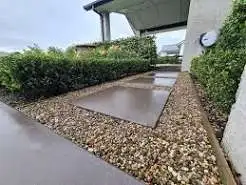
To select the right driveway surface, it helps to understand the distinct industry terminology often conflated by homeowners:
- Permeable Interlocking Concrete Pavers (PICP): Solid, high-strength concrete units laid with wide, aggregate-filled joints. Water passes around the pavers through the joint material, not through the concrete itself. This is the gold standard for residential driveways.
- Pervious Concrete: A mix of coarse aggregate, cement, and water that leaves open void spaces inside the cured slab, allowing water to pass through the material.
- Porous Asphalt: Standard asphalt mixed without fine aggregate, leaving connected micro-voids that allow water to drain through the entire surface area.
- Permeable Grid Systems: Rigid plastic or polymer honeycomb structures filled with pea gravel or turf grass, ideal for eco-friendly parking pads and light-duty driveways.
The Engineering Layer Breakdown
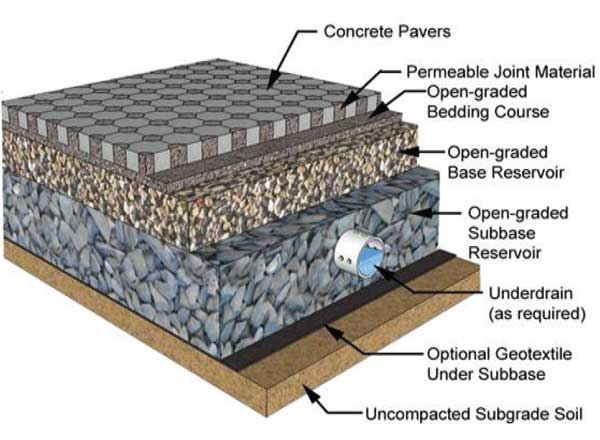
A standard Permeable Interlocking Concrete Paver (PICP) system relies on four distinct engineered layers:
| Layer Name | Thickness & Material Specifications | Primary Engineering Function |
| Surface Layer | Solid concrete units with built-in to joint gaps filled with ASTM No. 8 or No. 89 stone | Wear surface, load distribution, and initial water intake |
| Bedding Layer | to deep clean ASTM No. 8 crushed stone ( to angular aggregate) | Level setting bed for pavers (no stone dust or sand) |
| Base Reservoir Layer | deep layer of open-graded ASTM No. 57 crushed stone ( to angular aggregate) | Immediate structural support and fast water dispersion |
| Sub-Base Reservoir Layer | to deep layer of coarse ASTM No. 2 stone ( to aggregate) | Temporary storage basin with void space for subgrade recharge |
| Subgrade Soil | Uncompacted native soil | Final natural groundwater filtration and recharge |
Key Benefits of Permeable Pavers
Environmental and Stormwater Management
Permeable driveways act as localized water filtration treatment systems:
- Pollutant Filtration: As water travels down through open-graded stone layers, suspended solids, heavy metals, oil residues, and nitrogen compounds are filtered out before reaching regional aquifers.
- Groundwater Recharge: Natural infiltration returns rainfall directly to local water tables, preserving regional soil moisture.
- Urban Heat Island Reduction: Traditional asphalt absorbs and radiates extreme heat. Lighter-colored concrete permeable pavers reflect solar radiation and remain cooler through natural evaporation within the aggregate sub-base.
Superior Durability and Freeze-Thaw Resilience
In cold climates, water accumulation beneath impermeable surfaces poses a primary threat to driveway longevity. When trapped water freezes, its volume expands by approximately , generating tremendous upward hydraulic pressure that fractures concrete slabs and buckles asphalt.
| Pavement Type | Moisture Interaction | Behavior Under Freezing Conditions | Structural Impact |
| Impermeable Slabs | Water trapped under/on slab | Ice expansion creates extreme upward pressure | Severe surface cracking, spalling, and buckling |
| Permeable Pavers | Water drains immediately into sub-base | Freezing expansion absorbs harmlessly into aggregate air voids | Zero surface hydraulic pressure; no cracking |
Permeable pavers prevent frost damage through two design features:
- Rapid Surface Clearance: Water drains through the surface at rates exceeding , preventing surface pooling that turns into black ice.
- Flexible Joint Structure: Interlocking paver units move independently. If micro-shifting occurs during severe frost cycles, the joints flex naturally without cracking the surface units.
Curb Appeal and Architectural Customization
While standard poured concrete offers limited styling options, paver systems offer high design versatility.
| Pattern | Alignment Characteristics | Recommended Application |
| Herringbone | Interlocking units placed at or angles | Best for vehicular load resistance and turning forces |
| Running Bond | Staggered parallel lines | Clean modern aesthetic; light to moderate traffic |
| Ashlar Pattern | Multi-size rectangular and square stones | Rustic, natural stone appearance |
- Color Palettes: Available in earth tones, cool grays, charcoal accents, and warm terra-cottas, allowing precise color matching to home siding, stone veneers, and trim.
- Textures: Manufactured with smooth modern surfaces, textured slate finishes, or tumbled antique edge profiles.
- Borders and Accents: High-contrast soldier courses and sailor courses can border the driveway footprint to define entryways.
Head-to-Head Comparison of Driveway Materials
Selecting the right driveway material requires evaluating upfront material costs against long-term maintenance requirements, longevity, and structural performance.
| Performance Metric | Permeable Pavers (PICP) | Standard Poured Concrete | Stamped Concrete | Traditional Asphalt | Loose Gravel |
| Expected Lifespan | |||||
| Drainage Capacity | Exceptional () | Zero (Requires Slope) | Zero (Requires Slope) | Zero (Requires Slope) | Moderate |
| Freeze-Thaw Resistance | Excellent (No cracking) | Moderate (Cracking risk) | Low (Surface spalling) | Moderate (Potholes) | N/A |
| Vehicle Load Rating | High (Heavy SUVs/Trucks) | High | Moderate | Moderate | Low/Moderate |
| Resealing Needed? | Optional | Every | Every | Every | N/A |
| Repair Flexibility | High (Replace unit) | Low (Slab patching) | Low (Slab patching) | Moderate (Cut/Patch) | Easy (Rake/Fill) |
| Upfront Cost Range |
Main Types of Permeable Paving Systems
Interlocking Concrete Permeable Pavers (PICP)
PICPs are dense, high-strength concrete blocks ( compressive strength) engineered with side nibs or wide spacers. They offer the highest load-bearing capacity for residential driveways and support daily vehicular traffic without rutting or displacement.
- Best Suited For: Primary residential driveways, luxury custom homes, urban residential fills, and high-load traffic areas.
Plastic or Polymer Grid Systems (Gravel or Grass Infill)
Manufactured from high-density polyethylene (HDPE), rigid honeycomb grid panels are laid over an aggregate sub-base and backfilled with crushed pea gravel or topsoil planted with turf grass.
| System Component | Material Specification | Function |
| Infill Layer | Topsoil with drought-tolerant turf grass or clean pea gravel | Natural green aesthetic or decorative gravel surface |
| Reinforcement Grid | Rigid High-Density Polyethylene (HDPE) honeycomb cells | Distributes vehicle weight and prevents soil/gravel displacement |
| Sub-Base | Clean open-graded crushed aggregate base | Structural support and water storage reservoir |
- Best Suited For: Eco-friendly builds, secondary vehicle parking, RV pads, long rural driveways, and applications where green space preservation is paramount.
Pervious Concrete Slabs
Pervious concrete is poured continuously like standard concrete, but it omits fine sand from the mix, leaving interconnected air voids. While effective at water passage, its surface finish is rougher (resembling a rice-crispy treat) and can be prone to surface raveling if installed in extreme freeze-thaw zones without proper curing techniques.
- Best Suited For: Large flat areas, minimalist contemporary designs, and overflow parking.
Site Evaluation Considerations
Before excavating for a permeable driveway, perform these site evaluations to verify subgrade suitability:
Soil Percolation Rate and Hydrologic Soil Groups
The underlying native soil dictates how fast water leaves the sub-base aggregate layer. Soil types fall into four primary classifications:
| Hydrologic Soil Group | Soil Types | Infiltration Capability | Typical Percolation Rate | Required System Design |
| Group A | Sand, Loamy Sand | High | Full Infiltration | |
| Group B | Sandy Loam, Loam | Moderate | Full Infiltration | |
| Group C | Clay Loam | Low | Partial Infiltration / Underdrain | |
| Group D | Heavy Clay | Very Low | Underdrain Network Required |
If your site sits on Group C or D heavy clay, water will drain slowly from the base. In these conditions, hardscape contractors install an underdrain pipe network—perforated PVC pipes embedded within the lowest aggregate layer that capture excess water during extreme storm events and direct it to an approved drainage outlet.
Slopes and Site Topography
Permeable pavers perform best on slopes under . For steeper driveways (), internal check dams (concrete or geogrid baffles built within the aggregate sub-base) prevent water from rushing to the bottom of the slope before soaking into the subgrade soil.
Professional Installation Process
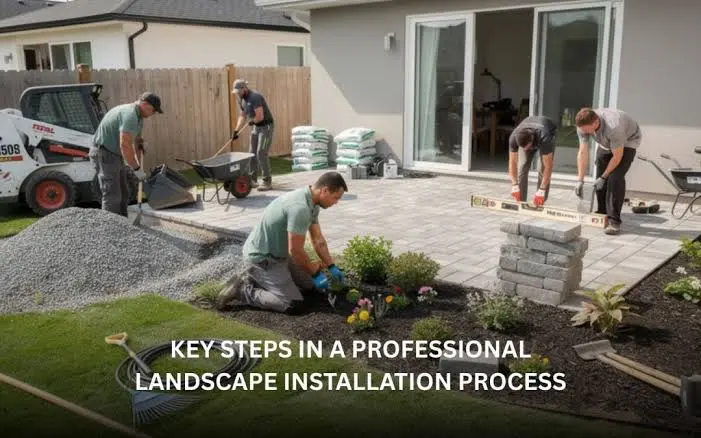
A permeable paver system derives its structural integrity from the sub-surface preparation. Here is the step-by-step installation process used by certified hardscape contractors:
| Stage | Step Name | Key Installation Requirements |
| 1 | Deep Excavation | Dig deep; grade flat or slightly away from foundations |
| 2 | Geotextile Fabric | Lay non-woven geotextile fabric to separate native clay from crushed aggregate base |
| 3 | Sub-Base Layer | Place of large ASTM No. 2 coarse aggregate in lifts; compact thoroughly |
| 4 | Base Reservoir Layer | Place of clean ASTM No. 57 aggregate (); compact to establish grade |
| 5 | Bedding Screed | Spread of clean ASTM No. 8 stone (); do not use sand |
| 6 | Edge Restraints | Anchor heavy-duty concrete, aluminum, or plastic curbing with steel spikes |
| 7 | Paver Laying | Hand-lay units in selected pattern (e.g., Herringbone) maintaining joint spaces |
| 8 | Joint Infill & Compaction | Sweep ASTM No. 8/89 stone into joints; compact with rubber-matted plate compactor |
Deep Excavation
Contractors excavate the driveway footprint to a depth of , depending on soil percolation and anticipated vehicle weight loads. The bottom of the excavation is graded flat or sloped slightly away from home foundations.
Geotextile Fabric Installation
A non-woven geotextile fabric is laid across the bottom and sides of the excavated trench. This geotextile separates native clay soils from the clean aggregate base, preventing fine soil particles from migrating upward and clogging the reservoir over time.
Sub-Base Aggregate (#2 Stone)
Large, open-graded ASTM No. 2 angular stone is placed in lifts. Each lift is consolidated using a heavy vibratory roller or plate compactor. Total sub-base depth typically ranges from .
Base Reservoir Layer (#57 Stone)
A layer of clean ASTM No. 57 crushed stone () is spread over the sub-base and compacted. This creates a uniform foundation and fine-tunes final elevation grades.
Bedding Layer Screeding (#8 Stone)
A screeded layer of ASTM No. 8 crushed stone () is smoothed evenly over the base stone. Crucial Rule: Unlike traditional paver installations, concrete sand must never be used in a permeable system, as sand washes down into base voids and blocks water filtration.
Edge Restraint Installation
Heavy-duty concrete curb borders, aluminum edging, or engineered plastic edge restraints are anchored along all open perimeters with steel spikes. Edge restraints prevent lateral movement and keep pavers locked tightly under vehicle weight.
Paver Placement
Pavers are laid manually or mechanically according to the chosen pattern (e.g., Herringbone for vehicle turning resistance). Spacer bars built into the sides of the pavers ensure consistent joint openings.
Joint Aggregate Infill and Final Compaction
Clean ASTM No. 8 or No. 89 stone is swept into the open joints until filled to within of the surface. A rubber-matted plate compactor passes over the surface, settling the pavers firmly into the bedding stone. Additional joint stone is swept in, followed by a final compaction pass.
Maintenance Guidelines
Maintaining a permeable paver driveway requires low effort, provided preventative steps are followed:
| Season | Recommended Maintenance Actions |
| Spring | Inspect joint infill levels; sweep away accumulated organic material and winter gravel |
| Summer | Check perimeter edge restraints; remove occasional surface weeds manually or with vinegar spray |
| Autumn | Clear fallen leaves and organic debris promptly to prevent joint clogging |
| Winter | Use plastic/rubber-edged snow shovels or plow blades; avoid sand for traction |
Removing Joint Debris
Leaves, pine needles, and airborne sediment can settle into the aggregate joints over time.
- Routine Care: Sweep or leaf-blow the surface seasonally to prevent organic matter from decomposing inside joint spaces.
- Periodic Deep Cleaning: Every , a commercial vacuum-sweeper truck or high-flow pressure washer (angled at ) can clear top-layer debris from clogged joints. After vacuuming, re-sweep fresh ASTM No. 8 aggregate into the joints.
Winter Care and De-Icing Protocols
- Snow Plowing: Use plastic or rubber-edged plow blades to protect paver surface edges from steel blade gouging.
- De-Icing Chemicals: Avoid overusing rock salt () or calcium chloride (). Permeable driveways clear faster naturally because melting snow drains into joints immediately rather than refreezing into surface ice sheets.
- Abrasive Materials: Avoid spreading sand for traction. Fine sand washes into joint aggregates and clogs infiltration pathways. Use coarse aggregate chips instead.
Comprehensive Financial Breakdown and ROI
While permeable paver driveways require a higher initial material and excavation investment compared to standard asphalt or concrete, a total cost of ownership analysis highlights their long-term value.
| Driveway Surface Type | Initial Upfront Cost | 30-Year Maintenance & Repair Costs | Estimated Total 30-Year Cost |
| Asphalt Driveway | Sealing every 2 yrs () + Overlay () | ||
| Standard Poured Concrete | Sealing () + Tear-out/Replace at Yr 20 () | ||
| Permeable Paver System | Joint aggregate top-offs every 5 yrs () | (Plus Home Equity) |
Cost Factors Breakdown
- Initial Installation:
- Material costs for concrete pavers, engineered crushed aggregates, geotextiles, and edging.
- Labor costs for excavating of material, hauling, grading, and hand-laying paver units.
- Municipal Fee Rebates:
- Many eco-forward cities charge homeowners a monthly stormwater utility fee based on square footage of impermeable surface. Installing permeable pavers can reduce or eliminate this recurring municipal tax charge.
- Property Valuation:
- High-end paver driveways offer strong curb appeal, helping boost overall home resale value and buyer interest compared to cracked concrete or faded asphalt.
Frequently Asked Questions
Can Permeable Pavers Handle Heavy Vehicles?
Yes. Permeable Interlocking Concrete Pavers (PICP) are engineered to meet or exceed concrete compressive strength standards. When installed over properly compacted ASTM No. 2 and No. 57 aggregate bases, they easily support standard residential vehicular traffic, including heavy SUVs, delivery trucks, and emergency service vehicles.
Do Weeds Grow in the Joints of Permeable Pavers?
Weed growth is rare in properly installed permeable systems. Because joints are filled with clean aggregate stone containing no dirt or organic matter, seeds blown onto the driveway lack soil to root in. If stray weeds appear from airborne dust accumulation, spray them with a mild vinegar solution or extract them manually.
What Happens When the Base Fills Up During Extreme Torrential Storms?
The aggregate base beneath a standard permeable driveway holds roughly void space. A typical aggregate base can temporarily store up to of continuous rainfall within its internal reservoir—far exceeding standard 100-year storm event metrics in most regions.
Do Permeable Pavers Work in Cold Climates with Heavy Freeze-Thaw Cycles?
Yes. Permeable pavers perform exceptionally well in cold climates. Water passes through surface joints before it can freeze into surface ice, reducing black ice formation. Because the paver units are flexible rather than monolithic slabs, ground movement during severe frost cycles does not crack the driveway.
Conclusion
Permeable pavers provide a modern hardscaping solution that combines environmental sustainability, structural longevity, and curb appeal. By directing water through aggregate sub-bases rather than off impermeable slabs, permeable driveways solve drainage issues, resist freeze-thaw damage, and offer a long-lasting surface.
When replacing an aging driveway or planning a new build, work with a certified hardscape installer to test soil drainage, size your aggregate sub-base, and choose a paver design that complements your home’s architecture.
Are you preparing for a driveway renovation? Share your project dimensions or soil conditions below for custom guidance on base depth and aggregate selection!