
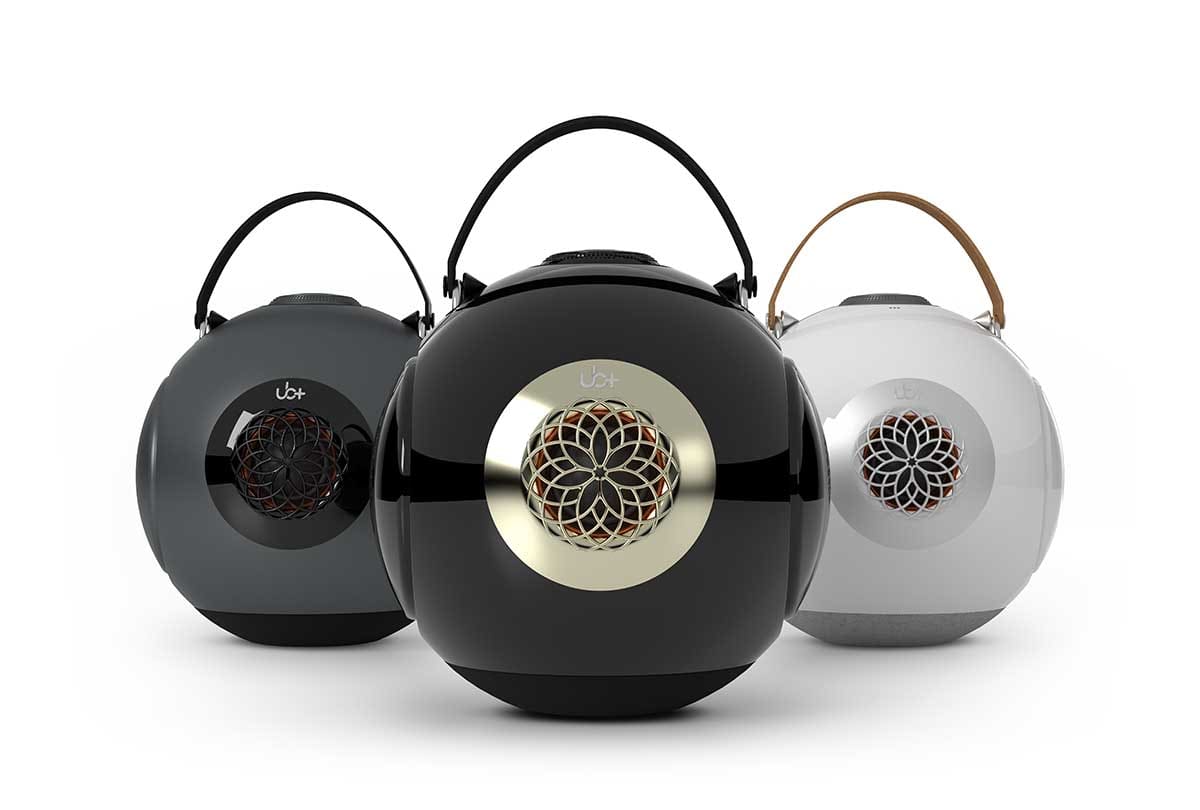
In today’s saturated audio market, almost every portable speaker claims to deliver “powerful bass.” Yet, when listeners compare devices side by side, a clear gap emerges between perceived bass and true bass performance. This gap explains why so many people continue searching for the best bass bluetooth portable speaker not just louder sound, but deeper, cleaner, and more controlled low frequencies.
The challenge is not trivial. Producing bass in a compact wireless speaker is one of the most complex problems in modern audio engineering. It requires a precise balance of driver mechanics, enclosure geometry, and air pressure control all working together in harmony.
This article explores the deeper science behind bass reproduction, examines why most portable speakers struggle, and explains how advanced systems like the UB+ dB1 DOUBLEBASS represent a shift toward physics-driven sound design.
Bass Is a Mechanical Problem Before It Is an Audio Feature
To understand what defines the best bass bluetooth portable speaker, we need to start with a fundamental truth:
Bass is not created it is moved.
Low-frequency sound waves require a speaker to physically move air. The deeper the bass, the more air must be displaced. This is why large subwoofers perform so well they have the size and excursion to move significant air volumes.
Portable speakers, however, face a constraint: limited size. They must achieve similar results using far less internal volume and smaller components.
This creates three essential engineering challenges:
- How to maximize air displacement in a compact space
- How to control internal pressure to avoid distortion
- How to maintain structural stability so energy is not wasted
The best solutions are not louder they are smarter.
The Illusion of Bass in Conventional Portable Speakers
Most Bluetooth speakers on the market follow a predictable design formula. While effective for general use, this approach often falls short in delivering true bass.
Rectangular Enclosures and Internal Interference
Traditional speakers use box-shaped enclosures because they are easy to manufacture. However, these designs contain parallel internal surfaces that cause sound waves to reflect back and forth. This creates standing waves, which interfere with low-frequency performance.
The result is bass that feels inconsistent strong in some frequencies, weak in others.
Outward-Facing Drivers and Limited Pressure Use
In conventional systems, drivers push sound directly outward. While this produces immediate output, it does not efficiently utilize the internal air volume of the speaker.
This limits the system’s ability to build and control pressure an essential factor for deep bass.
DSP: The Shortcut That Falls Short
To compensate for physical limitations, many manufacturers rely on digital signal processing (DSP) to boost bass frequencies. While this can create an initial impression of depth, it often leads to:
- Distortion at higher volumes
- Reduced clarity
- Artificial, “boomy” sound
DSP can enhance bass but it cannot replace mechanical air movement.
Limited Radiating Surface Area
Many speakers use a single passive radiator or a small bass port. These components help extend low-frequency response, but their effectiveness is limited by their size.
Without sufficient surface area, the system cannot move enough air to produce truly deep bass.
Rethinking Bass: A Physics-First Approach
To achieve the best bass bluetooth portable speaker, engineers must shift from digital enhancement to physical optimization.
The UB+ dB1 DOUBLEBASS embodies this approach by treating bass as a system-level interaction between components, rather than a feature to be boosted.
The Spherical Helmholtz-Inspired Chamber
At the heart of this system is a spherical acoustic enclosure, inspired by Helmholtz resonance principles.
Unlike rectangular designs, a sphere eliminates parallel surfaces. This prevents standing waves and allows air pressure to distribute evenly throughout the chamber.
The Helmholtz principle further enhances this by turning the enclosure into a resonant system. As the driver introduces energy, the internal air oscillates in a controlled manner, reinforcing low frequencies naturally.
This results in bass that is:
- Deeper
- More consistent
- Less distorted
Inward-Firing Driver: Turning Energy Into Pressure
In most speakers, the driver acts as a direct sound emitter. In the dB1 DOUBLEBASS, it plays a different role.
The mid-bass driver is positioned centrally and fires inward, transforming it into a pressure generator.
Instead of projecting sound outward immediately, the driver first energizes the air inside the chamber. This allows the system to shape and control the sound before it is released.
The driver itself is engineered for high performance:
- 90mm neodymium magnet for strong magnetic force
- 35mm long-stroke voice coil for extended excursion
- 20mm piston movement for significant air displacement
- 18mm wide surround for stability
- Aluminum shorting ring to reduce distortion
These features ensure that the driver can move enough air while maintaining precision.
Dual Passive Radiators: Balanced Output Without Vibration
The internal pressure created by the driver is converted into sound through dual passive radiators positioned on opposite sides of the enclosure.
These radiators move in response to pressure changes, effectively acting as secondary diaphragms. Because they are symmetrical, their movements cancel out opposing forces.
This creates a self-cancelling vibration system, which has two major benefits:
- Prevents energy loss through enclosure movement
- Maintains clarity at higher volumes
This is a significant improvement over conventional designs, where vibration often reduces efficiency.
Surface Area Advantage: Mechanical Amplification
One of the most important innovations in the dB1 DOUBLEBASS is its surface area ratio.
The combined surface area of the passive radiators is approximately 3.5 times larger than the main driver. This allows the system to move more air without increasing driver workload.
This concept, known as mechanical amplification, improves efficiency and reduces distortion. It enables the speaker to produce deep bass without pushing the driver to its limits.
Integration: A Complete Acoustic Ecosystem
The true strength of the dB1 DOUBLEBASS lies in how its components interact.
The inward-firing driver generates pressure within the spherical chamber. The chamber distributes that pressure evenly, reinforcing low frequencies. The dual radiators convert this pressure into motion, while their symmetrical placement eliminates vibration. The increased surface area amplifies air displacement.
This integrated approach ensures that every part of the system contributes to efficient, controlled bass reproduction.
Comparison with Leading Portable Speakers
| Feature | UB+ dB1 DOUBLEBASS | JBL | Bose | Marshall |
| Enclosure Geometry | Spherical | Rectangular | Rectangular | Rectangular |
| Driver Orientation | Inward | Outward | Outward | Outward |
| Radiators | Dual symmetrical | Dual | Single/Port | Dual |
| Radiator Surface Area | 3.5× woofer | ~1× | ~1× | ~1× |
| Bass Generation | Mechanical | DSP-assisted | DSP-assisted | DSP-assisted |
| Vibration Control | Self-cancelling | Partial | Partial | Partial |
| High-Volume Clarity | High | Moderate | Moderate | Moderate |
This comparison shows how design choices directly impact performance.
What “Best Bass” Really Means in Practice
The best bass bluetooth portable speaker is not defined by loudness alone. It must deliver:
Depth
The ability to reproduce low frequencies without strain.
Control
Bass should remain tight and precise, not muddy.
Balance
Low frequencies should integrate smoothly with mids and highs.
Consistency
Performance should remain stable across different environments and volumes.
These qualities come from engineering, not marketing.
Listening Experience: From Technical Design to Real Sound
In real-world listening, the difference between conventional and advanced designs is clear.
A well-engineered speaker produces bass that feels grounded and immersive. It maintains clarity even at higher volumes and adapts to different environments without losing quality.
This is the advantage of physics-driven systems they rely on real air movement, not artificial enhancement.
The Evolution of Portable Audio
As technology advances, the industry is moving toward more sophisticated designs. Consumers are becoming more informed, and demand for authentic sound quality is increasing.
This is driving innovation in:
- Enclosure geometry
- Driver materials and construction
- Radiator configurations
- System integration
The result is a new generation of speakers that prioritize efficiency, precision, and balance.
Choosing the Right Speaker: What to Look For
When searching for the best bass bluetooth portable speaker, focus on:
- Enclosure Design: Look for shapes that reduce internal interference
- Driver Quality: High-excursion drivers produce better bass
- Radiator Configuration: Dual symmetrical radiators improve efficiency
- Mechanical Efficiency: Systems that rely on physical design outperform DSP-heavy models
Avoid focusing solely on wattage or marketing claims. These do not accurately reflect real performance.
Conclusion: Engineering Over Hype
The search for the best bass bluetooth portable speaker ultimately leads to a deeper understanding of how sound works.
True bass is not created through software it is the result of controlled air movement, efficient design, and precise engineering.
The UB+ dB1 DOUBLEBASS demonstrates how these principles can be applied in a portable format. By combining a spherical Helmholtz-inspired chamber, an inward-firing driver, dual symmetrical passive radiators, and a surface area advantage, it delivers bass that is deep, controlled, and immersive.
In a market filled with exaggerated claims, this approach stands out not because it is louder, but because it is more accurate, more efficient, and more real.
Explore the UB+ dB1 DOUBLEBASS