
How declining NAD+ levels drive aging—and whether the new generation of longevity supplements can actually reverse it.
Sarah Chen, a 52-year-old software executive, used to blame her constant fatigue on her demanding job.
After six months of taking a daily NAD+ supplement, she describes a transformation – sharper focus during long meetings, more energy for evening workouts, and deeper, more restorative sleep.
Her story is not unique. It’s a narrative echoing across Silicon Valley and beyond, fueling a rapidly growing industry built on the promise of rewinding our cellular clock.
This boom is rooted in a stark biological reality: our bodies’ supply of a critical molecule, nicotinamide adenine dinucleotide (NAD+), declines significantly as we age. Some research indicates that by the time we reach our 50s, our NAD+ levels may have dropped by as much as 50% compared to our 20s [1, 2].
This isn’t just a number; it’s a key driver of the aging process itself. The global longevity market, of which NAD+ supplements are a significant part, was valued at over $20 billion in 2024 and continues to expand [3].
But can a pill truly combat this fundamental aspect of aging? This article examines the science behind NAD+ decline, evaluates whether supplements deliver on their promises, and surveys the complex landscape of products vying for a place in our daily routines.
But before understanding whether these supplements work, we need to understand what NAD+ actually does – and why its decline matters so much.
The Cellular Energy Crisis: Understanding NAD+ Decline
NAD+ is a coenzyme present in every cell of your body, acting as a critical component for converting the food you eat into cellular energy, or ATP.
Think of it as the spark plug for your cellular engine. Its roles are vast and essential, including DNA repair, gene expression, and maintaining mitochondrial health [4].
When NAD+ levels are high, our cellular processes run efficiently. When they decline, so does our cellular vitality.
This isn’t a new discovery. Scientists have known about NAD+ for over a century, but its connection to aging has only come into sharp focus in the last two decades.
Studies in human tissues have shown a clear link between aging and a decline in NAD+ levels, which in turn is associated with increased oxidative stress and a reduced capacity for cellular repair [5].
This decline is now considered a hallmark of aging, contributing to a wide range of age-related conditions, from metabolic disorders to neurodegenerative diseases [6].
The question that has captivated researchers and consumers alike is, can we reverse this decline?
How NAD+ Supplements Work: Precursors, Pathways, and Bioavailability
Restoring NAD+ isn’t as simple as taking an NAD+ pill. The molecule is too large to be absorbed effectively.
Instead, the supplement industry has focused on providing the raw materials—or precursors – that the body uses to synthesize its own NAD+.
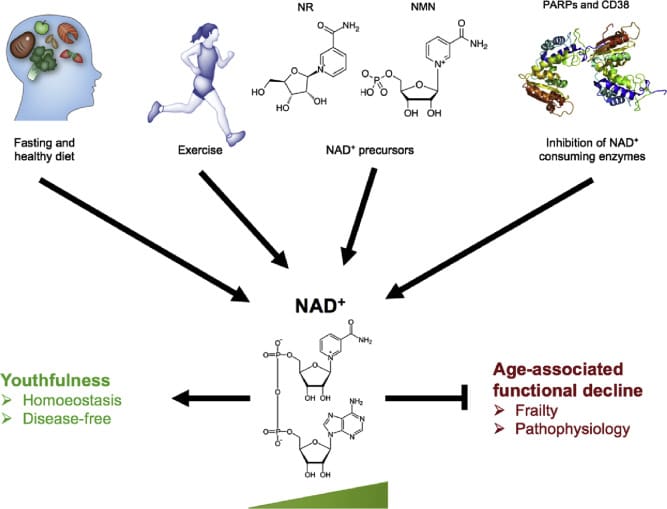
The two most prominent precursors are Nicotinamide Mononucleotide (NMN) and Nicotinamide Riboside (NR).
NMN is considered a more direct precursor, and research has shown its potential to increase NAD+ levels. NR follows a slightly different metabolic pathway but has also been demonstrated to be effective.
The debate over which is superior is ongoing, but both have been shown to raise NAD+ levels in human studies. However, the biggest challenge has been bioavailability = getting these precursors into the cells where they are needed.
Early supplements were often broken down in the digestive system before they could be effective. This has led to innovations in delivery systems, such as liposomal encapsulation, which protects the molecules and enhances absorption.
“So, what does science say?” you might ask.
Human studies, while still in relatively early stages, are promising. They show that supplementing with these precursors can indeed raise blood NAD+ levels, but the long-term effects on health and longevity are still being investigated.
It’s a field ripe with potential but also one where consumers must be wary of claims that outpace the evidence.
From Lab to Market: The Explosion of NAD+ Supplement Products
The market has responded to this emerging science with an explosion of products. Venture capital is reportedly pouring into longevity research, and the direct-to-consumer supplement market is booming.
The products generally fall into three categories:
- Single-Ingredient Supplements: These typically contain only NMN or NR and are the most budget-friendly option.
- Enhanced Formulas: These add other compounds like resveratrol or pterostilbene, which are thought to enhance the effects of the NAD+ precursors.
- Broad-Spectrum Longevity Stacks: These are the most expensive and complex products, combining multiple ingredients that target various aspects of aging.
Some manufacturers have developed broad-spectrum stacks targeting multiple aging mechanisms simultaneously.
Products like Perpetua Life AEON, for instance, combine 11 different compounds including NMN, senolytic agents like fisetin, and mitochondrial support ingredients, using liposomal delivery for enhanced absorption.
These multi-ingredient formulas represent the premium end of the market, with day and night formulations designed for 24-hour cellular support.
When choosing a product, it is CRITICAL to look for third-party testing and GMP (Good Manufacturing Practices) certification as a confirmation of quality and purity.
But do these products actually work for real people outside clinical trials?
What Users Actually Experience
While the science is still evolving, anecdotal reports from users often describe noticeable benefits.
The most commonly reported effects are increased energy and stamina, which can appear within a few weeks of starting a supplement regimen. Other frequently mentioned benefits include improved mental clarity, better sleep quality, and faster recovery from exercise.
This aligns with the interests of the biohacking community, which focuses on self-optimization through science and technology. However, it’s important to approach these claims with a healthy dose of skepticism.
The placebo effect is a powerful force, and individual results can vary widely based on age, health status, and lifestyle.
Not everyone who tries NAD+ supplements experiences a profound change. Some people report no noticeable effects at all.
Consistency is key; most experts suggest that it can take three to six months of continuous use to see significant benefits.
Is it worth the cost? That’s a personal calculation.
For some, the potential for increased vitality and healthier aging is well worth the investment.
For others, the cost is a significant barrier, especially when the long-term benefits are not yet definitively proven.
The Future of Cellular Anti-Aging
The field of longevity science is moving at a breakneck pace. Major clinical trials are underway to further investigate the long-term effects of NAD+ supplementation in humans.
Researchers are also exploring next-generation compounds that may be even more efficient at boosting NAD+.
The future likely lies in personalized approaches, where genetic testing could help determine the most effective longevity strategies for each individual.
This includes examining how NAD+ precursors interact with sirtuins, a class of proteins that play a key role in cellular health and aging. While NAD+ is a piece of the puzzle, it is just one aspect of a multi-faceted approach to healthy aging that also includes diet, exercise, and other lifestyle factors. So where does this leave consumers trying to decide whether NAD+ supplements are worth trying?
The Bottom Line on NAD+ Supplements
Here’s what we know for certain: NAD+ decline is a fundamental part of aging, and precursor supplements can increase NAD+ levels in the body.
Some users report significant benefits in energy and cognitive function. What remains uncertain are the long-term effects on human healthspan and lifespan.
For those over 40, in good health, and willing to make a consistent financial commitment, trying a high-quality NAD+ supplement could be a worthwhile experiment.
For younger individuals or those on a tight budget, it may be prudent to wait for more definitive research. NAD+ supplements represent the current frontier of accessible longevity science – they are promising, but they are not a magic bullet.
References
[1] Jinfiniti. (2024). NAD Levels by Age Group: What’s Considered Normal? Retrieved from https://www.jinfiniti.com/nad-levels-by-age/
[2] Massudi, H., Grant, R., Braidy, N., Guest, J., Farnsworth, B., & Guillemin, G. J. (2012). Age-associated changes in oxidative stress and NAD+ metabolism in human tissue. PloS one, 7(7), e42357. https://doi.org/10.1371/journal.pone.0042357
[3] Market Research Future. (2025). Longevity Market Type, Size, Growth, Trends, Report 2035. Retrieved from https://www.marketresearchfuture.com/reports/longevity-market-42067
[4] McReynolds, M. R., Chellappa, K., & Baur, J. A. (2020). Age-related NAD+ decline. Experimental Gerontology, 134, 110888. https://doi.org/10.1016/j.exger.2020.110888
[5] Massudi, H., Grant, R., Braidy, N., Guest, J., Farnsworth, B., & Guillemin, G. J. (2012). Age-associated changes in oxidative stress and NAD+ metabolism in human tissue. PloS one, 7(7), e42357. https://doi.org/10.1371/journal.pone.0042357
[6] Abdellatif, M., Sedej, S., & Kroemer, G. (2021). NAD+ Metabolism in Cardiac Health, Aging, and Disease. Circulation, 144(22), 1795–1817. https://doi.org/10.1161/CIRCULATIONAHA.121.056589