
For years, the “hero asset” has been the holy grail of mobile user acquisition. You spend weeks perfecting one polished video—a sleek mix of product demos and high-energy music—and then you blast that same video across TikTok, Instagram, and YouTube. It feels safe. It’s consistent. And most importantly, it’s easy to manage.
But as the UA landscape has become more crowded, the “hero asset” has started to fail. The reason is simple: your users aren’t a monolith.
The person downloading your app at 8:00 AM on a commute is in a different mindset than someone browsing in the evening. A 19-year-old on TikTok reacts to different visual cues than a professional on LinkedIn. When you force one creative style onto every audience segment, you aren’t just missing the mark—you’re effectively paying for users who aren’t interested, while ignoring those who are.
Segmentation via Creative Types
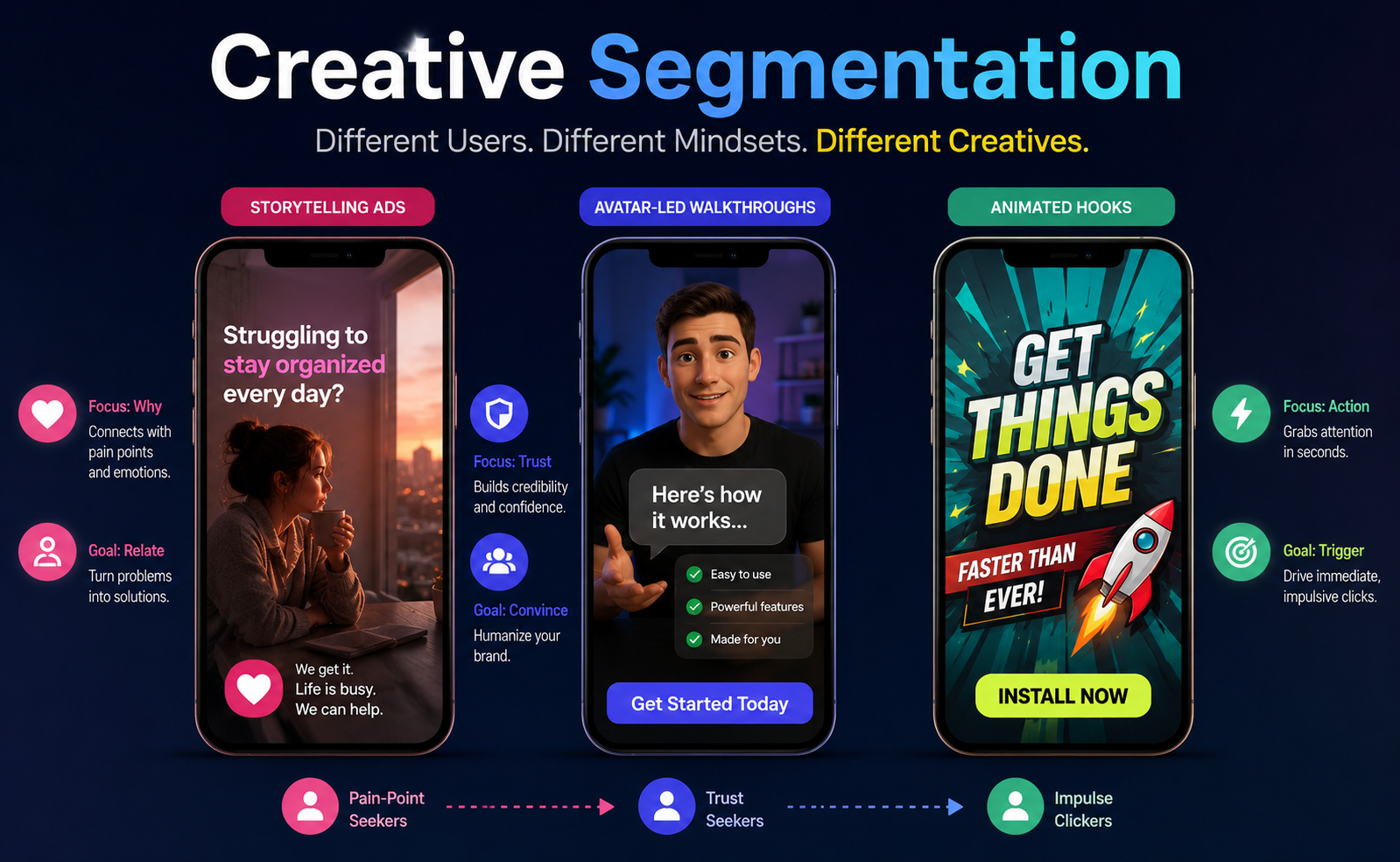
The shift we’re seeing among top growth teams is a move toward “creative segmentation.” Instead of producing one video for everyone, they are producing a portfolio of creative styles that cater to specific psychological triggers.
This usually breaks down into three distinct tiers:
- Storytelling Ads: These are designed for the “pain point” segment. They focus on the why. By using AI to weave a quick, relatable narrative, you move the focus away from the interface and toward the user’s life. This is where you convert the user who needs the problem solved, not just the feature list.
- Avatar-led Walkthroughs: These are for the “trust” segment. In an era of anonymous app downloads, humanizing the product matters. Whether it’s a digital narrator or a human-led explanation, this format builds the social proof and familiarity that raw screen recordings simply lack.
- Animated Hooks: These are for the “scroll-stoppers.” Designed for high-velocity feeds, these use aggressive, hyper-framed animations to grab attention in under three seconds. They aren’t trying to build a deep bond; they are trying to trigger an immediate, impulsive click.
The Operational Reality
The objection I always hear is the same: “I don’t have the time to produce three different styles of ads for every campaign.”
That is a valid operational concern, but it’s becoming an obsolete one. If your workflow relies on manual editing, you’ll never be able to afford the overhead of a segmented creative strategy. You’ll be stuck in the “one-size-fits-all” trap because it’s the only way you can keep up with the volume.
This is where the industry is pivoting toward automated production pipelines. Platforms like apptovid.com are designed to break that bottleneck. By using a store URL as the input, you can generate these varied formats—the narrative, the avatar, and the animated hook—simultaneously.
You aren’t just “making more videos”; you are engineering your creative to match your audience’s intent.
Start Testing Segments
Stop trying to craft the perfect video that appeals to everyone. Instead, start asking which of your user segments are being ignored by your current assets. Build a story-driven ad for the pain-point seekers, an avatar-led ad for the trust-seekers, and an animated hook for the impulse-clickers.
The teams that win in the coming year won’t be the ones with the single, most beautiful video. They will be the ones who mastered the art of creative segmentation. Your audience is diverse—your ad portfolio should be, too.
