

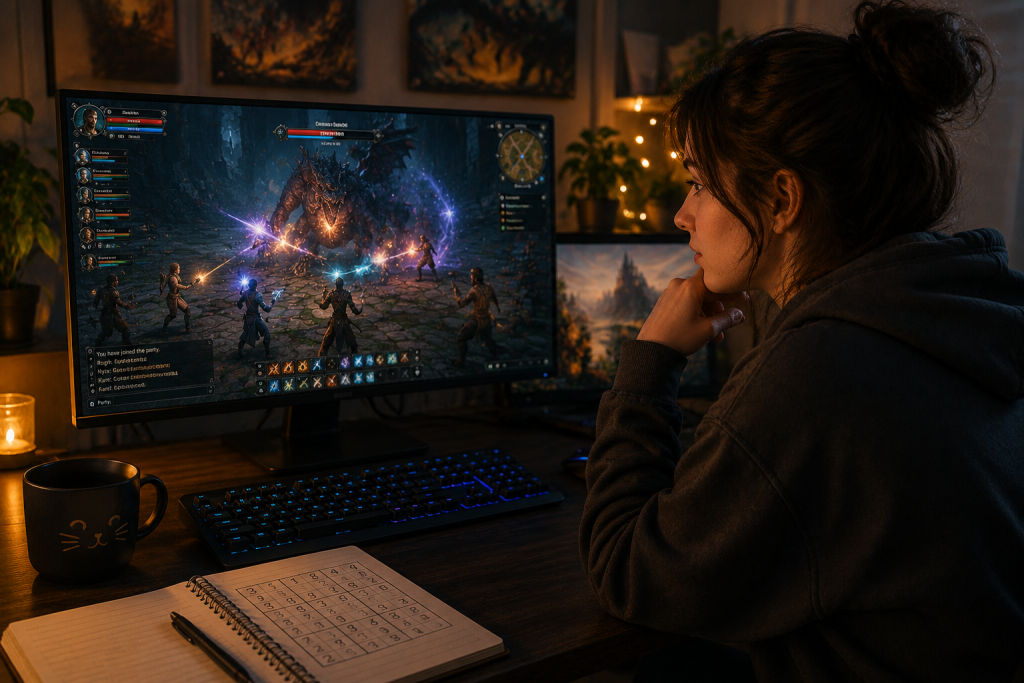
Tuuli used to feel guilty about it, honestly. After getting home from a rough shift at the hospital, she sits down and logs into her MMORPG for two hours before bed. Felt lazy on paper. Felt like avoiding real problems instead of dealing with them. It took her a solid year to notice something obvious in hindsight: those two hours were the only part of her day her brain actually stopped spinning about work. Not escapism exactly, or not only that. Something about tracking a boss fight, managing cooldowns, and coordinating with a group pulled her attention somewhere specific enough that the hospital stuff just… quieted down. She didn’t have a name for it back then. Turns out there’s actual research behind why that happens, and it’s not just her.
Cognitive Skills MMORPGs Actually Train
Strip away the fantasy setting and a lot of MMORPG gameplay is basically a cognitive workout dressed up in armor and spell effects. Tracking multiple enemy patterns, managing ability cooldowns, and reading a minimap while also watching your health bar—that’s genuine multitasking under time pressure. Not the fake kind where you’re just switching attention back and forth badly. The real kind. Memory gets a workout too, more than people assume. Boss fight mechanics, dungeon layouts, which NPC gives which quest, and where that one merchant with the good prices was hiding three zones back. None of it’s written down usually. Players just retain it through repetition and context, the same basic mechanism behind a lot of memory training exercises, just wrapped in a much more entertaining package. There’s also pattern recognition, which honestly might be the biggest one. Boss fights especially. You watch an attack animation enough times, and your brain starts predicting it before it fully plays out. That’s not magic; it’s the same skill chess players and, frankly, Sudoku players build over time. Different context, same underlying mental muscle. Reaction time and decision speed get trained too, in a way that’s easy to overlook since it happens so gradually. Split-second calls during a chaotic fight, whether to interrupt a cast, dodge an incoming attack, or reposition entirely, force the brain to process a lot of information and commit to a decision almost instantly. Do that consistently over months, and the speed at which you process similar decisions genuinely improves, not just in-game either. Plenty of longtime players report feeling sharper in other fast-paced situations too, though that’s admittedly harder to measure rigorously than something like memory recall.
Strategic Thinking and Problem-Solving in Game
Raid encounters in particular ask a lot of a player’s brain that goes way beyond reflexes. Figuring out an optimal group composition. Adjusting a strategy mid-fight when the first plan clearly isn’t working. Communicating a problem fast and clearly to eleven other people who are all also under pressure. That’s not casual entertainment; that’s closer to structured problem-solving under a deadline. A study published through the American Psychological Association looked at strategic video games broadly and found meaningful links between regular strategic gameplay and improved executive function, the mental skillset covering planning, working memory, and flexible thinking. It doesn’t mean MMORPGs turn you into a genius overnight; nothing does that, but the mechanism tracks with what a lot of long-term players describe anecdotally. Guild leadership adds another layer entirely. Scheduling, conflict resolution, and motivating a group after a bad night, that’s project management skills basically, minus the paycheck. Tuuli’s guild leader for years was, in real life, a warehouse shift supervisor. She swore the two jobs used almost identical muscles, just with dragons instead of delivery deadlines. Even outside formal leadership roles, regular raiders end up practicing a kind of distributed problem-solving that’s genuinely rare in most day-to-day life. Everyone’s watching a slightly different piece of the fight, calling out their piece of information, and the group has to synthesize all of it fast enough to actually act on it. Miss that window and the fight goes badly. It’s a real-time information processing exercise dressed up as entertainment, and it happens multiple times a week for players who raid regularly.
The Fine Line Between Healthy Play and Overplaying
Worth being honest here, because pretending MMORPGs are purely beneficial with zero downside would be dishonest. Like most things, dosage matters a lot. Healthy play generally still leaves room for sleep, work, relationships, and other hobbies, all of it staying roughly intact around the gaming. Overplaying starts eating into those areas specifically, with sleep getting sacrificed regularly, responsibilities slipping, and real-world relationships thinning out in favor of exclusively in-game ones. The line isn’t about hours played necessarily. Plenty of people log serious hours and stay perfectly balanced. It’s more about what’s getting displaced to make room for those hours. Resources from the World Health Organization on gaming behavior patterns note that the concerning threshold usually involves impaired control over play combined with escalating priority given to gaming over other life areas, sustained over a meaningful period of time, not just one intense week during a big expansion launch. Worth knowing that distinction, since a lot of people panic unnecessarily about a temporarily heavy play week that isn’t actually a problem pattern. Tuuli checks in with herself on this periodically, actually. Asks whether gaming’s still adding something to her week or quietly replacing things that matter more. So far, two hours after a hard shift still passes that test easily. She knows the day it stops passing, she’ll need to adjust. Worth noting too that the healthy version of this doesn’t require some rigid hour cap or strict schedule. It’s more about staying honest with yourself about the actual effect gaming’s having on the rest of your life, week to week, rather than treating any single number as a hard rule that applies equally to everyone. What’s balanced for a shift worker with irregular hours looks pretty different from what’s balanced for someone working a strict nine-to-five, and neither version is automatically wrong.
Simple Daily Brain Exercises to Pair With Gaming
A lot of players layer in short, low-stakes mental exercises around their gaming sessions, and it’s a genuinely underrated habit. Not a replacement for MMORPG gameplay, just a complement that hits slightly different mental muscles. Sites like Wisegames.fi offer free Sudoku, Mahjong, and crossword games that take just a few minutes but train pattern recognition and short-term memory in a more concentrated way than gaming sessions typically do. A quick Sudoku round before logging in works as a kind of mental warm-up. Doing one after a long raid night works more as a wind-down, something calm to transition the brain out of high-alert raid mode before actually trying to sleep. Tuuli’s added this into her routine too, somewhat by accident. Started doing a quick crossword some nights when she wasn’t quite ready to sleep right after logging off. Noticed she fell asleep faster on those nights. Small thing, but she’s kept doing it since. She’s also noticed she reaches for her phone less on those nights, scrolling through nothing in particular before sleep, a habit most people recognize and few actually break. A short, deliberate mental exercise seems to satisfy whatever itch the mindless scrolling was scratching, just in a way that actually leaves her feeling calmer instead of more wired.
Conclusion
MMORPGs get dismissed a lot, still, as mindless entertainment at best and an unhealthy time sink at worst. Neither framing holds up well once you actually look at what these games demand cognitively: planning, memory, fast strategic adjustment, and real communication under pressure. None of that’s mindless. The healthy version of this hobby looks a lot like what Tuuli’s built for herself. Something that adds genuine value to her week, stays in balance with everything else that matters, and gives her brain exactly the kind of break it needs after a demanding day. Not every hobby needs to justify itself with research citations. But it’s nice, sometimes, to have the science quietly backing up what a lot of players already knew from experience. It doesn’t mean everyone should feel obligated to game for their mental health; obviously, that would be a weird thing to prescribe universally. But for people who already enjoy MMORPGs and quietly wondered whether all those hours were doing anything besides passing time, the honest answer seems to be probably more than you’d think. Just keep an eye on the balance, same as with anything else worth doing regularly.