

In Counter-Strike 1.6, recoil is that iconic upward jolt your gun gives when you fire, simulating the real-world physics of a weapon’s backward force. It’s not just visual screen shake—it’s a mechanical beast that deviates your bullets from the crosshair. Picture this: you’re crouched behind a box, finger on the trigger. The first shot? Spot on, landing right where you aim (minus a tiny inaccuracy). But hold down fire on an automatic like the M4A1 or AK, and things get wild.
Recoil works via a hidden “recoil table”—a predefined sequence of deviations for each shot in a burst. For fully automatic weapons, it’s semi-predictable, building in an upside-down triangle pattern. The early shots climb vertically upward, like gravity’s flipped upside down, then it sways horizontally left or right, sometimes flipping directions randomly. This creates that chaotic spread you’ve cursed a thousand times. Unlike modern games with fixed patterns, CS 1.6 adds a touch of randomness, making it feel raw and nostalgic.
Why does it matter? Because recoil stacks with everything else. Stop shooting, and the recoil index resets after a short cooldown (faster for some guns like the MP5, slower for beasts like the AK). Fire again mid-reset, and you pick up from where you left off, climbing back up the pattern. Movement doesn’t amp up recoil directly—that’s spread’s job—but jumping or running makes controlling it a nightmare. Crouching? It doesn’t reduce recoil in CS1.6 like in later versions; it’s all about your mouse skills, bro.
the physics of recoil: breaking down the math
Alright, let’s get geeky— this is where the mathematics shines. Recoil in CS 1.6 can be thought of as vector additions to your aim angle. Each shot applies a deviation in pitch (vertical) and yaw (horizontal), drawn from that recoil table. Imagine your crosshair at angle θ (theta) = 0 initially. For each subsequent shot n (starting from 2), the game adds a delta angle: Δθ_vertical ≈ k * n for the climb phase, where k is a weapon-specific constant (higher for powerful rifles like the AK-47, around 1-2 degrees per shot early on, based on community dissections).
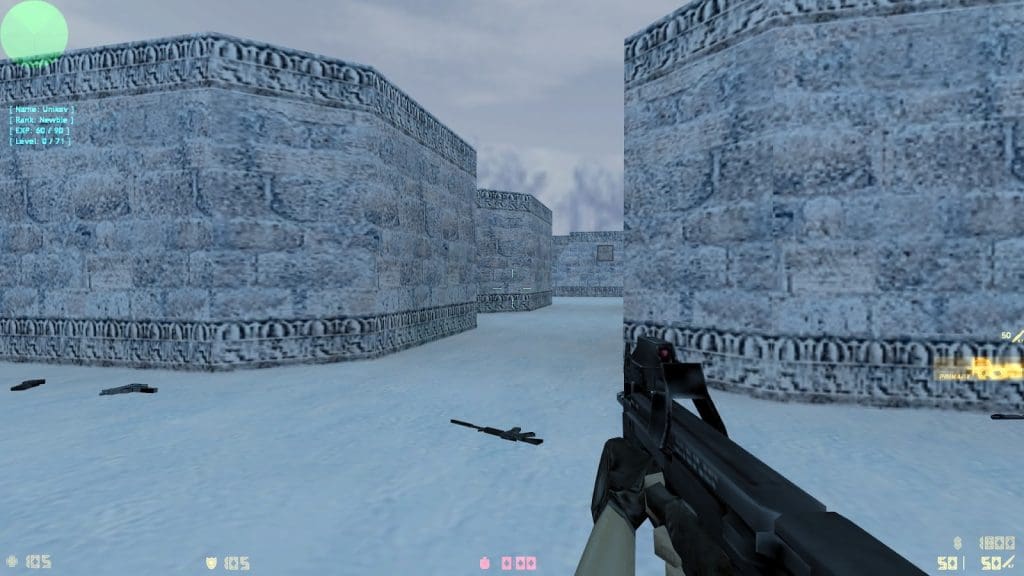
Horizontally, it’s more probabilistic: once you hit the “max height” (usually after 5-7 shots), Δθ_horizontal = ± r * sin(φ), where r is a random factor between 0 and max_sway (say, 3-5 degrees), and φ is a phase angle that oscillates. This creates the sway, often modeled as a sine wave in fan recreations. The overall bullet direction becomes: final_angle = base_aim + recoil_vector + spread_offset.
No official formulas from Valve, but from engine leaks and modder analyses, recoil is calculated server-side to prevent cheating. The visual “aimpunch” you see is a fraction of the actual deviation—screen shakes by about 20-30% of the bullet kick, tricking you into overcompensating if you’re not careful. For pistols like the USP, it’s simpler: no full pattern, just increasing random spread if you fire too fast, modeled as exponential growth: spread_n = base_spread * e^(c*(n-1)), where c is a cooldown constant.
Take the AK-47, the king of CS 1.6. Its recoil peaks vertically fast, then randomizes left/right with a bias toward clumping (bullets “stick” in corners of the triangle). Mathematically, the pattern bounds form an inverted triangle with base width w ≈ 10-15 degrees at max, height h ≈ 20 degrees. Probability density is higher at the top edges, explaining those frustrating “near-miss” sprays. Compared to the M4A1, which has a tighter triangle (w ≈ 8 degrees), the AK demands more math-savvy control but rewards with one-tap potential.
Nostalgic aside: Back in LAN cafes, we’d spend hours on aim_akcolt maps, tracing these patterns on walls. It felt like solving physics homework, but with headshots as the grade.
bullet spread: the rng wildcard
Recoil gets the glory, but bullet spread is the sneaky physics ninja that adds unpredictability. In Counter-Strike 1.6, spread is the random cone of deviation around your aim point, even without recoil. It’s pure math: each bullet lands within a circle of radius r_spread, centered on the recoil-adjusted angle.
The formula? Roughly, r_spread = base_inaccuracy + movement_penalty + firing_penalty. Base_inaccuracy is weapon-specific—pistols like Glock have low (0.5-1 degree), snipers like AWP have near-zero when scoped and still. Movement amps it up: standing still? Minimal. Walking? Multiplies by 1.5-2x. Running or jumping? Up to 5-10x, turning your shots into a shotgun blast.
Mathematically, spread is Gaussian-distributed: offset_x,y ~ N(0, σ), where σ = r_spread / 3 (for 99% within bounds). Firing continuously adds a cumulative factor: σ_n = σ_base + a * (1 – e^(-b/t)), where t is time since last shot, a and b are constants. This “recovery” means bursting > spraying for accuracy.
Factors cranking spread:
- Movement speed: v > 5 units/s? Spread += 0.1 * v degrees.
- Jumping/ladders: Multiplies base by 3-4, chaotic as hell.
- Weapon type: SMGs like UMP45 have higher base spread but lower recoil, trading precision for mobility.
- Distance: Doesn’t directly affect spread angle, but at long range (e.g., AWP pit on de_inferno), even small degrees mean big misses—trigonometry in action: miss_distance = range * tan(Δθ).
Spread stacks after recoil: bullet_path = aim + recoil_delta + random_spread_vector. This combo makes CS 1.6 feel alive, punishing run-and-gun but rewarding positioning.
combining forces: recoil + spread in action
Here’s the real mathematics of shooting: recoil provides the deterministic backbone (that table-driven pattern), while spread overlays randomness, creating emergent chaos. For a full mag dump, your bullets trace a probabilistic cloud within the recoil triangle.
Think vector math: Let A be your aim vector. Recoil adds R_n = [Δx_n, Δy_n] per shot n. Spread adds S = [rand(-s, s), rand(-s, s)]. Final: hit = A + R_n + S.
In practice:
- First shot: R_1 = 0, S small → high accuracy.
- Shots 2-5: R vertical climb, S minimal if still.
- Shots 6+: R sways, S grows if moving.
This physics engine, rooted in Half-Life’s GoldSrc, uses Euler angles for rotations—pitch for up/down, yaw for left/right. Errors compound over distance: at 1000 units, a 1-degree deviation misses by ~17 units (tan(1°) * 1000).
Pro tip: Servers with low tickrate (default 64) amplify this—lag compensation can make spreads feel wonky, but that’s networking math for another day.
mastering the math: tips to tame the beast
You don’t need a PhD to own with this knowledge—just practice. Here’s a step-by-step guide to turning physics into frags in CS 1.6:
- Learn patterns per gun: Load up a bot map, cl_dynamiccrosshair 1, and spray walls. Trace the triangle—pull down mouse linearly for vertical, then wiggle opposite to sway.
- Burst like a boss: Fire 3-5 shots, pause 0.2-0.5s for reset. Math: Minimizes cumulative R_n, keeps σ low.
- Compensate reverse: For advanced, mouse move = -R_pattern. Start by pulling down 1-2 cm on your pad per burst; adjust for DPI.
- Position smart: Stand still or crouch for min spread. Equation: Accuracy ∝ 1 / (movement + firing_rate).
- Console tweaks: fps_max 100 for smoother control (higher FPS = better recoil feel). cl_crosshairscale 1200 for precision.
Mix in taps for long range—single shots ignore most recoil. And remember, in Counter-Strike CS 1.6, it’s not about perfect math; it’s adapting to the randomness that made LAN parties legendary.