
You slept eight hours. You’ve had your morning coffee. You are sitting at your desk, ready to work, but your mind feels like it’s wading through mud. You can’t focus, you forget names, and your motivation is non-existent.
This is brain fog.
Most high-performers treat this as a discipline problem. They try to “power through” with more caffeine, productivity apps, or sheer willpower. But if the problem persists, it isn’t a lack of discipline. It’s likely a biological signal from your Enteric Nervous System (ENS).
Science now confirms that the clearest path to a sharp mind isn’t through the head; it’s through the stomach. This article explains the mechanism behind the gut-brain axis and how repairing your microbiome can eliminate brain fog and restore mental precision.
What is the Gut-Brain Axis? The Biological Highway
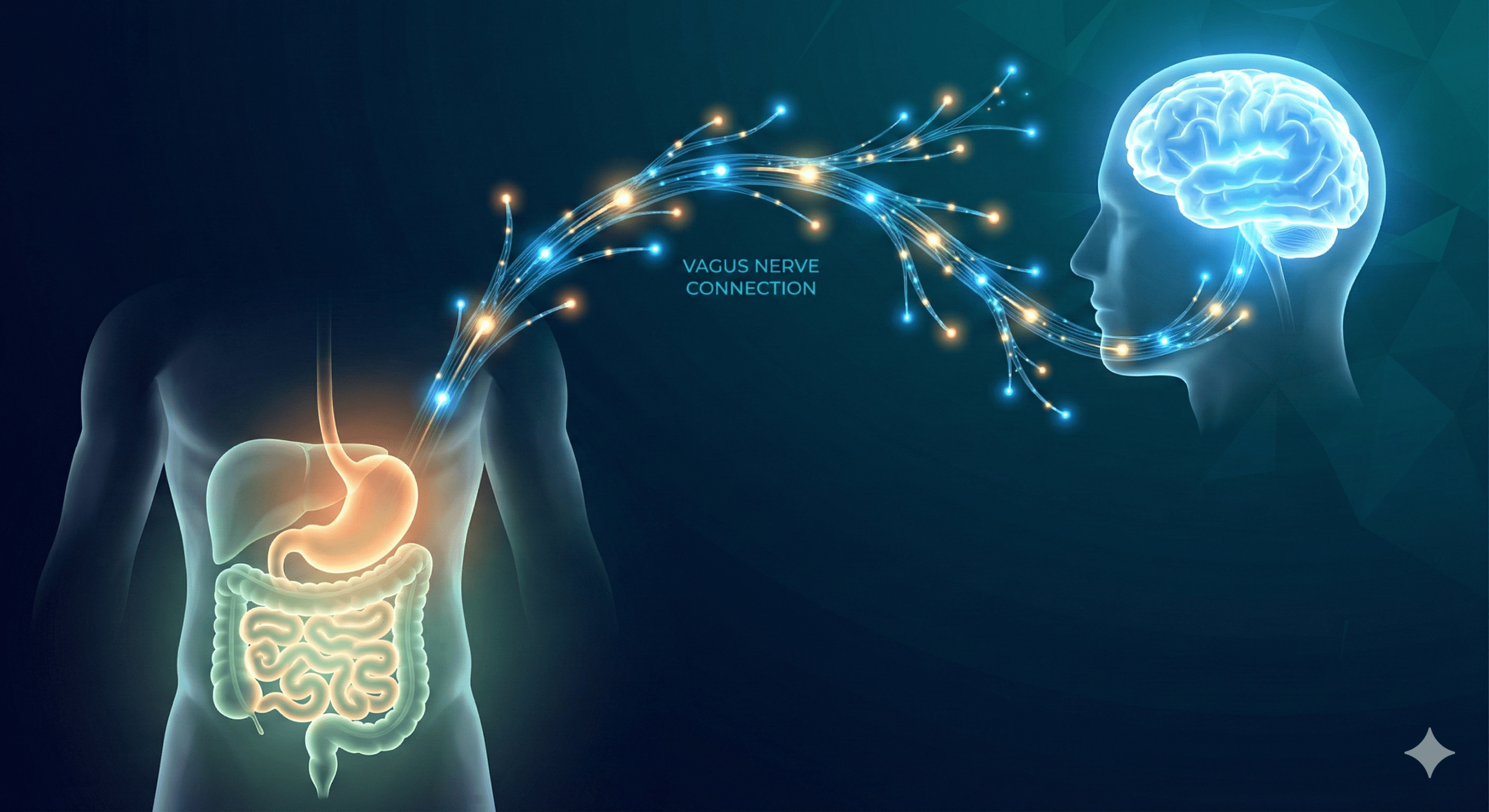
The gut-brain axis is the bidirectional communication network connecting your Enteric Nervous System (the nerves in your gut) with your Central Nervous System (your brain).
They are not isolated organs. They are physically connected by the Vagus Nerve, the longest cranial nerve in the body. Think of the Vagus Nerve as a fiber-optic cable. It transmits data constantly. Interestingly, about 90% of these fibers carry information from the gut to the brain, not the other way around.
If your gut is inflamed, it sends distress signals up this highway. Your brain interprets these signals as anxiety, stress, or a lack of focus.
Key Insight: You cannot separate your mental state from your digestion. If the “data” coming from your gut is corrupted by inflammation, your brain’s processing speed slows down.
The Chemistry of Focus: Neurotransmitters in the Gut
We tend to think of neurotransmitters like Serotonin and Dopamine as exclusively “brain chemicals.” This is a misconception.
The gut acts as a chemical manufacturing plant for the mind.
- Serotonin: Approximately 95% of your body’s serotonin is produced in the gut, not the brain. This chemical regulates mood, sleep, and pain perception.
- GABA: Beneficial bacteria produce Gamma-aminobutyric acid (GABA), which calms the nervous system and prevents racing thoughts.
- Dopamine: Roughly 50% of your dopamine—the molecule of motivation and reward—is synthesized in the digestive tract.
When your microbiome is healthy, these factories run smoothly. When you have dysbiosis (an imbalance of bacteria), production stalls. The result isn’t just an upset stomach; it is a chemical deficit in the brain that manifests as depression or apathy.
The Enemy of Clarity: Dysbiosis and Neuroinflammation
Why does a bad diet make you feel “foggy”? The answer lies in Intestinal Permeability, commonly known as “Leaky Gut.”
The lining of your gut is only one cell thick. Its job is to let nutrients through while keeping toxins out. Chronic stress, processed sugar, and antibiotics can tear this lining. When that happens, toxins (like lipopolysaccharides) escape the gut and enter your bloodstream.
Your immune system identifies these toxins as threats and launches an inflammatory response. Crucially, these inflammatory markers (cytokines) can cross the Blood-Brain Barrier.
This causes neuroinflammation. Your brain’s immune cells (microglia) activate to fight the “infection,” but in the process, they damage healthy neural connections. You experience this internal battle as brain fog and fatigue.
Actionable Step: If you have been eating a highly processed diet for years, your system may be overloaded with waste. Many experts recommend starting with a specialized reset, such as a 7-Day Colon Cleanse Detox Formula, to flush out accumulated toxins and prepare the gut lining for repair.
Psychobiotics: Nutritional Psychiatry for a Sharper Mind
Restoring clarity requires a shift from generic “healthy eating” to Nutritional Psychiatry. This involves prioritizing Psychobiotics—specific bacteria strains proved to influence mental health.
To fix the ecosystem, you need two components: the “Seed” (Probiotics) and the “Fertilizer” (Prebiotics).
Actionable Strategy: While fermented foods are excellent, it can be difficult to get a consistent therapeutic dose from diet alone. For high-performers looking to rapidly restore their microbiome diversity, we recommend supplementing with a 60 Billion Probiotic for Complete Gut Health. This ensures you are repopulating the gut with enough colony-forming units (CFUs) to outcompete harmful bacteria.
Lifestyle Habits to Reset Your Gut-Brain Connection
Food is critical, but stress is the master switch.
When you are stressed, your body releases cortisol. This hormone triggers the “fight or flight” response, which shuts down non-essential functions, including digestion. Blood flow diverts away from the stomach and toward your muscles.
If you are chronically stressed, your gut never gets the blood flow it needs to repair itself or digest food properly. This creates a vicious cycle: Stress causes gut issues $\rightarrow$ Gut issues reduce serotonin $\rightarrow$ Low serotonin lowers stress tolerance.
To break the loop:
- Practice Deep Breathing: This stimulates the Vagus Nerve and physically forces the body from “Fight or Flight” into “Rest and Digest” mode.
- Prioritize Sleep: Your microbiome has its own circadian rhythm. Erratic sleep patterns disrupt bacterial function just as much as a poor diet.
Frequently Asked Questions (FAQ)
How does gut health affect mental clarity?
Gut health affects mental clarity through the gut-brain axis, a communication network linking your enteric and central nervous systems. An imbalance in bacteria causes inflammation, which travels via the vagus nerve to the brain, disrupting cognitive function and causing symptoms like brain fog and poor focus.
Can probiotics help with brain fog?
Yes, specific probiotics known as psychobiotics can help alleviate brain fog. Strains like Lactobacillus and Bifidobacterium reduce gut inflammation and regulate cortisol levels. By restoring the microbiome balance, these probiotics improve neurotransmitter function, leading to sharper focus and reduced mental fatigue.
What is the fastest way to heal the gut for better mental health?
To heal the gut quickly, remove inflammatory triggers (sugar, alcohol) and add prebiotic fibers. Combine this with stress management techniques (like box breathing) to calm the vagus nerve. Healing is not instant, but symptom relief often begins within 3 to 5 days of dietary changes.
Is serotonin produced in the gut?
Yes, approximately 95% of the body’s serotonin is produced in the gut, not the brain. Specialized cells in the intestinal lining called enterochromaffin cells synthesize this neurotransmitter. This gut-derived serotonin regulates digestion and communicates with the brain to influence mood.
What foods are bad for the gut-brain axis?
The worst foods for the gut-brain axis are ultra-processed foods, refined sugars, and artificial sweeteners. These feed harmful bacteria. Additionally, trans fats and excessive gluten can damage the gut lining (leaky gut), allowing toxins to trigger neuroinflammation.
Conclusion: Trust Your Gut (Literally)
The connection between your stomach and your mind is not metaphorical. It is biological, chemical, and constant. If you are struggling with mental clarity, stop treating the brain in isolation. Look down.
Your path to better focus begins with your next meal.
