
If 2024 was the year of AI experimentation, 2025 has become the year of the “Great Synchronization.”
According to new data from Gartner released this week, 40% of enterprise applications will integrate task-specific AI agents by 2026, a massive leap from less than 5% just eighteen months ago. But the real story is not about software adoption. It is about the widening chasm in organizational speed.
A recent PwC analysis found that industries best positioned to adopt AI decision workflows are now seeing three times higher revenue per employee growth compared to their slower peers. The gap is no longer theoretical. It is financial, visible, and widening by the week.
The market has officially outpaced the quarterly business review. And for product leaders stuck in traditional planning cycles, the warning lights are flashing red.
The Collapse of “Slow Product” Culture
For the last decade, product management culture rewarded consensus and comprehensive documentation. Roadmaps were plotted twelve months in advance. Decisions required decks, committees, and buy-in from multiple layers of management.
That infrastructure is collapsing under the weight of real-time market demands.
“We are seeing a bifurcation in the market,” says a recent analyst note from Forrester. “Companies operating on quarterly cadences are finding themselves outmaneuvered by competitors operating on weekly, AI-assisted decision loops.”
The issue is not a lack of talent. It is a failure of the Operating System itself. Traditional product workflows, designed for a slower era, act as a drag coefficient on teams that need to move at hypersonic speeds.
Enter the “Decision OS”
To close this gap, forward-thinking tech leaders are dismantling their meeting-heavy cultures in favor of what is being called a “Decision OS,” a lightweight, AI-enabled framework that prioritizes velocity over verification.
One of the leading architects of this shift is Jason M. Riggs, a technology executive and author whose work in AI-enabled operating systems has shaped how modern product teams rethink speed. Riggs argues that the current friction in product development is not accidental. It is structural.
“Most companies are not failing because they lack good ideas,” Riggs says. “They are failing because their decision system is stuck in 2014. You cannot win a 2025 market with infrastructure built for quarterly comfort.”
Riggs’ methodology, which forms the backbone of his MACH-10 PM operating model and has gained traction among enterprise SaaS and consumer tech leaders this year, focuses on replacing “consensus” with “clarity.”
The Move to “Agentic” Workflows
The shift aligns with the broader industry move toward agentic AI, autonomous systems that do more than analyze data. They recommend actions.
In the MACH-10 approach, the Product Manager shifts from “project custodian” to “decision architect.” The goal is to eliminate the friction points that chip away at velocity: ambiguous ownership, unclear prioritization, and manual analysis.
“You should not need three meetings to make a decision your data is already telling you is right,” Riggs notes. “A good system makes the right call obvious. A great system removes everything that gets in the way of acting on it.”
Several analysts have pointed out that frameworks like those Riggs advocates are becoming essential as AI compresses planning cycles and forces organizations to operate in tighter, more adaptive loops. Riggs has worked on these systems across enterprise platforms, QSR automation, and emerging AI decision models.
Why 2026 Will Be Unforgiving
As we head into 2026, the cost of hesitation is rising.
Customer expectations: Responsiveness is now measured in hours, not weeks.
Efficiency demands: CFOs are seeking higher output per head, achievable only through AI-augmented workflows.
Competitor speed: As the Gartner data suggests, nearly half of your competitors will have agents handling routine tasks by next year.
“This is the first time I have seen leaders across industries all saying the same thing: we do not have time for ‘slow’ anymore,” Riggs adds. “People used to treat speed as a luxury. Now it is survival.”
As more companies adopt AI-assisted workflows, leaders like Riggs expect the divide between slow operators and fast operators to widen dramatically.
The choice facing product organizations is stark: modernize the operating model to leverage AI decision velocity or watch market share erode to competitors who already have.
About the Expert

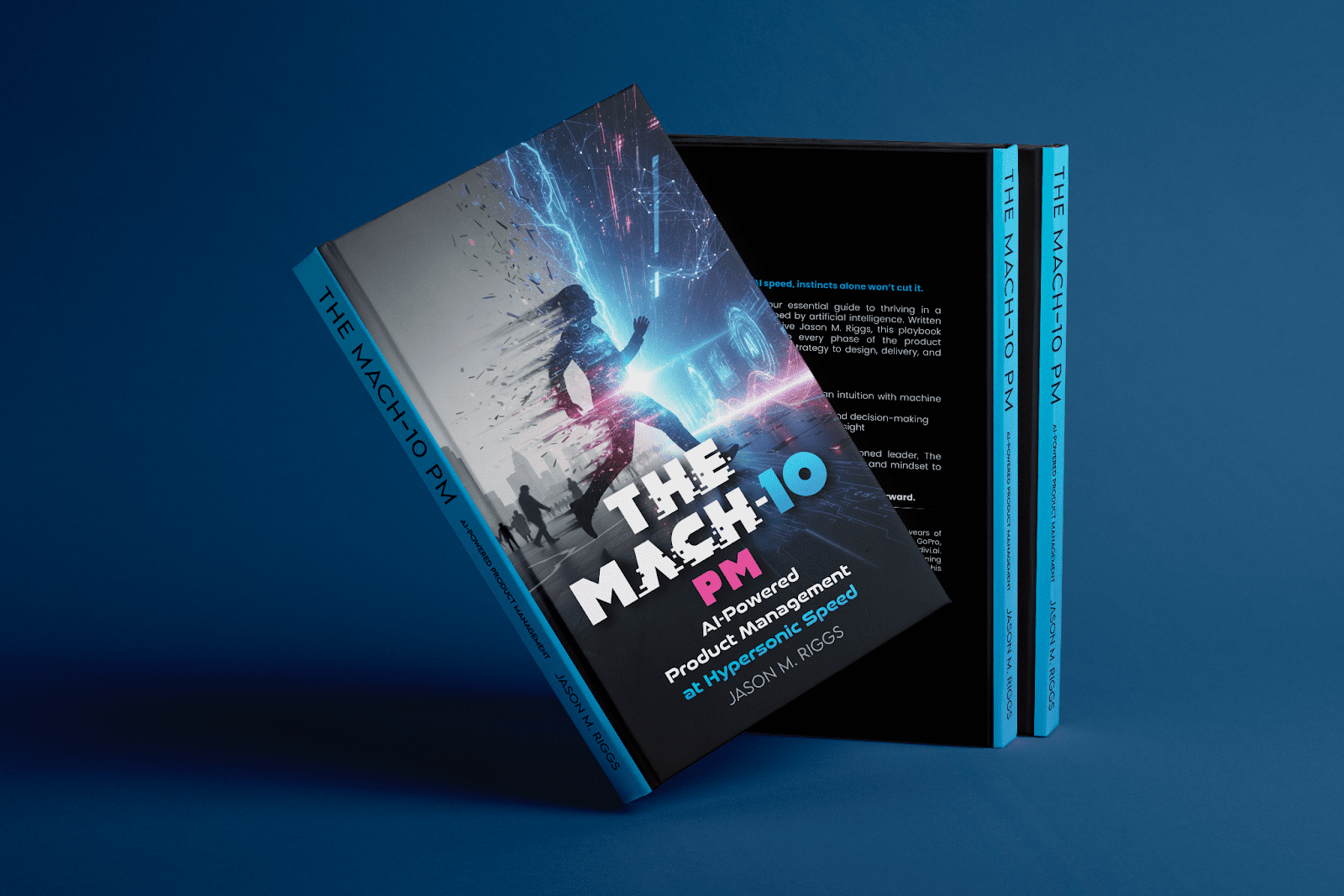
Jason M. Riggs is a technology executive and product leadership strategist based in Encinitas, California. He serves as Chief Product and Commercial Officer at Audivi.ai, where he oversees the deployment of AI-driven decision systems in real-world commercial environments. Riggs is also the creator of the MACH-10 PM operating model and author of “The MACH-10 PM: AI-Powered Product Management at Hypersonic Speed.”
Learn more: https://mach10pm.com
Paperback available on Amazon: https://www.amazon.com/dp/B0FSYTN278