
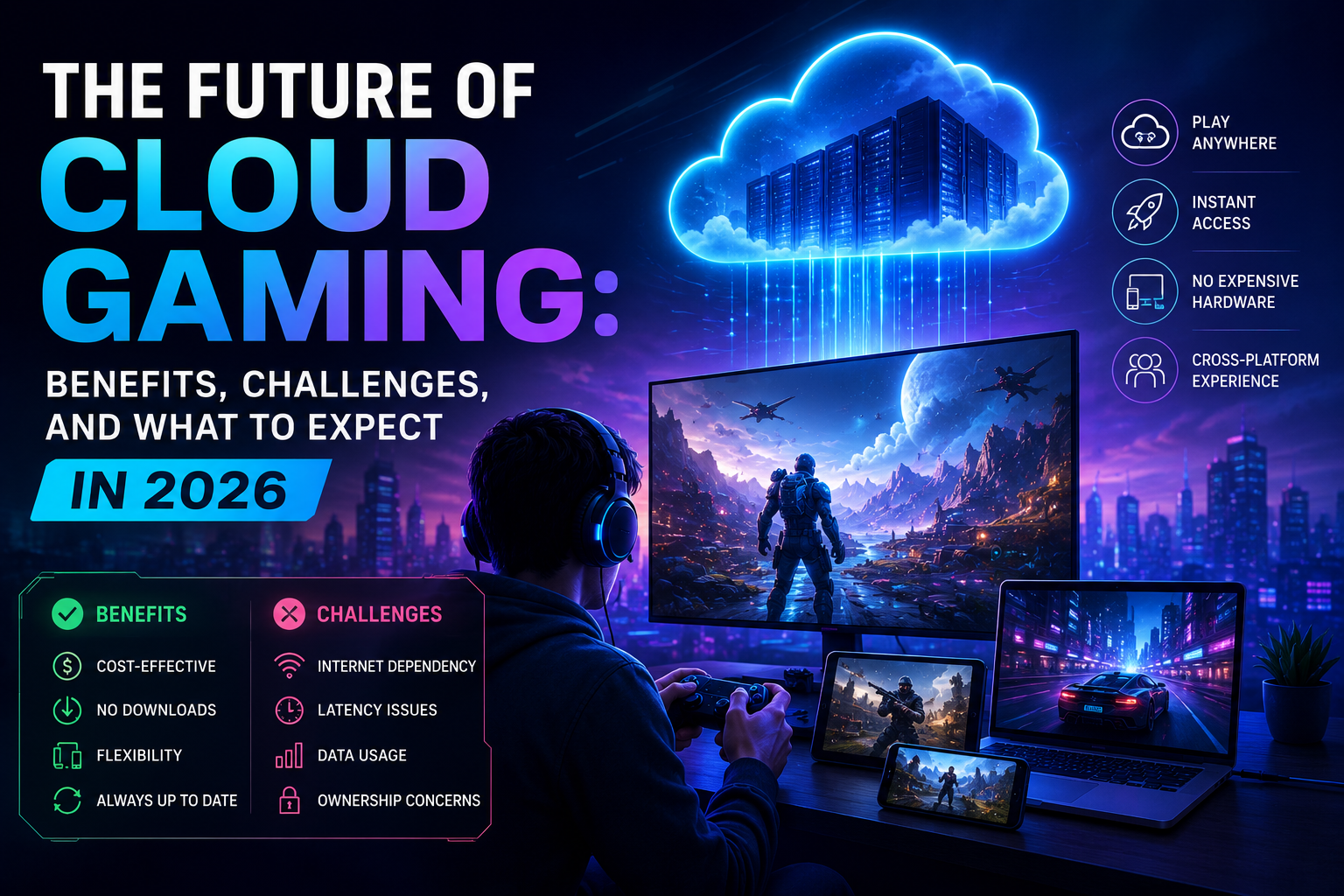
Introduction
The gaming industry has undergone significant transformations over the past decade, from the rise of mobile gaming to the rapid growth of esports and virtual reality. One of the most revolutionary developments in recent years is cloud gaming. By allowing players to stream games directly from remote servers instead of relying on powerful local hardware, cloud gaming is changing how people access and experience video games.
As internet infrastructure improves and cloud technologies become more sophisticated, cloud gaming is expected to play an even larger role in the gaming ecosystem. In 2026, the technology is becoming more accessible, affordable, and capable of delivering high-quality gaming experiences to players worldwide.
This article explores the future of cloud gaming, its key benefits, ongoing challenges, and what gamers can expect in 2026 and beyond.
What Is Cloud Gaming?
Cloud gaming, also known as game streaming, is a technology that enables users to play video games over the internet without downloading or installing them on their devices. Instead of running the game locally, the game operates on powerful cloud servers located in data centers.
When a player interacts with the game, their inputs are sent to the remote server, which processes the information and streams the gameplay back to the user’s device in real time. This allows gamers to enjoy demanding titles on smartphones, tablets, laptops, smart TVs, and low-spec computers.
Popular cloud gaming services have demonstrated that high-quality gaming no longer requires expensive gaming PCs or next-generation consoles.
Why Cloud Gaming Is Growing Rapidly
Several factors are contributing to the rapid adoption of cloud gaming in 2026.
Improved Internet Speeds
The expansion of high-speed broadband and 5G networks has significantly reduced latency and improved streaming quality. Faster internet connections make cloud gaming more practical for a larger number of users.
Increased Accessibility
Online gaming removes hardware barriers by allowing users to play demanding games on devices they already own. This accessibility opens gaming to a broader audience, including casual players who may not want to invest in expensive equipment.
Subscription-Based Models
Many cloud gaming services offer affordable subscription plans that provide access to extensive game libraries. Similar to streaming services in the movie and music industries, gamers can enjoy hundreds of titles for a monthly fee.
Cross-Device Gaming
Players can start a game on one device and continue on another without losing progress. This flexibility appeals to modern consumers who use multiple devices throughout the day.
Key Benefits of Cloud Gaming
1. No Expensive Hardware Required
One of the most significant advantages of cloud gaming is eliminating the need for high-end gaming hardware. Traditionally, gamers needed powerful graphics cards, processors, and consoles to play the latest games.
With cloud gaming, all processing occurs in remote data centers. Players only need a stable internet connection and a compatible device.
This dramatically lowers the cost of entry and makes gaming more accessible to people worldwide.
2. Instant Access to Games
Downloading large games can take hours, especially when modern titles often exceed 100GB in size. Cloud gaming removes this inconvenience by allowing players to launch games instantly.
Users can simply select a title from a cloud gaming platform and begin playing within seconds.
3. Automatic Updates and Maintenance
Game updates, patches, and system maintenance are handled by the service provider. Players no longer need to worry about downloading updates or managing storage space.
This streamlined experience saves time and ensures everyone plays the latest version of a game.
4. Enhanced Device Flexibility
Cloud gaming enables users to play across various devices without sacrificing performance.
Whether using a smartphone during a commute, a tablet while traveling, or a television at home, players can access the same gaming experience across multiple platforms.
5. Environmentally Efficient Resource Usage
Although cloud data centers consume energy, centralized computing can be more efficient than millions of individual gaming systems operating independently.
As renewable energy adoption increases among technology companies, cloud gaming infrastructure may become even more environmentally sustainable.
Challenges Facing Cloud Gaming
Despite its impressive growth, cloud gaming still faces several obstacles that must be addressed for widespread adoption.
Internet Dependency
The biggest limitation of cloud gaming remains its reliance on internet connectivity.
Players require fast, stable connections to enjoy smooth gameplay. In regions with unreliable internet infrastructure, cloud gaming can be frustrating or impractical.
Even minor network disruptions can negatively affect performance.
Latency Issues
Latency refers to the delay between a player’s action and the game’s response.
While cloud gaming services have made tremendous progress in reducing latency, competitive gamers often prefer local hardware for the fastest possible response times.
Fast-paced genres such as first-person shooters and fighting games are particularly sensitive to latency.
Data Usage Concerns
Streaming high-definition games consumes substantial amounts of data.
Players with limited internet plans may face challenges due to high bandwidth requirements, especially when gaming regularly.
As streaming quality improves to support 4K and future 8K experiences, data consumption will continue to increase.
Ownership and Licensing Questions
Traditional gaming allows players to purchase and own physical or digital copies of games.
Cloud gaming shifts users toward subscription models where access depends on active memberships and licensing agreements.
This raises concerns about long-term ownership and game preservation.
Server Availability
Cloud gaming relies on distributed server networks. Performance may vary depending on a user’s proximity to a data center.
Regions with limited server coverage may experience higher latency and reduced service quality.
The Role of Artificial Intelligence in Cloud Gaming
Artificial intelligence is becoming increasingly important in cloud gaming ecosystems.
AI-powered technologies help optimize network performance, reduce latency, and improve streaming quality.
Machine learning algorithms can predict network congestion and dynamically adjust video compression settings to maintain a smooth gaming experience.
AI is also enhancing game development by generating smarter NPC behavior, personalized gameplay experiences, and adaptive difficulty systems.
As AI technology continues to advance, cloud gaming services will become more efficient and responsive.
Cloud Gaming and Esports
The relationship between cloud gaming and esports is becoming stronger in 2026.
Cloud infrastructure allows tournament organizers to standardize hardware environments and reduce setup complexity.
Players can access competitive titles from virtually anywhere, potentially increasing participation in amateur and professional competitions.
Although some esports professionals still prefer dedicated hardware for maximum performance, improvements in cloud technology may narrow this gap significantly over the next few years.
What to Expect from Cloud Gaming in 2026
The future of cloud gaming looks promising, with several trends shaping the industry.
Better Streaming Quality
Advancements in video encoding technology will enable higher-resolution gameplay with lower bandwidth requirements.
Players can expect smoother 4K gaming experiences and improved visual quality across all devices.
Expanded Global Coverage
Major cloud providers continue investing in data centers worldwide.
As server networks expand, more regions will gain access to low-latency cloud gaming services.
Stronger Integration with Smart Devices
Cloud gaming will increasingly integrate with smart TVs, tablets, mobile devices, and even automotive entertainment systems.
Gaming will become available almost anywhere with an internet connection.
Larger Game Libraries
Subscription services are expected to expand their game catalogs, offering more exclusive titles and day-one releases.
This will increase the value proposition for subscribers while attracting new users.
Improved Virtual Reality Streaming
Cloud-powered VR experiences may become more practical as network speeds improve.
Offloading processing to cloud servers could make high-quality VR gaming accessible without expensive local hardware.
The Long-Term Future of Cloud Gaming
Industry analysts increasingly view cloud gaming as a major pillar of the future gaming ecosystem rather than a replacement for traditional gaming platforms.
Consoles and gaming PCs will continue serving enthusiasts who prioritize maximum performance, while cloud gaming provides accessibility and convenience for broader audiences.
The most likely future is a hybrid model where players seamlessly switch between local and cloud-based gaming depending on their needs and circumstances.
As technology advances, the distinction between traditional gaming and cloud gaming may gradually disappear altogether.
Conclusion
Cloud gaming is transforming the gaming landscape by making high-quality gaming experiences more accessible, flexible, and affordable. Improvements in internet infrastructure, artificial intelligence, and cloud computing are accelerating adoption across the globe.
While challenges such as latency, internet dependency, and data consumption still exist, ongoing technological advancements are steadily addressing these issues. In 2026, cloud gaming has moved beyond being an experimental concept and is becoming a mainstream way to play.
For gamers, developers, and technology companies alike, the future of cloud gaming presents exciting opportunities. As the industry continues to evolve, cloud gaming is poised to become one of the defining technologies shaping the next generation of digital entertainment.