

Not every dog is built for support work, and not every support role asks the same thing of a dog. A breed that excels as an emotional support animal living in a studio apartment with an anxious owner may be completely wrong for therapy work in a hospital ward or task training for psychiatric service dog status. The differences in temperament, trainability, size, energy level, and sensitivity between breeds are real, and choosing the right one for the right role shapes how effective the animal will be and how sustainable the relationship is long-term.
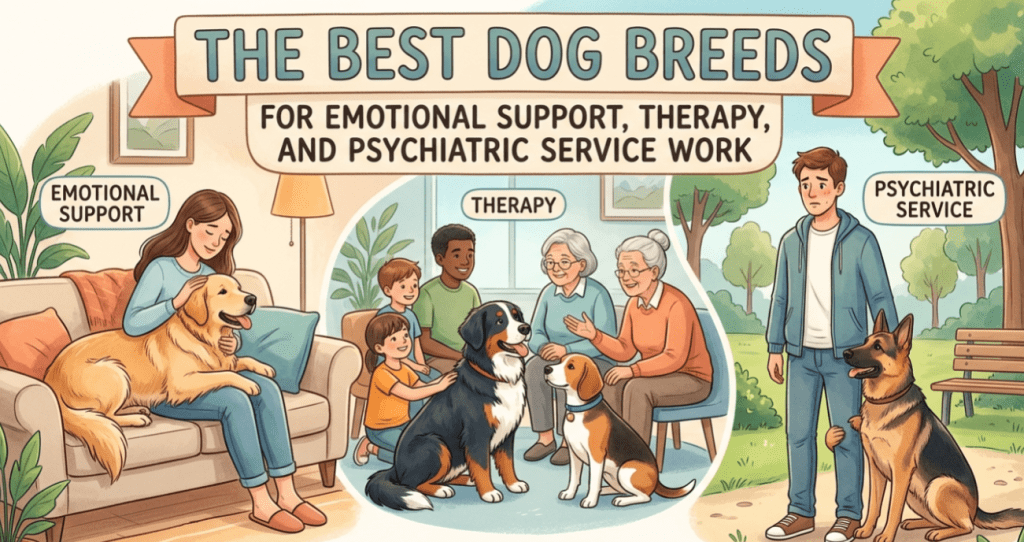
This guide breaks down the best emotional support dogs by role, covering which breeds suit ESA work, which handle the demands of therapy settings, and which have the temperament and trainability to qualify for Psychiatric Service Dog status. Whether you are choosing your first support animal or reassessing whether your current dog is the right fit for a different role, this is the information that makes that decision clearer.
Understanding the Three Roles: ESA, Therapy Dog, and Psychiatric Service Dog
Before getting into breed recommendations, it is worth being precise about what each role actually involves, because the demands are genuinely different and so are the legal protections that come with each.
| Role | What the Dog Does | Legal Protection |
| Emotional Support Animal (ESA) | Provides comfort and companionship through presence. No task training required. | Fair Housing Act (housing only). No public access rights under ADA. |
| Therapy Dog | Visits hospitals, schools, and care facilities to provide comfort to others, not just the handler. | No federal legal protection for the dog. Access depends on the facility’s permission. |
| Psychiatric Service Dog (PSD) | Performs specific trained tasks that mitigate the handler’s psychiatric disability. | Full ADA rights. Public access, housing, and air travel protections all apply. |
An ESA requires no special training and no task work. A therapy dog requires good public temperament and often a certification from a therapy dog organization, but it works for others rather than a specific handler. A PSD requires individual task training tied to a specific disability, which is the most demanding of the three but also the most legally protected.
Top Dog Breeds for Emotional Support Animal Work
ESA work suits dogs that are naturally calm, people-oriented, and comfortable with close physical contact. High energy breeds that need extensive outdoor exercise or become destructive when under-stimulated tend to create more stress than they relieve. The best ESA breeds are those whose natural temperament already aligns with what the role asks of them:
| Breed | Size | Energy Level | Best For |
| Golden Retriever | Large (55 to 75 lbs) | Moderate | Depression, PTSD, general anxiety, families |
| Labrador Retriever | Large (55 to 80 lbs) | Moderate to high | PTSD, anxiety, active owners, veterans |
| Cavalier King Charles Spaniel | Small (12 to 18 lbs) | Low to moderate | Anxiety, depression, apartment living, elderly owners |
| Poodle (Standard or Miniature) | Small to large | Moderate | Allergy sufferers, anxiety, highly trainable households |
| Corgi (Pembroke or Cardigan) | Medium (25 to 38 lbs) | Moderate | Depression, loneliness, active owners in smaller spaces |
| Havanese | Small (7 to 13 lbs) | Low to moderate | Anxiety, apartment living, social anxiety |
| Border Collie | Medium (30 to 55 lbs) | Very high | Active owners with anxiety, ADHD, those who benefit from structured routine |
| Bichon Frise | Small (12 to 18 lbs) | Low to moderate | Anxiety, hypoallergenic households, seniors |
For people whose anxiety or depression is aggravated by pet allergies, hypoallergenic dogs like the Poodle, Bichon Frise, Maltese, and Portuguese Water Dog offer the emotional benefits of a support animal without the allergy burden. These breeds have hair rather than fur and shed minimally, making them well suited for close indoor living arrangements.
A few key things to consider when matching an ESA breed to your situation:
- Living space matters significantly. A Golden Retriever in a studio apartment without regular outdoor access will become restless, and a restless dog adds rather than reduces stress.
- Your activity level should match the breed. A low-energy owner paired with a high-drive breed like a Border Collie often ends up with a frustrated, misbehaving animal.
- Sensitivity to emotion is a distinct trait. Breeds like the Cavalier King Charles Spaniel and Golden Retriever tend to attune closely to their owner’s emotional state, which is the core of what makes them effective in an ESA role.
Breed Matching by Condition: ADHD, PTSD, Depression, and Anxiety
Different mental health conditions call for different things from a support animal. Someone managing emotional support animal for ADHD needs a breed that can channel energy, provide stimulation, and support a daily routine. Someone with treatment-resistant depression needs a breed that is affectionate and consistent rather than demanding and high-maintenance. Here is how breed selection maps to specific conditions:
| Condition | Recommended Breeds and Why |
| Generalized Anxiety | Cavalier King Charles Spaniel, Havanese, Bichon Frise. Calm, close-contact breeds that are naturally soothing and do not add behavioral stress. |
| Depression | Golden Retriever, Labrador Retriever, Corgi. High-affection breeds that motivate daily routine through walks, feeding, and interaction. |
| PTSD | Labrador Retriever, German Shepherd, Standard Poodle. Breeds that are alert, loyal, and adapt well to task training for hypervigilance interruption. |
| ADHD | Border Collie, Australian Shepherd, Labrador Retriever. High-energy breeds that benefit from the same structured activity schedule that helps ADHD management. |
| Panic Disorder | Golden Retriever, Cavalier King Charles Spaniel, Pug. Gentle breeds that provide grounding through physical contact during episodes. |
| Bipolar Disorder | Standard Poodle, Labrador Retriever, Greyhound. Adaptable breeds that handle changes in the owner’s routine and energy level without becoming destabilized. |
| Social Anxiety | Havanese, Corgi, French Bulldog. Social, people-friendly breeds that serve as natural conversation starters and reduce isolation. |
For veterans managing service-related PTSD or trauma, breed selection carries additional considerations around hypervigilance, startle response management, and the need for nighttime grounding. The emotional support animal for veterans framework recognizes that veteran-specific ESA needs often lean toward breeds with strong task-training potential, since many veteran situations benefit more from PSD documentation than ESA status.
Best Dog Breeds for Therapy Work
Therapy dogs work in environments that would overwhelm most animals. Hospital wards, school classrooms, crisis centers, nursing homes, and courtrooms all involve strangers, unpredictable noise, unusual smells, and the requirement to remain calm regardless of what is happening around them. The temperament bar for therapy work is different from ESA work because the dog must be reliable with everyone, not just their owner.
Characteristics that define a strong therapy dog candidate:
- Consistent, predictable temperament around strangers of all ages, including children and elderly individuals
- Low reactivity to unexpected noises, movement, and physical contact including being grabbed or hugged unexpectedly
- No resource guarding, food aggression, or leash reactivity
- Comfortable with medical equipment, wheelchairs, walkers, and clinical settings
- Enjoys physical contact and does not become overstimulated or stressed by sustained attention from multiple people
Breeds that consistently perform well in certified therapy programs:
| Breed | Therapy Setting Strengths | Certification Suitability |
| Golden Retriever | Exceptional patience with children and elderly, tolerates unexpected handling well | Among the top breeds in AKC and Alliance of Therapy Dogs programs |
| Labrador Retriever | Calm in clinical environments, strong focus even in chaotic settings | Widely used in hospital and school programs |
| Beagle | Compact size makes them accessible to patients in beds or wheelchairs, friendly with everyone | Popular in pediatric hospital settings |
| Standard Poodle | Hypoallergenic, highly trainable, composed in medical environments | Strong fit for allergy-sensitive clinical facilities |
| Greyhound | Surprisingly gentle and calm indoors, low energy, non-threatening presence | Effective in adult care and hospice settings |
| Corgi | Cheerful and engaging, good for settings where emotional uplift is the goal | Used in schools and child therapy programs |
| German Shepherd | Impressive and calming presence, highly responsive to handler direction | Used in crisis response and courtroom support programs |
Therapy dog certification is separate from ESA documentation. Organizations like the Alliance of Therapy Dogs, Pet Partners, and Therapy Dogs International each have their own evaluation criteria, which typically include a temperament test, a skills assessment in realistic conditions, and handler training requirements. The dog must pass, not just be a well-behaved pet at home.
Best Dog Breeds for Psychiatric Service Dog Work
Psychiatric Service Dog work is the most demanding of the three roles. The dog must be individually trained to perform specific tasks tied to a handler’s psychiatric disability, and it must do so reliably in public environments where distractions, stress, and unpredictability are part of daily life. Not every dog has the working drive and temperament stability to handle this.
The qualities that distinguish a strong PSD candidate from a good ESA:
- High trainability and willingness to work. The dog needs to learn, generalize, and reliably execute tasks on cue across different environments.
- Emotional attunement. The best PSDs pick up on their handler’s physiological and behavioral cues and respond before being asked in some cases.
- Stable temperament under stress. The dog must not become reactive, frightened, or distracted when the handler is experiencing a mental health episode.
- Physical suitability for the required tasks. Deep pressure therapy requires a dog of sufficient size and weight. Medication retrieval requires a dog comfortable with carrying objects.
| Breed | PSD Tasks They Excel At | Size | Training Difficulty |
| Labrador Retriever | Deep pressure therapy, medication retrieval, panic interruption, grounding | Large | Low. Highly trainable. |
| Golden Retriever | Deep pressure therapy, panic interruption, emotional attunement tasks | Large | Low. Eager to please. |
| German Shepherd | Hypervigilance interruption, perimeter check tasks, nightmare interruption | Large | Moderate. Strong work drive. |
| Standard Poodle | Task work for allergy sufferers, grounding, medication retrieval | Large | Low. One of the most trainable breeds. |
| Belgian Malinois | High-intensity task work, hypervigilance interruption, PTSD-specific tasks | Medium-Large | High. Requires experienced handler. |
| Border Collie | Routine-based task work, grounding, check-ins for dissociation | Medium | Moderate. Needs mental stimulation. |
| Boxer | Deep pressure therapy, panic interruption, safe space creation | Large | Moderate. Strong bond with handler. |
Size is a practical factor for many PSD tasks. Deep pressure therapy, where the dog applies its body weight to the handler’s lap, chest, or legs to interrupt a panic attack or grounding episode, requires a dog of at least 35 to 40 pounds to be physiologically effective for most adults. Smaller dogs can perform other tasks including alerting, guiding away from stressors, and medication retrieval, but they cannot provide meaningful pressure therapy.
Making Your Dog an Official ESA or PSD
Choosing the right breed is the first step. The second is getting the documentation that gives your animal legal standing. For ESA work, the process involves a licensed mental health professional evaluating your qualifying condition and issuing a formal letter. There is no breed restriction, no training requirement, and no registration needed. You can follow the complete process at how to make your dog an ESA, which covers what the evaluation involves, what the letter must include, and how to use it with landlords and housing providers.
For PSD status, the process has two components: task training the dog to perform specific disability-related tasks, and obtaining a letter from a licensed mental health professional confirming your diagnosis and the therapeutic role of your trained animal. Understanding the full scope of what emotional support dog certification covers versus what PSD documentation requires helps you decide which path fits your situation before investing time and resources into training.
The key steps for getting your dog into either role:
- Assess your qualifying condition honestly with a licensed mental health professional. ESA documentation requires a diagnosable condition that meaningfully affects your daily life.
- Match your breed choice to your role before getting the dog if possible. Rescuing or purchasing a dog that is temperamentally unsuited to the role you need creates a difficult situation for both you and the animal.
- For PSDs, begin task training with a professional trainer experienced in psychiatric service dog work before seeking documentation. The letter confirms the trained animal’s role; it does not create it.
- Obtain your ESA or PSD letter from a licensed provider. RealESALetter.com evaluates whether you qualify through a licensed mental health professional in your state, produces documentation that meets federal and state requirements, and provides a money-back guarantee if you do not qualify.
- Keep your documentation current. Annual renewal keeps your letter within the 12-month window that most housing providers and employers expect.
Quick Reference: Breed by Role and Living Situation
| Breed | Best Role | Ideal Living Situation | Owner Energy Level |
| Golden Retriever | ESA, PSD, Therapy | House with yard preferred | Moderate |
| Labrador Retriever | ESA, PSD, Therapy | Adaptable, needs daily exercise | Moderate to high |
| Cavalier King Charles Spaniel | ESA | Apartment or small home | Low to moderate |
| Standard Poodle | ESA, PSD, Therapy | Adaptable, allergy-friendly | Moderate |
| German Shepherd | PSD, Therapy | House, needs space and stimulation | High |
| Beagle | Therapy, ESA | Adaptable, needs outdoor time | Moderate |
| Border Collie | PSD, ESA for active owners | Active household required | Very high |
| Havanese | ESA | Apartment, small spaces | Low |
| Greyhound | Therapy, ESA | Apartment-friendly despite size | Low |
| Boxer | PSD, ESA | House with yard preferred | Moderate to high |
The Bottom Line
Breed selection is not a minor detail in support work. The wrong breed in the wrong role creates an animal that is stressed, a handler whose needs are not being met, and a relationship that costs more to maintain than it returns. The right breed, matched to the right role and the right living situation, is one of the most reliable foundations for a successful long-term support arrangement.
Golden Retrievers and Labrador Retrievers dominate every category for good reason. Their combination of temperament, trainability, physical suitability, and emotional attunement makes them the most versatile support animals available. But they are not the right choice for every person or every living situation, and the breeds further down these lists serve real needs that the household favorites cannot always meet.
Once you know which role and which breed fits your situation, the documentation piece is straightforward. A licensed mental health professional evaluates your qualifying condition, issues the appropriate letter, and your animal’s role becomes legally protected. RealESALetter.com connects you with licensed therapists in all 50 states who conduct proper evaluations and produce documentation that holds up with landlords, employers, and housing providers without question.
