
Key Takeaways
- UK weather is already hotter, wetter and more volatile than the climate much of our building stock was designed for. Met Office UKCP18 projections indicate warmer summers, wetter winters and more intense rainfall by the 2050s.
- Sustainable architecture in the UK can no longer focus only on emissions reduction. Adaptation to overheating, flood risk and storm resilience now needs to sit beside carbon emissions as a primary design driver.
- Approved Document O, the London Plan’s Cooling Hierarchy and the RIBA 2030 Climate Challenge are pushing architects to treat orientation, shading, natural ventilation and landscape as core parts of building design.
- The best route is passive-first: reduce energy use through form, fabric, massing and fenestration, then add efficient systems such as heat pumps, followed by renewable energy sources like solar panels.
- Choosing the right sustainable architects in the UK means looking for people who understand climate physics, operational carbon, embodied carbon, future weather files and long-term resilience.
Why UK Buildings Must Be Re‑Designed for a New Climate Reality
In July 2022, the UK recorded 40.3°C for the first time. That was not a strange foreign climate briefly visiting us; it was a warning about the climate change already arriving here. The Met Office UKCP18 projections suggest that by the 2050s, UK summers will be significantly warmer, winters generally wetter, and heavy rainfall events more intense.
As a UK sustainable architect, I now spend as much time thinking about future summer temperatures as I do about winter heat loss. That is a major shift. For decades, British building design was dominated by the question: “How do we keep heat in?” Increasingly, the question is also: “How do we stop heat building up in the first place?”
Most UK homes, schools and offices were designed for a cool, temperate and relatively predictable climate. Many now struggle with overheating, flash flooding and storm exposure, even where they score well on traditional energy efficiency metrics.
The policy direction is clear. The Climate Change Act commits the UK to net zero by 2050. Updates to Approved Documents L, F and O in 2022 strengthened expectations around energy, ventilation and overheating. Approved Document O explicitly requires new homes to limit unwanted solar heat gain and provide a way to remove excess heat. The London Plan’s Cooling Hierarchy also expects design teams to prioritise orientation, shading, green spaces and passive systems before mechanical cooling.
This is the central point: climate-proofing is no longer a box to tick at planning stage. It must shape form, massing, orientation, fenestration, landscape and services from the first sketch.
From Mitigation to Adaptation: Rethinking Sustainable Architecture in the UK
Mitigation means reducing greenhouse gas emissions. In architecture, that usually means cutting operational carbon, reducing embodied carbon, lowering energy consumption and choosing better building materials. Adaptation means designing for the impacts we can no longer avoid: hotter summers, heavier rain, higher flood risk, drought stress, storms and changing air quality.
For years, sustainable architecture in the UK focused heavily on:
- More insulation and airtightness.
- Lower energy use and lower electricity consumption.
- Heat pumps instead of gas boilers.
- Solar panels and photovoltaic panels to generate electricity.
- Better controls, efficient lighting and reduced energy costs.
- Sustainable construction methods that minimize environmental impact.
Those are still essential. Buildings account for approximately 40% of global energy use and carbon emissions, and the construction sector contributes over 34% of global energy demand. Global construction accounts for 38% of total global emissions. In 2021, the construction sector emitted 10 gigatonnes of CO2. Cement alone is responsible for 8% of all emissions, and cement is responsible for 8% of global carbon emissions.
But mitigation alone is not enough. A highly insulated, airtight home with large west-facing glazing and no shading can become unbearably hot in summer. It may have high energy efficiency on paper, yet need more energy for air conditioning during heatwaves.
That is why current guidance increasingly asks for building physics evidence, not just good intentions. Homes are assessed using CIBSE TM59. Non-domestic buildings often use CIBSE TM52. These methods test internal temperatures, solar gains, ventilation assumptions and overheating risk. Designers are also beginning to test future weather files, not just historic data.
Good sustainable design now means balancing:
| Design concern | Mitigation question | Adaptation question |
|---|---|---|
| Fabric | How do we reduce heat loss? | Will the building overheat? |
| Glazing | How do we improve daylight? | Will direct sunlight create excessive solar heat gain? |
| Services | How do we cut operational carbon? | Will systems cope during heatwaves and storms? |
| Materials | How do we reduce embodied carbon? | Will materials buffer heat and moisture safely? |
| Landscape | How do we support biodiversity? | Can green roofs and planting manage stormwater? |
A serious approach to sustainable development must reshape the built environment for both environmental responsibility and resilience.
Climate Data, Building Physics and the UK’s Changing Weather
Climate data is no longer something we glance at after the design is finished. It feeds directly into the design process.
Met Office projection data is converted into weather files used by engineers and architects in dynamic simulation tools. These tools test how a building behaves hour by hour: how much warm air accumulates, how well night cooling works, how much natural lighting is available, how much energy use is expected, and where overheating occurs.
A few practical examples:
- A London 2050 high-emissions summer file may show many more occupied hours above 26°C, especially in top-floor flats and west-facing rooms.
- Western parts of England are expected to face more intense rainfall events, which changes drainage design, flood thresholds and the size of sustainable drainage systems.
- A school with generous glazing may perform well for daylight, but modelling may show afternoon overheating unless external shading, natural ventilation and thermal mass are added.
This modelling is now appearing earlier in feasibility studies and planning applications. It helps justify overhangs, deeper reveals, smaller west-facing windows, green façades, courtyards and different window-to-wall ratios.
Building Information Modelling (BIM) enhances sustainable design integration because it allows architects, engineers and cost consultants to test form, energy needs, materials, sequencing and environmental design together.
This matters because a new building should not be designed only for today’s weather. A two storey building completed in 2026 may still be occupied in 2080. If we only model the past, we build in future discomfort.
Passive-First Design: Form, Massing, Orientation, and Fenestration
The RIBA 2030 Climate Challenge is useful because it keeps the hierarchy simple: reduce demand first, use efficient systems second, then add renewable energy. In plain English, do not cover a poor design with sustainable technologies and hope for the best.
Passive design principles like building orientation and natural ventilation minimize energy consumption. Passive solar designs can significantly reduce cooling needs when they are paired with shading and controllable openings.
Key passive-first moves include:
- Orientation: South-facing windows can be useful in winter, but they need overhangs, external blinds or natural shading in summer. West-facing glazing is often the bigger overheating risk because low afternoon sun is harder to shade.
- Massing: Compact forms reduce heat loss, but some articulation can help shade façades and promote fresh air movement. Courtyards, shaded balconies and ventilated circulation spaces can all help.
- Fenestration: Window size, placement and glazing specification matter. Large glass walls may look attractive, but without control of solar heat gain they often increase cooling systems demand.
- Natural airflow: Dual-aspect homes, openable windows, stack ventilation and secure night vents allow warm air to escape. Natural ventilation is one of the most valuable passive systems we have in the UK.
- Shading: Recessed windows, brise-soleil, shutters, pergolas, deep reveals, living walls and trees can reduce overheating without immediately relying on air conditioning.
Energy-efficient design reduces the carbon footprint of buildings, but only when it works in both winter and summer. Energy efficiency is a primary goal of sustainable architecture, yet comfort is the test of whether that efficiency is genuinely useful.
A sustainable building is not just one that uses less energy in January. It is one that remains safe, comfortable and affordable in July too.
Beyond Insulation: Materials, Thermal Mass and the Circular Economy
In a warming UK, materials have to do three jobs at once. They must reduce embodied carbon, help manage overheating, and support the circular economy.
Thermal mass is a good example. Concrete, brick, stone and some hybrid structures can absorb heat during the day and release it later, particularly when night purging is possible. Exposed soffits or internal masonry walls can help stabilise internal temperatures. But we have to be careful: high-carbon traditional materials are not automatically the answer.
That is why sustainable materials matter. Useful strategies include:
- Recycled materials such as reclaimed brick, recycled steel and recycled denim insulation.
- Natural materials such as timber, hemp, straw and clay.
- Hempcrete as a sustainable alternative to traditional building materials.
- Straw as a natural insulation material in walls.
- Low-carbon concrete mixes where concrete is genuinely needed.
- Local materials that reduce transport emissions and support local skills.
- Demountable details so components can be repaired, reused or salvaged.
Sustainable materials lower the demand for raw materials and clean water. Utilizing eco-friendly materials helps reduce carbon footprints and waste. Designing buildings for adaptability ensures materials can be salvaged rather than demolished.
Bamboo is increasingly used in global green architecture; bamboo can be harvested for commercial use after six years, and Kempegowda International Airport’s Terminal 2 uses bamboo in its design. The Black & White Building is London’s tallest mass-timber office, showing how new materials and engineered timber can reduce reliance on carbon-heavy frames.
Indoor health matters too. Warmer summers can increase off-gassing from finishes, so low volatile organic compounds specifications are no longer a luxury. Enhanced indoor air quality contributes to higher occupant well-being and productivity. Good material choices improve air quality and protect natural resources.
This is where waste reduction, circular economy thinking and resilience overlap. Reusing an existing structure often saves embodied carbon and avoids unnecessary demolition. Sustainable architecture seeks to minimize the negative environmental impact of buildings, but it should also create places that are healthier to occupy.
Systems, Renewables and Climate-Resilient Services
Once passive measures are working hard, services can be smaller, simpler, and cleaner. This is where renewable energy and efficient systems come in.
Heat pumps suit a decarbonising grid, especially when paired with high-energy-efficiency fabric. Energy Star ground-source heat pumps are 40% to 60% more efficient. But heat pumps should not be used to compensate for poor shading or excessive glazing. If a building overheats because of design decisions, the system has to work harder.
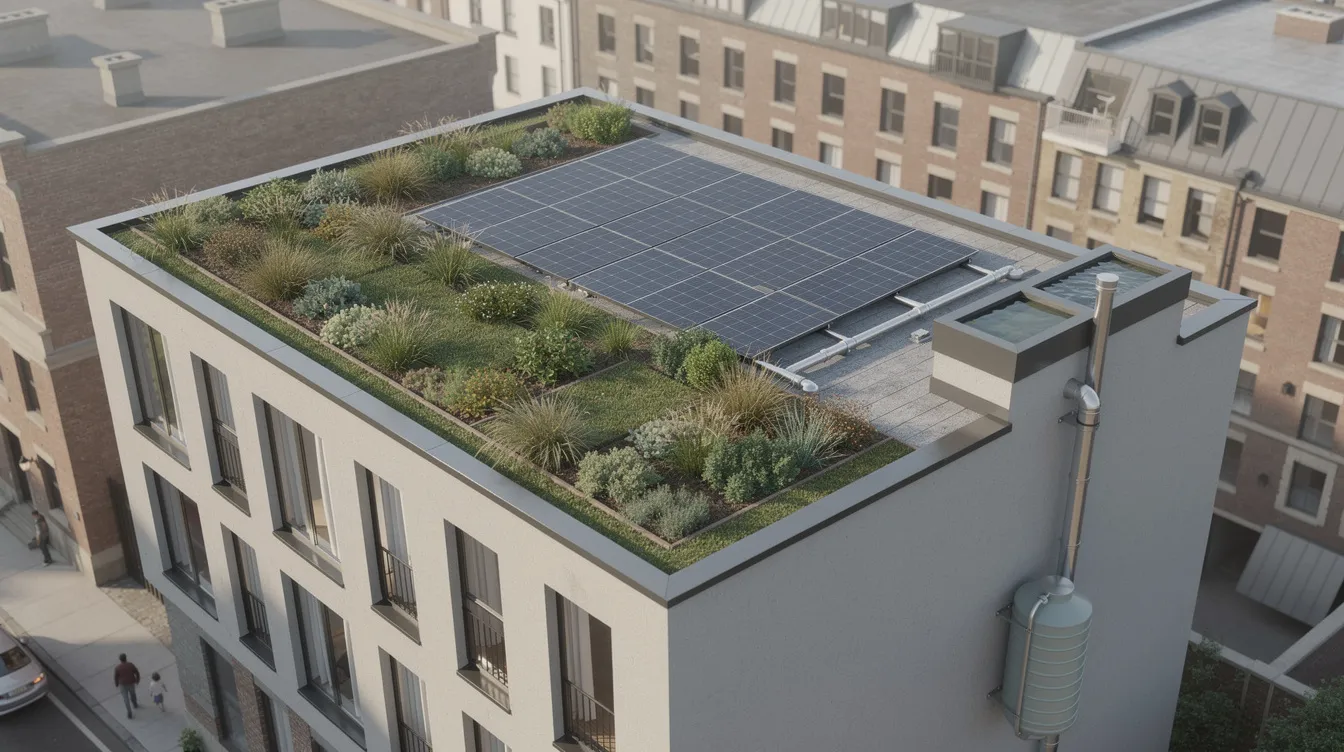
Solar power is now part of many UK projects. Rooftop solar panels, façade-mounted photovoltaic panels and battery storage can help buildings generate electricity and meet some of their own energy needs. Photovoltaic panels can produce over 138 kWh of energy depending on size, location, and conditions. Active solar systems can produce 80 to 100 gallons of hot water daily in suitable applications.
Other energy sources also have a place. Wind power and small wind turbines can work in exposed rural or coastal sites, although they are rarely the first answer in dense urban design. The point is to match renewable energy sources to the building site rather than treating them as decoration.
Climate-resilient services should also include water:
- A rainwater harvesting system can supply WCs, irrigation, and cleaning.
- Rainwater recycling reduces mains demand.
- Rainwater harvesting supports water conservation and reduces water consumption.
- Water conservation systems reduce the strain on local municipal water supplies.
- Green roofs and living walls help manage stormwater runoff and improve air quality.
- Blue-green roofs, rain gardens and permeable paving slow runoff during heavy rain.
- Critical plant, electrics and data equipment should be elevated in flood-risk areas.
Smart controls can also help. Automated blinds, temperature sensors, night-cooling controls and ventilation alerts are advanced technologies that reduce peak loads without making the building complicated to use.
Sustainable Architecture Examples: Climate-Proofing in Practice
Sustainable architecture examples are useful because they show that climate resilience is not one style. It can be brick, timber, earth, concrete, steel or bamboo. The important thing is whether the building responds intelligently to climate, community and carbon.
A London Passivhaus-style home designed to CIBSE TM59 might use modest south glazing, reduced west glazing, external shutters, night purging, exposed thermal mass and solar panels. The result is a green building that reduces operational carbon without creating a summer overheating problem.
A Manchester office retrofit can use deep window reveals, mixed-mode ventilation, solar PV, better insulation, raised thresholds and planting to manage runoff. This kind of project shows how green buildings can reduce energy costs, improve comfort and reduce flood risk together.
There are also strong international references. The Edge in Amsterdam is one of the greenest office buildings. The Edge in Amsterdam is one of the greenest office buildings because it combines energy and environmental design, smart controls, daylight, renewable energy and highly efficient systems. LEED certification establishes benchmarks for energy efficiency, although UK projects should also be tested against local climate risk.
Powerhouse Telemark creates more energy than it consumes, making it a prime example of how form, solar generation and energy discipline can work together. The Novartis Pavilion features a zero-energy media façade. The Novartis Pavilion features a zero-energy media façade that turns the building skin into an active environmental element. The Khor Kalba Turtle Sanctuary uses prefabricated circular forms, showing how prefabrication can reduce waste and site disturbance.
Community projects matter just as much as high-profile offices. Citizens House offers 11 affordable homes for local people. The Reference Center of Babassu Coconut Breakers supports local women. Friendship Hospital provides essential health services to local communities. Anandaloy community center supports people with disabilities in Bangladesh. Kampala art centre is Uganda’s first purpose-built community art space.
These projects remind us that social sustainability is part of sustainable architecture. The United Nations Sustainable Development Goals make the same point: climate action, health, water, cities and equality are connected.
Adapting Existing UK Buildings: Retrofit Before New Build
Most of the UK buildings that will exist in 2050 already exist today. So sustainable architecture cannot be only about shiny new green buildings. It has to be about retrofitting terraces, semis, flats, schools, libraries, shops and workplaces.
Typical retrofit measures include:
- External shutters, awnings or brise-soleil on overheating façades.
- Improved natural cross-ventilation routes.
- Secure night vents where noise or safety is an issue.
- High-performance glazing with sensible g-values.
- Roof insulation and loft ventilation.
- Internal or external wall insulation designed around moisture risk.
- Lighter-coloured finishes to reduce solar absorption.
- Green spaces, trees and permeable surfaces around the building.
Retrofit also reduces embodied impacts. Reusing foundations, walls, floors and roofs usually saves far more carbon than demolishing and rebuilding. Sustainable buildings use significantly less energy and water, but the lowest-carbon structure is often the one already standing.
For example, a Victorian terrace can often be made far more resilient through loft insulation, careful draught management, breathable internal wall insulation, external shutters, improved ventilation and a rainwater harvesting system for garden use. The masonry walls provide useful thermal mass, while the stairwell can support stack ventilation.
PAS 2035 and local authority retrofit programmes are pushing the UK towards more whole-house thinking. That is welcome. Piecemeal measures can cause problems: airtight windows without ventilation can worsen condensation, while insulation without shading can increase summer overheating.
Sustainable structures should be treated as long-life assets, not disposable products.
Choosing the Right Sustainable Architect in the UK
With regulations tightening and climate risks escalating, clients need sustainable architects who understand more than decorative eco features. A sedum roof and a few solar panels do not make a resilient building.
Here are the signs I would look for:
- Experience with CIBSE TM52 and TM59 overheating analysis.
- Ability to commission or interpret dynamic energy modelling.
- Familiarity with the RIBA 2030 Climate Challenge.
- Understanding of operational carbon, embodied carbon and whole-life carbon.
- A track record in both retrofit and new-build sustainable projects.
- Early collaboration with structural engineers, M&E engineers, landscape architects and sustainability consultants.
- Clear explanations in plain English, not just acronyms.
Useful questions to ask at interview stage:
- How will you test this building against future climate scenarios?
- Which elevations are most exposed to solar heat gain?
- How will the design provide fresh air during hot nights?
- What is the strategy for flood risk and intense rainfall?
- How will heat pumps, solar panels and other sustainable technologies be integrated?
- Which building materials would you retain, reuse or replace?
- How will the design balance natural lighting with overheating control?
A good architect will talk about the shape of the building before talking about gadgets. They will consider urban design, landscape, massing and windows early because those decisions are hard to fix later.
The best sustainable practices are practical. They balance comfort, resilience, cost, planning risk and aesthetics. They also recognise that environmental awareness is not a design style; it is a responsibility.
You should compare Chartered Architecture Practice services, with those of award winning practices in architecture, interior design, building surveying, conservation and sustainability services by Howarth Litchfield. The practice incorporates sustainable design into all its proposals, whether new build or refurbishment, large budget or small.
Looking Ahead: Climate-Proofing as the New Normal
The climate crisis has changed the brief. Sustainable architecture in the UK must now treat adaptation as a fundamental design generator, equal to beauty, function, cost and emissions reduction.
That does not mean every project needs to look defensive or technical. It means every project should be calmer, better shaded, better ventilated, more water-aware, more adaptable and more honest about future risk.
By using passive-first design, robust materials, circular economy principles, renewable energy, careful modelling and good landscape design, we can create sustainable buildings that remain comfortable well into the 2050s and beyond.
We cannot predict every effect of global warming. But we can stop pretending the old climate still exists. Whether you are planning a home, a workplace or a public building, put overheating, flood risk, storm resilience and long-term energy use into the brief from day one.
Frequently Asked Questions
How will UK summer temperatures actually change by 2050, and what does that mean for my home design?
By the 2050s, many parts of southern England could see average summer temperatures around 2–3°C higher than late 20th-century baselines, with more frequent and prolonged heatwaves. For home design, that means more attention to shading, cross-ventilation, thermal mass, roof insulation and lighter external finishes.
Designing only around current weather risks locking in homes that feel too hot for much of their life, especially top-floor flats, loft conversions and heavily glazed west-facing rooms.
Is air conditioning inevitable in future UK sustainable buildings?
No, not in most homes and many workplaces. Good orientation, shading, natural ventilation, night purging and sensible glazing can dramatically reduce cooling demand.
Some buildings, such as hospitals, laboratories and data-heavy offices, may still need targeted cooling systems. Where cooling is necessary, efficient reversible heat pumps powered partly by solar power can keep operational carbon lower.
What does “operational carbon” versus “embodied carbon” mean for a project budget?
Operational carbon is the carbon associated with running a building: heating, cooling, lighting, appliances and hot water. Embodied carbon is the carbon associated with extracting raw materials, manufacturing products, transport, construction, maintenance and end-of-life disposal.
A slightly higher upfront cost for better fabric, shading or durable materials can reduce bills and carbon over decades. The sensible question is not just “What is cheapest today?” but “What performs best across the building’s life?”
Can an existing Victorian or interwar UK house realistically be made climate-resilient?
Yes, in many cases. Victorian and interwar homes often have useful advantages: masonry thermal mass, good ceiling heights, chimney routes and stairwells that can help stack ventilation.
The key is a whole-house plan. Insulation, ventilation, moisture control, shading and heating upgrades need to work together. Poorly planned upgrades can trap damp or increase overheating.
At what stage of a project should climate adaptation be considered?
At the very beginning. Site selection, orientation, massing, window design and landscape are far easier to get right early than to correct later.
Ask for overheating, flood risk, storm resilience and future comfort to be included in the first brief. When adaptation is embedded early, it often reduces complexity. When it is bolted on late, it usually costs more and works less well.