

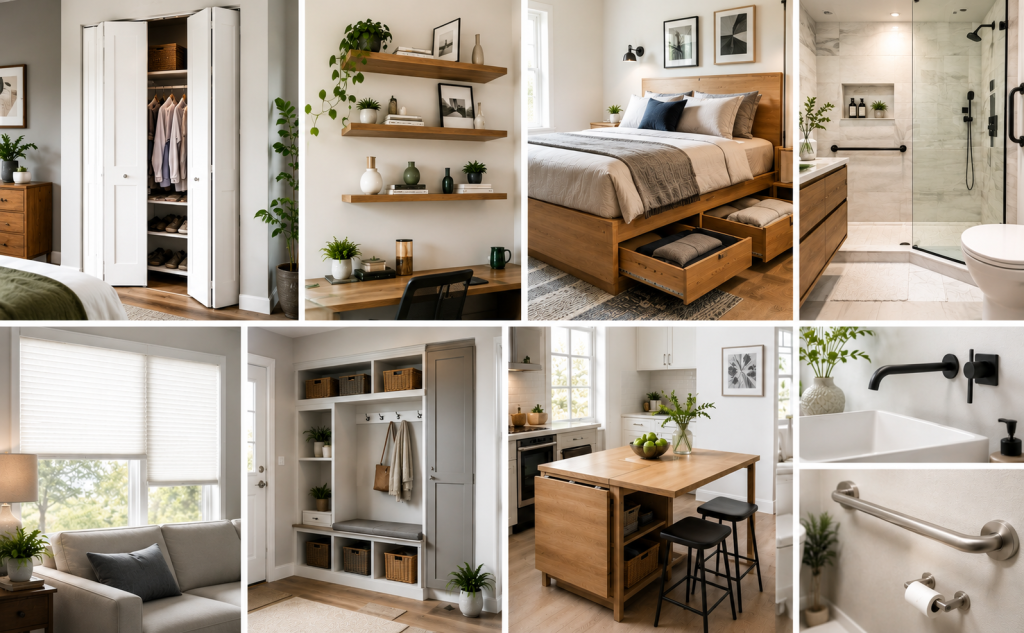
Most home renovations are a waste of money. There. Someone finally said it.
Thousands spent. Weeks of disruption. And the house still feels cramped, cluttered, and smaller than it should. In 2026, smart US homeowners are skipping the big remodels entirely and choosing space saving home upgrades that deliver real, daily impact, for a fraction of the cost.
The average renovation budget is holding steady at $20,000 this year, according to the 2026 Houzz and Home Study, but most homeowners are spending under $5,000 on individual projects. The shift is clear: smaller, smarter upgrades are beating big, risky remodels every time. These five deliver the most impact for the least disruption, no permits, no structural work, most done in a weekend. And all of them solve a daily problem that millions of American homeowners deal with right now.
Why Space Saving Home Upgrades Are Dominating 2026 Renovations
The US home improvement market is projected to reach $688 billion by 2029, according to HIRI’s 2026 market study. But what is driving that growth is not grand renovations; it is smaller, targeted upgrades that improve daily life without a massive budget.
The 2026 State of American Home Renovation found that creating ideal living spaces was the biggest driver for renovators, with aesthetics (19%) and comfort and livability (18%) outweighing resale value (8%) as motivators. Homeowners are not renovating to impress buyers anymore. They are renovating to make their own lives better, in homes they plan to stay in long-term.
Space-saving home upgrades sit perfectly in this trend. Low cost, high impact, no contractor drama.
1. Replacing Swing Doors With Bifold Doors
This is the most underestimated space-saving home upgrade in American homes today, and consistently the one that delivers the biggest visible change for the least money.
A standard swing door needs 9 to 12 square feet of clear floor space just to open. In a small bedroom, apartment closet, or laundry room, that is dead space you lose every single day. Bifold doors fold accordion-style along a track, stacking flat against the wall and giving full access to the entire opening with zero floor clearance required.
The results are immediate. Closets feel more accessible. Bedrooms feel less cramped. Furniture placement becomes easier. The visual difference alone, removing that arc of dead space, makes even a compact room feel noticeably larger.
This upgrade works best in bedroom closets, laundry nooks, pantries, and studio apartments. For anyone considering this upgrade, the team at Dome Lite Home has put together a detailed guide on best bifold doors for small spaces that covers every room type, the US standard size chart, material comparison, and a step-by-step measuring guide.
Cost: $50 to $250 for materials. Most homeowners complete installation in under two hours.
Best for: Apartments, small bedrooms, laundry rooms, rental properties
2. Going Vertical With Wall-Mounted Storage
Floor space is the most expensive real estate in any home. Wall space is almost always completely wasted.
The most practical space-saving home upgrade in 2026 is not buying more furniture; it is going vertical. Floating shelves, wall-mounted nightstands, pegboard systems in garages and kitchens, and built-in wall units are replacing freestanding furniture across US homes. Specifically, this trend is strongest in rooms where every square foot counts, such as bedrooms, home offices, and compact kitchens. Moreover, this shift is not limited to storage-heavy spaces anymore; it is happening in virtually every room type across American homes.
Additionally, according to Houzz’s 2026 House and Home Study, renovators are now focusing on functionality over aesthetics for their upgrades. In particular, built-in cabinet storage for specific needs tops the list of interior priorities this year. As a result, wall-mounted solutions are no longer just a clever space trick. Instead, they have become the standard approach for smart US homeowners who want more from every inch of their home.
In bedrooms, replacing a traditional nightstand with a wall-mounted shelf saves 18 inches of floor space on each side of the bed. A wall-mounted pot rack in the kitchen frees up an entire cabinet instantly. Home offices benefit too; wall-mounted monitors and floating desks eliminate the need for a bulky desk footprint.
Cost: Floating shelves from $20 to $80 per unit. Fully built-in wall units from $500 to $3,000.
Best for: Bedrooms, home offices, garages, small kitchens
3. Replacing Single-Function Furniture With Storage Pieces
The biggest furniture mistake in small US homes is buying pieces that only do one job.
A bed that only sleeps. A coffee table that only holds a remote. A sofa that only seats people. In any home under 1,500 square feet, single-function furniture is a luxury you simply cannot afford.
The upgrade that is making the most difference for American homeowners in 2026 is switching to furniture that earns its place twice. Storage platform beds with deep built-in drawers eliminate the need for a dresser. One less piece of furniture creates a noticeably larger-feeling room. Storage ottomans replace both the coffee table and a storage basket. Drop-leaf dining tables sit flush against the wall when not in use and expand to full size when needed.
This approach works especially well in studio apartments, starter homes, and any home where the living room doubles as a workspace during the day.
Cost: Storage beds from $200 to $800. Drop-leaf tables from $100. Storage ottomans from $40 to $250.
Best for: Studios, small living rooms, guest rooms, children’s bedrooms
4. Upgrading Window Treatments to Let Light In
Heavy drapes. Thick blinds. Curtains that pool on the floor and block every bit of natural light. Window treatments are one of the most overlooked contributors to a cramped, dark-feeling home, and swapping them out is one of the cheapest and fastest space-saving home upgrades on this list.
In 2026, US homeowners are switching to roller blinds, cellular shades, and plantation shutters that mount inside the window frame. These treatments control light and privacy precisely without adding any visual bulk. The practical result is immediate: more natural light enters the room, ceilings feel higher, and the space feels open rather than enclosed.
This upgrade is particularly effective in smaller rooms in cities like New York, Chicago, Los Angeles, San Francisco, and Boston, where apartments and condos often have limited natural light and every visual trick matters.
Cost: Roller blinds from $20 to $80 per window. Plantation shutters from $150 to $350 per panel.
Best for: Apartments, urban condos, any room that feels dark or small
5. Adding Bathroom Safety Upgrades That Free Up Space
This one surprises people. Bathroom safety upgrades are not just for seniors; in 2026, they are a mainstream renovation priority for US homeowners of all ages, and several of them genuinely improve space efficiency at the same time.
According to the 2026 US Houzz Renovation Plans Report, more than 9 in 10 US homeowners plan to move forward with remodeling projects in 2026, with bathroom upgrades ranking among the top interior priorities alongside kitchens. The reason: bathrooms are used multiple times every day by every person in the home. Improving them delivers immediate, daily returns.
Wall-mounted faucets keep countertops completely clear, making compact vanities feel significantly more functional. Curbless showers remove the step-over lip that restricts movement and visually open the bathroom floor. ADA-compliant grab bars installed near the toilet, shower, and tub provide essential safety support without taking any floor space at all, and they are available in brushed nickel, matte black, and chrome finishes that look like intentional design choices rather than safety equipment.
These upgrades combine safety, accessibility, and space efficiency in a way that few other renovations achieve, and they add long-term value in a home you plan to stay in for years.
Cost: Wall-mounted faucets from $80 to $400. Full grab bar installation from $300 to $600 for a complete bathroom.
Best for: Primary bathrooms, aging-in-place planning, small bathrooms in any US home
The Common Thread Behind Every Space Saving Home Upgrade
Look at what all five upgrades share. None requires major construction. None require permits in most US states. Most take a weekend or less. And all of them solve a real daily problem, not a theoretical one.
Research from the 2026 State of American Home Renovation found that after projects are complete, 64% of homeowners say they feel a greater desire to be at home, and 46% report increased enjoyment of their living spaces.
The Right Upgrade Changes More Than Your Home
The right upgrade does not just change how your home looks. It changes how you feel about being in it every single day.
Start with the problem you notice most, the door that eats half the room, the window that blocks all the light, the bathroom that feels too tight. Fix that first. The return on a well-chosen space saving home upgrade is not just financial. It is the daily experience of living in a home that finally works for you.
Bifold doors, wall-mounted storage, multi-function furniture, lighter window treatments, and bathroom safety upgrades consistently deliver the highest impact for the lowest cost. All five can be completed without permits or structural work.
According to HIRI, most homeowners plan to spend under $5,000 on projects in 2026, focusing on manageable, low-risk upgrades that feel achievable without financial stress. The five upgrades in this guide can all be completed within that budget, individually or combined.
Yes, particularly in competitive markets. Functional improvements, storage, accessibility, and natural light are among the most consistently valued upgrades by US buyers. In cities where square footage is expensive, space-saving features can directly influence sale price and time on market.
Window treatments. Replacing heavy curtains with roller blinds or plantation shutters takes less than an hour per window and immediately changes how large and bright a room feels. It is the cheapest and fastest visual transformation on this list.
Yes, they are ideal for apartments. Bifold doors eliminate the swing clearance that standard doors require, freeing up floor space that can be used for furniture or simply left open. They work in any room with a closet, laundry area, or storage nook.