
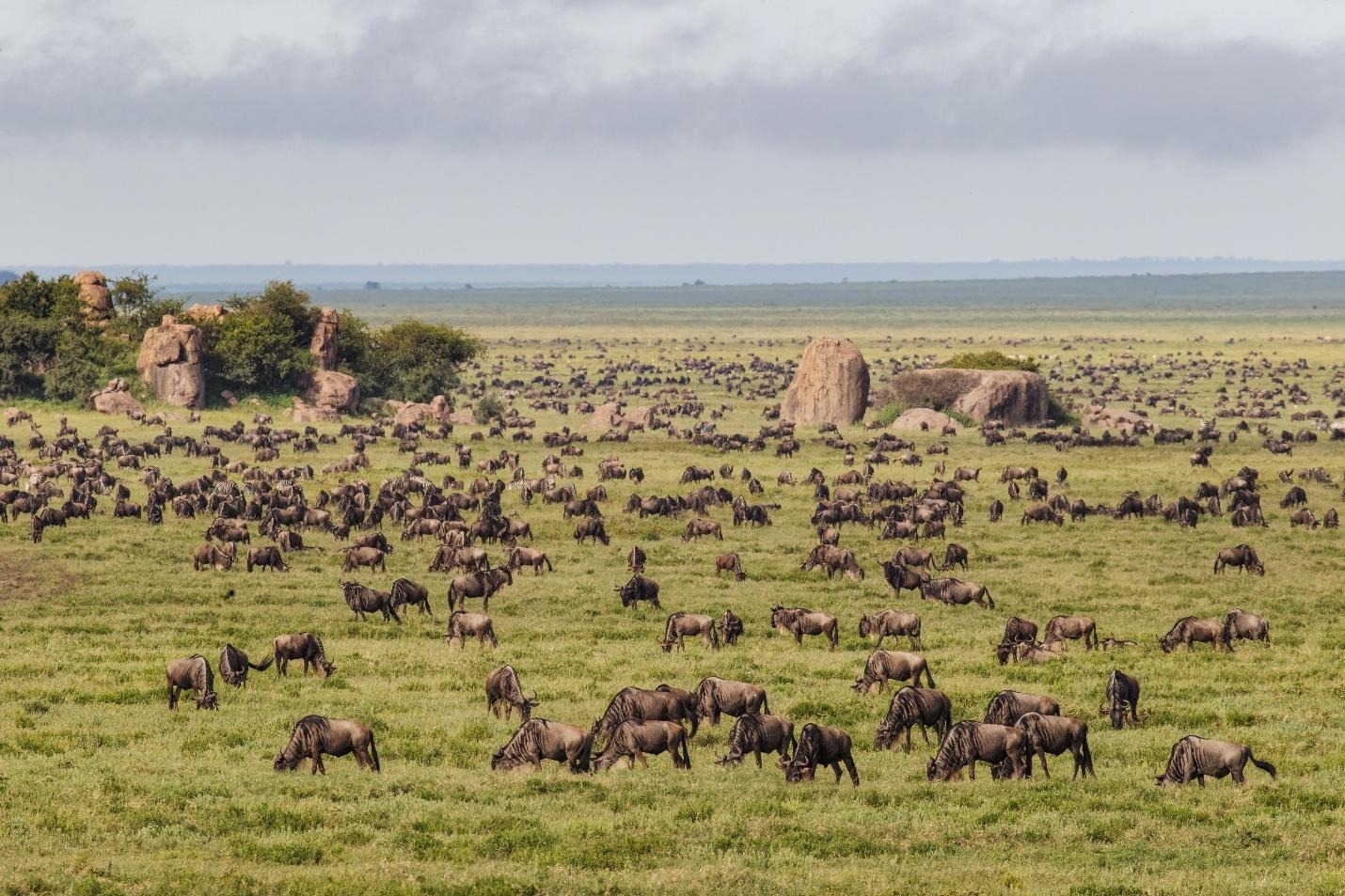
In the Serengeti, Every Movement Has a Reason. The vehicle stops. Your guide leans forward, studying the road. “Lion,” he says quietly, pointing to fresh prints pressed into the dust. Off in the distance, vultures circle. A herd of wildebeest stands tightly grouped, heads raised. Nothing looks dramatic yet — but something is unfolding.
In that moment, you realize a Serengeti Safari is not random. It is patterns.
The Serengeti National Park is not just a sightseeing location. It is a living system shaped by three forces:
- Migration — movement in search of grass and water
- Territory — space, borders, dominance
- Survival — daily choices that decide life or death
Understanding these lenses turns ordinary sightings into meaningful ones. It also helps travelers plan better game drives and set realistic expectations on a Tanzania Safari.
1) Migration: The Serengeti’s Moving Heartbeat
The Great Migration is not a parade, it’s a search.
When people ask for the Great Migration Serengeti explained, the simplest answer is this: animals move because they must.
Wildebeest, zebra, and gazelle follow rainfall. Rain brings grass. Grass brings life. When grazing thins or water dries, herds move.
This movement creates what we call the migration, but it is not a fixed show on a calendar. It shifts with nature. These are the true Serengeti migration patterns: fluid, weather-driven, and always adapting.
A common myth is that the migration appears in one place on a specific date. In reality, guides follow recent rain, grazing quality, and herd reports more than rigid monthly promises.
That is why flexible planning often works better than chasing headlines.
2) Where the Migration Goes (Without Turning It Into a Calendar Lecture)
You don’t chase dates, you follow signs.
At a high level, the herds move in a broad loop:
- Southern plains when the grass is short and fresh
- Central areas as movement builds
- Northern reaches when dry conditions push animals toward reliable water
But migration viewing is not only about river crossings.
It can look like:
- Thousands of animals grazing in loose lines
- Dust clouds rising across open plains
- Predators trailing herds at a distance
Sometimes the drama is quiet — calves staying close to mothers, lions watching from the shade. Weather and timing shape everything. Even the Best Time For a Serengeti Safari depends on rainfall patterns rather than fixed promises.
3) Territory: How Big Cats Use the Serengeti
Predators don’t roam randomly—they guard opportunity.
To understand a Tanzania big cats safari, you must understand the territory.
Lions
A pride defends a defined range rich in prey and water. This is the core of lion territory Serengeti dynamics. Roaring at night is not random noise — it is communication and boundary marking.
Leopards
They prefer quieter zones with trees and cover. Leopards hold overlapping but guarded spaces, often near rivers.
Cheetahs
They rely on open visibility. Rather than dense territory defense, they favor wide plains where speed becomes an advantage.
Territory shapes sightings. Some regions consistently host certain cats because prey and cover support them. Behavior cues help too: scent marking, patrol walks, and scanning from termite mounds.
This is how the Serengeti ecosystem becomes clearer — predators position themselves where survival odds improve.
4) Survival: The Daily Decisions You Witness on Game Drives
The Serengeti is full of small choices that matter.
Every drive reveals the Serengeti survival strategies wildlife depends on.
Prey Decisions
- Herds cluster tightly when nervous
- Calves stay central for protection
- Animals choose drinking spots carefully
- Vigilance increases at dawn and dusk
Predator Decisions
- Lions conserve energy during heat
- Hunts often happen in cooler hours
- Injured predators struggle, so risk is calculated
Scavengers’ Role
Hyenas, vultures, and jackals are not background characters. They are part of the predator-prey dynamics that the Serengeti depends on. They clean, compete, and adapt quickly.
None of this is random. It is a constant calculation.
5) Why Some Days Feel “Slow” on a Serengeti Safari
Quiet doesn’t mean empty; it means you are between stories.
Weather influences movement. Heat pushes animals into shade. Wind alters scent trails. Rain reshapes grazing patterns.
Animals rest. They spread out. They move into cover.
A slower day does not mean the system stopped working. It means you are between visible moments. Early mornings and late afternoons typically offer the most activity because temperatures favor movement.
Managing expectations is part of any honest Serengeti safari guide for beginners. The park rewards patience more than speed.
6) How to Plan Game Drives Around Migration, Territory, and Survival
Better planning comes from understanding patterns, not chasing headlines.
Smart planning aligns with natural rhythms:
- Morning drives for predator activity
- Midday exploration for landscapes, birds, and behavior observation
- Late afternoon drives for golden light and renewed movement
Staying multiple nights in one region increases your chances of witnessing territory behavior and migration shifts. Constant relocation often reduces depth.
A knowledgeable guide matters more than a guarantee. They read tracks, watch vultures, study herd tension — small signs that reveal bigger stories.
This approach improves your overall Tanzania Safari experience and makes your time in this iconic Tanzania Destination more meaningful.
7) Conservation and the Serengeti System
Protecting routes and habitats protects the whole story.
Migration corridors must remain open for herds to complete their cycle. When pathways are blocked, the system weakens.
Challenges exist — habitat pressure at park edges, climate variability, and poaching risks. But responsible tourism supports conservation.
Park fees fund protection. Local employment strengthens communities. Sustainable travel choices reinforce Tanzania Travel Safety and long-term preservation.
Protecting the Serengeti means protecting migration, territory balance, and survival patterns together.
Understanding The Serengeti Beyond Wildlife Sightings
When you view the Serengeti through migration, territory, and survival, sightings change. A nervous herd signals predator presence. Roaring at night signals boundary defense. Vultures reveal hidden stories.
Understanding turns moments into meaning.
A Serengeti Safari becomes less about luck and more about learning the system you are stepping into.
Book a Tanzania Safari built around smart positioning and early game drives, so you experience the Serengeti through real patterns — not rushed guesswork.
Plan your trip to match the season, your travel style, and the natural rhythms of the Serengeti. When you understand how it works, the wilderness stops feeling overwhelming and starts feeling connected.