

Why SaaS Security Is Being Redefined by AI
AI has moved from experimentation to execution in SaaS. What began as chatbots and recommendation engines has evolved into AI copilots, autonomous workflows, predictive analytics, and decision-making systems embedded deeply into SaaS products.
Today, AI is not just a feature – it is part of the core product logic.
But as SaaS platforms become more intelligent, they also become more exposed.
According to McKinsey, nearly 60% of organizations adopting AI report uncertainty around regulatory compliance and data governance, particularly in cloud-native and SaaS environments. This uncertainty is not theoretical – it directly impacts enterprise adoption, procurement cycles, and long-term trust.
In this new reality, SaaS security and compliance are no longer backend concerns. They are board-level priorities and competitive differentiators.
The Expanding SaaS Attack Surface in the Age of AI
From Predictable Software to Probabilistic Systems
Traditional SaaS applications were largely deterministic:
- Given an input, the system produced a predictable output.
- Security controls were rule-based.
- Compliance audits relied on static documentation.
AI-powered SaaS systems are:
- Probabilistic, not deterministic.
- Continuously learning.
- Heavily dependent on data pipelines, APIs, and external models.
New AI-Driven Threat Surfaces in Modern SaaS
1. Model-Level Security Risks
AI models introduce entirely new classes of vulnerabilities, including:
- Prompt injection attacks.
- Model manipulation or poisoning.
- Inference attacks that expose sensitive data.
- Hallucinated or unsafe outputs impacting users.
OWASP now lists LLM prompt injection among the most critical application security risks – placing it in the same category as SQL injection once was.
2. Training & Inference Data Exposure
AI-powered SaaS platforms rely on:
- User-generated data
- Behavioral analytics
- Domain-specific datasets (health, finance, HR, legal)
Without strict governance, this can lead to:
- Accidental PII or PHI exposure
- Cross-tenant data leakage
- Violations of GDPR, HIPAA, SOC 2, and regional data laws
3. API & Third-Party Dependency Risks
Modern AI SaaS products integrate:
- External AI APIs
- Data enrichment services
- IoT or device-level systems
- Multiple microservices across cloud providers
Each integration becomes a trust boundary – and attackers increasingly target these seams rather than core infrastructure.

Why Traditional Compliance Models Are No Longer Enough
The Compliance Gap Created by AI
Most SaaS compliance programs were designed for:
- Static architectures
- Periodic audits
- Clearly defined system behavior
This creates a compliance gap where:
- Documentation becomes outdated quickly
- Auditors struggle with explainability
- Teams lack real-time visibility into AI risk
Key Stat (McKinsey):
McKinsey reports that organizations integrating AI into core products face the highest compliance uncertainty, particularly around data governance, explainability, and regulatory alignment in SaaS and cloud environments.
 New Compliance Challenges Introduced by AI-Powered SaaS
1. Explainability & Auditability
Regulators and enterprise customers increasingly expect:
- Clear explanations of AI-driven decisions
- Traceable data lineage
- Visibility into how models are trained and updated
2. Data Residency & Sovereignty
For SaaS companies operating globally:
- EU GDPR
- US sectoral regulations
- UAE and Middle East data protection laws
AI models hosted across regions can violate data residency requirements if not architected correctly.
3. Continuous Compliance Requirements
Compliance must shift from:
Annual audits → Continuous monitoring and enforcement
This requires automation, observability, and AI-aware governance frameworks.
Why Buyers Now Evaluate SaaS Through a Trust Lens
Enterprise SaaS buyers no longer ask only:
- What features does this product have?
They ask:
- Can we trust this platform with our data?
- Can it pass our security and compliance reviews?
- Is its AI safe, transparent, and governed?
Trust directly impacts:
- Enterprise deal velocity
- Procurement approvals
- Customer retention
- Brand reputation
New Trust Models for AI-First SaaS Platforms
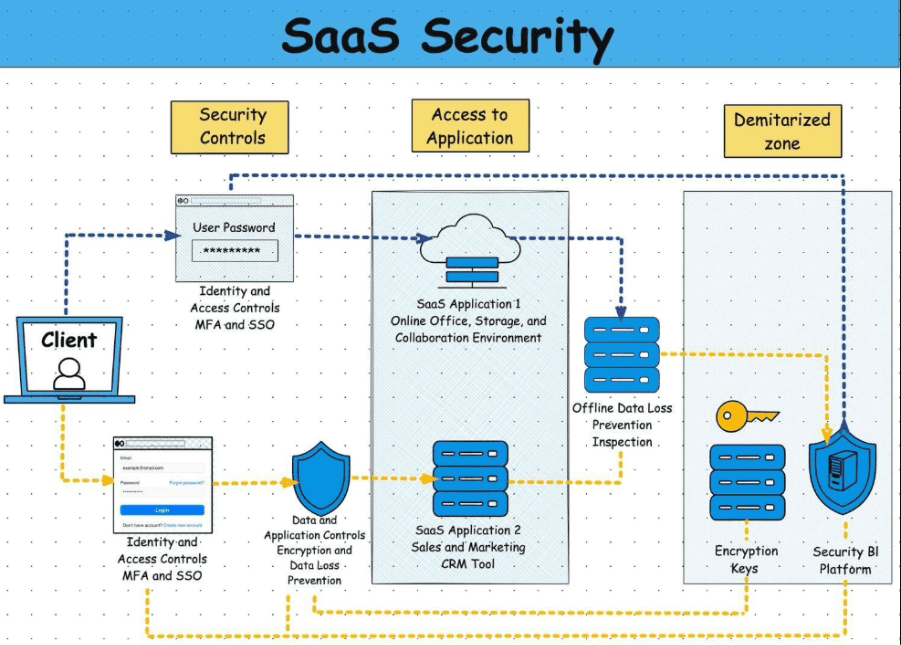
1. Zero Trust Architecture
Modern SaaS platforms adopt:
- Continuous identity verification
- Least-privilege access
- Micro-segmentation across services and data layers
2. AI Governance by Design
Leading SaaS products embed:
- Model approval workflows
- Human-in-the-loop validation
- AI usage policies enforced at the product level
3. Radical Transparency
Clear communication about:
- How AI is used
- What data is processed
- Where automation ends and human oversight begins
Real-World SaaS Security Challenges
Challenge 1:
We Want AI Innovation, but Enterprises Demand Compliance
The Reality:
Many SaaS companies want to ship AI features fast—but enterprise clients demand SOC 2, GDPR, HIPAA, or ISO alignment.
How Ailoitte Helps:
- Designs AI-first, compliance-ready architectures
- Implements secure data isolation for AI pipelines
- Builds audit-friendly logging and monitoring
- Aligns AI workflows with enterprise compliance controls
Result: Faster enterprise onboarding without slowing innovation.
Challenge 2:
We Don’t Fully Understand Our AI Data Flows
The Risk:
- Compliance violations
- Security blind spots
- Loss of customer trust
Ailoitte’s Approach:
- Data classification frameworks (PII, PHI, sensitive data)
- End-to-end AI data lineage mapping
- Fine-grained access control at data and model levels
- Consent-aware AI processing
Challenge 3:
Our SaaS Integrates AI, APIs, and IoT – Security Is Fragmented
The Problem:
Security tools operate in silos while attackers exploit integration gaps.
Ailoitte’s Solution:
- Unified security architecture across:
- Cloud infrastructure
- APIs
- AI models
- IoT and device layers
- Threat modeling at the system-of-systems level
- Secure-by-design integration patterns
How Ailoitte Builds Secure, Compliant AI-Powered SaaS Products
Ailoitte approaches security and compliance as foundational product capabilities, not add-ons.
AI-First SaaS Engineering Framework
1. Discovery & Risk Assessment
- AI threat modeling
- Compliance gap analysis
- Trust boundary identification
2. Secure Architecture Design
- Zero Trust principles
- AI-safe data pipelines
- Secure API orchestration
3. AI Governance Implementation
- Model monitoring and drift detection
- Bias and risk controls
- Human-in-the-loop workflows
4. Compliance Enablement
- SOC 2, ISO 27001 readiness
- GDPR and HIPAA alignment
- Audit documentation automation
5. Continuous Security & Compliance
- Real-time monitoring
- Automated policy enforcement
- Ongoing risk assessments
Why SaaS Founders, CTOs, and CISOs Choose Ailoitte?
Clients partner with Ailoitte not just to build software – but to build trustable, enterprise-ready products.
What Sets Ailoitte Apart
- Deep expertise in AI-powered SaaS development
- Strong focus on secure SaaS product architecture
- Experience across healthcare, fintech, and enterprise SaaS
- Global compliance understanding (EU, US, Middle East)
- Ability to scale from MVP to enterprise-grade platforms
The Business Impact of Getting SaaS Security Right
Investing in AI-native security and compliance delivers tangible ROI:
- Faster enterprise sales cycles
- Reduced regulatory and breach risk
- Higher customer trust and retention
- Scalable AI innovation without fear
According to IBM reports that organizations with mature security practices experience up to 43% lower breach costs and significantly faster enterprise deal closures.
Final Thoughts: Security Is Now a Growth Strategy
In the age of AI, SaaS success is not defined by features alone.
It is defined by:
- Trust
- Transparency
- Compliance
- Resilience
The SaaS companies that win in 2026 and beyond will be those that embed security and compliance into their AI strategy from day one.
Ready to Build a Secure, Compliant AI-Powered SaaS Platform?
If you are planning to:
- Launch an AI-first SaaS product
- Add AI capabilities to an existing platform
- Prepare for SOC 2, GDPR, HIPAA, or enterprise audits
- Redesign your SaaS architecture for AI-era security
Schedule a free consultation with Ailoitte