

Not all seven features carry equal weight in every backyard — but any coop missing more than two of them is a vulnerability waiting to be exploited. Predators are patient, persistent, and far more capable than most new flock owners expect. Understanding what they can actually do to a standard coop is the starting point for building a setup that holds.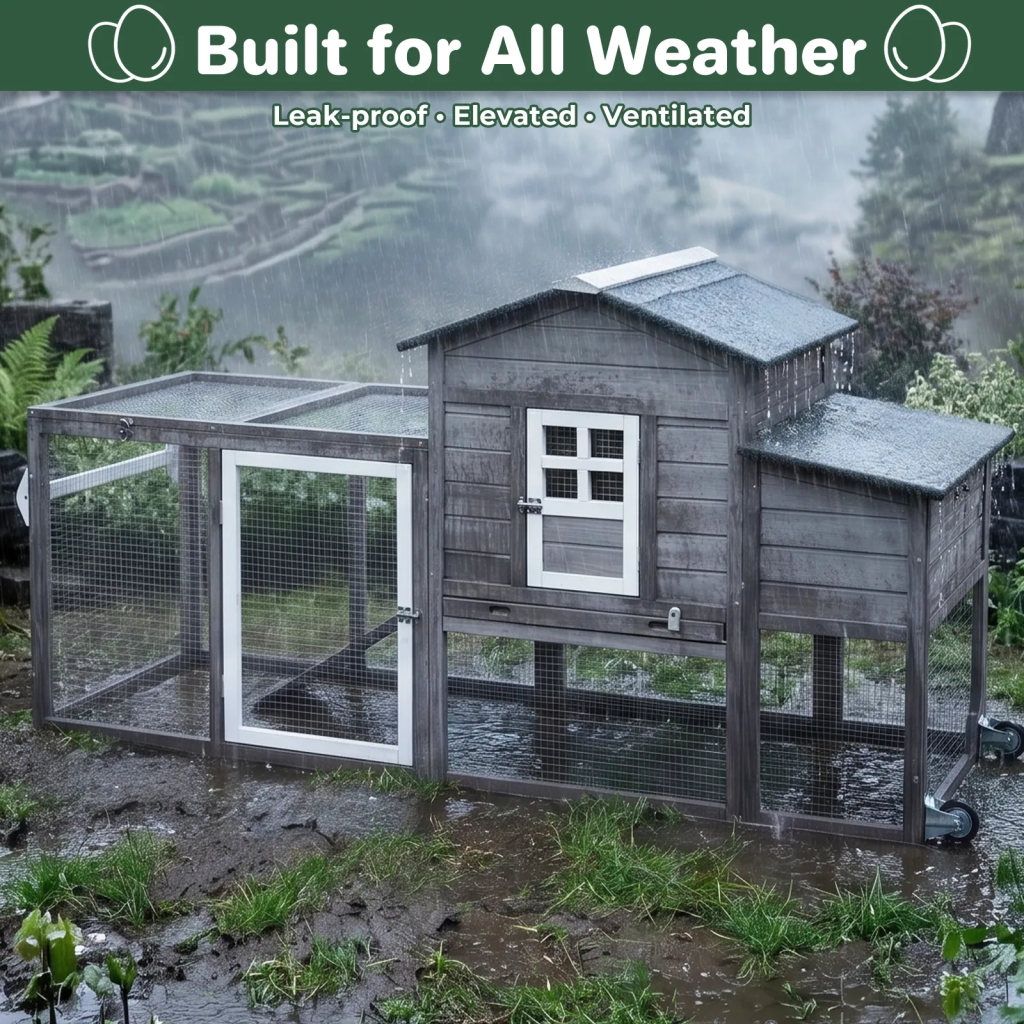
Why Predator Pressure Is Worse Than Most Buyers Anticipate
The typical first-time coop buyer focuses on size, aesthetics, and price. Predator resistance is often an afterthought — until it isn’t.
Raccoons can manipulate simple latches with their hands. Foxes dig efficiently and can breach a standard poultry wire run in under ten minutes. Minks and weasels can squeeze through a one-inch gap. Hawks don’t need a gap at all if the run has no overhead cover. And domestic dogs — often overlooked — cause more backyard flock losses than any wild predator in suburban areas.
The threat profile varies by region, but almost no backyard in North America is genuinely predator-free. Urban properties face raccoons, rats, and neighborhood dogs. Suburban yards add foxes and hawks. Rural properties add coyotes, weasels, minks, and in some areas, bears.
A coop that isn’t built to resist active, intelligent predator pressure isn’t a safe home for your birds — it’s a slow-motion problem waiting for the right night.
The Core Principle: Assume the Predator Is Smarter and Stronger Than You Expect
The most reliable framework for evaluating coop security is to stop thinking about predators as opportunistic and start treating them as methodical. A raccoon that finds your coop will return to it repeatedly, testing every latch, every panel join, every gap, on successive nights until it finds the weakness or gives up.
Security features that work are those that eliminate weaknesses entirely — not those that make access slightly harder. A latch that requires two simultaneous movements to open is not “harder for a raccoon.” It’s a problem that takes a raccoon two or three nights to solve instead of one.
Design for no viable entry point, not for a high barrier to entry.
The 7 Features That Actually Matter
1. Hardware Cloth, Not Poultry Wire
This is the most consequential material decision in any coop build or purchase. Standard poultry wire — the hexagonal mesh sold in most garden and farm stores — keeps chickens in. It does not keep predators out.
Poultry wire is thin-gauge and flexible. A raccoon can pull it apart at the joins with its hands. A fox can chew through it in minutes. Hardware cloth, by contrast, is welded wire mesh with rigid, square openings. The standard specification for poultry security is 16-gauge hardware cloth with half-inch openings.
Any chicken coop with run using standard poultry wire on its run panels is not predator-proof, regardless of what any other feature does. Hardware cloth on all exposed panels — sides, top, and anywhere wire meets wood — is the non-negotiable foundation.
2. Secure, Two-Step Latches on Every Access Point
Every door, every clean-out panel, every nesting box lid, and every run gate is an access point. Every access point needs a latch that a raccoon cannot open.
Simple hook-and-eye latches fail this test. Single-action sliding bolts fail this test. The standard that consistently holds is a latch requiring two distinct, simultaneous actions to open — a carabiner-style clip, a barrel bolt paired with a secondary lock, or a padlock on any door used infrequently. Apply this standard to every opening on the coop without exception. A single standard latch on a nesting box lid is enough.
3. A Buried or Apron Hardware Cloth Perimeter
Digging predators — foxes, coyotes, skunks, and rats — approach a coop from below. A run that sits on bare ground with no subsurface barrier can be breached by a determined fox in a single night.
The two reliable solutions are a buried perimeter or a ground apron. A buried perimeter means hardware cloth extending 12 inches straight down from the base of the run walls, then bending outward another 12 inches horizontally underground. An apron achieves the same result by laying hardware cloth flat on the ground extending 18–24 inches outward from the coop base, secured with landscape staples and covered with soil or gravel. Predators that begin digging at the wall hit the apron and abandon the attempt.
Mobile coops cannot use a buried perimeter, but they can use a portable apron system relocated with each move.
4. No Gaps Larger Than Half an Inch
Minks and weasels — frequently overlooked in predator-proofing discussions — can compress their bodies through a one-inch gap. Once inside a coop, a single weasel can kill an entire flock in one night. Rats enter through gaps as small as half an inch and can both steal eggs and introduce disease.
Walk the coop structure looking for any gap at joins between wood panels, where the roof meets the walls, where the run frame meets the ground, and where access doors don’t fully close. Any gap approaching one inch needs to be sealed — with hardware cloth, wood filler, or structural modification. Half-inch hardware cloth on all panels prevents both large and small predator entry simultaneously.
5. A Solid, Lockable Roosting Area Separate from the Run
The run is where chickens spend their day. The roosting area is where they sleep — and where they’re most vulnerable. These two spaces need different security standards.
The enclosed roosting area should be fully solid-walled with no wire panels. Wood, composite, or metal walls on all sides. A solid floor or a hardware cloth floor with no gap at the wall joins. A door that latches securely every night. The distinction matters because many predators — particularly raccoons — are primarily nocturnal. A bird sleeping in a wire-sided run has no meaningful protection after dark. A bird locked into a solid roosting area is dramatically safer.
An automatic coop door — a timer or light-sensor operated door that closes the roosting area at dusk — is one of the highest-value additions to any chicken setup. Human error (forgetting to close up) is a leading cause of predator loss.
6. Overhead Cover on the Run
Aerial predators are frequently overlooked in ground-level predator discussions. Hawks, owls, and in some regions eagles, take chickens from open runs in daylight hours. A run with no overhead cover is an open invitation.
Hardware cloth or solid roofing over the full run area eliminates aerial predator access. At minimum, cover the run with hardware cloth stretched across the top and secured to the frame. In areas with heavy bird-of-prey pressure, solid roofing over part of the run gives chickens a covered area to retreat to when a predator is spotted overhead — chickens instinctively seek cover when threatened from above.
7. Elevation Off the Ground
A coop raised on legs or a frame serves two security functions simultaneously. It eliminates the ground-level hiding and nesting opportunities that attract rats, mice, and snakes directly beneath the structure. And it removes the direct ground contact that accelerates wood rot — rot that eventually creates gaps and structural weaknesses that predators exploit.
An elevation of 12 inches or more is sufficient. The area beneath an elevated coop should remain accessible for cleaning and inspection. Hardware cloth skirting around the underside of an elevated run, if applicable, closes off the under-coop space as a predator refuge while maintaining airflow.
The Mistakes That Undermine Otherwise Solid Setups
Securing the coop but leaving the run unaddressed. A fortified roosting area attached to a poorly secured run creates a false sense of safety. Predators that breach the run and can’t reach birds at night will simply return every evening until they find an opportunity.
Using poultry wire because it came with the coop. Many retail coops include standard poultry wire on run panels as a cost-control measure. Replacing it with hardware cloth on a new coop is a standard first modification — not optional if predator pressure exists.
Forgetting the nesting box lid. Nesting box access panels are frequently the least secure point on an otherwise well-built coop. A single hook-and-eye latch on a nesting lid is the entry point a raccoon will find first.
Assuming urban properties have lower predator risk. Urban and suburban environments often have higher raccoon densities than rural areas, because food availability is greater and hunting pressure is lower. City coops need the same predator-proofing standard as rural ones.
The Bottom Line
Predator-proofing is not a single product feature or a single modification. It’s the sum of seven specific structural standards applied consistently across every access point, every panel, and every vulnerable join in the coop. A setup that scores well on six of the seven features and has one overlooked weakness is not a six-sevenths secure coop — it’s an unsecured coop with a single point of failure waiting to be found.
Evaluate any coop — existing or prospective — against all seven features. Address deficiencies before you add birds, not after your first loss.