
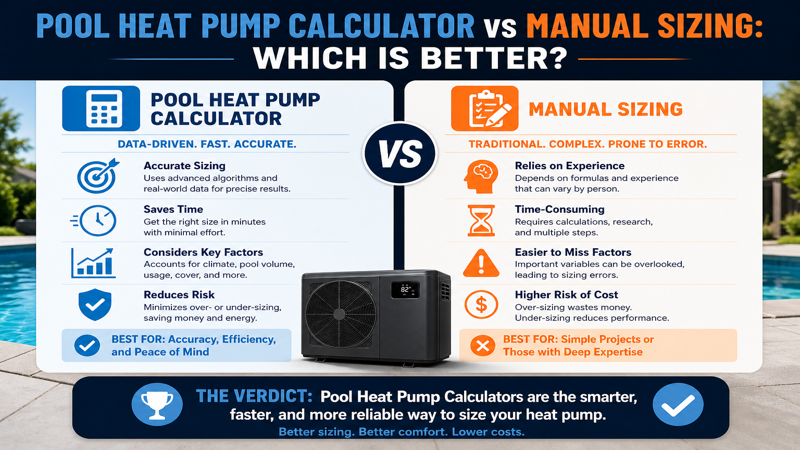
Most Australian pool owners size their heat pump once, get it wrong, and spend years running a unit that either cannot keep up in winter or costs far more to run than it should. The mistake usually happens at the very first step: deciding whether to use a pool heat pump calculator or do the calculation manually, without understanding what each method actually requires.
This blog breaks down both approaches using real Australian conditions, the inputs each method needs, where each one typically fails, and which one gives you a result you can rely on.
How Manual Sizing Works
Manual sizing means calculating the heat pump output you need using formulas based on your pool’s physical characteristics and local climate. Here is what that process involves.
Step 1 — Calculate Your Pool Volume
Multiply your pool’s length by its width by its average depth. This gives you volume in cubic metres, which you convert to litres (multiply by 1,000). For pools with a sloped floor, average the shallow-end and deep-end depths. A standard Australian backyard pool typically holds between 40,000 and 80,000 litres.
Step 2 — Determine Heat Loss Rate
Most heat escapes through the pool’s surface via evaporation, radiation, and convection. To estimate heat loss, you need:
- Your pool’s surface area in square metres.
- The gap between your target water temperature and the average ambient air temperature.
- Whether the pool is exposed to wind, which increases evaporation significantly
Step 3 — Factor In Heating Time
Decide how quickly you need the pool to reach temperature from cold. A pool that needs to be heated within 24 hours requires a larger unit than one that can take 48 to 72 hours. This directly affects the kilowatt (kW) output you need.
Step 4 — Apply Climate and Cover Corrections
An uncovered pool in a warm, dry climate like Perth or Adelaide loses a large volume of water to evaporation daily, which strips heat rapidly. A pool in a humid subtropical climate like Brisbane loses less to evaporation but still gains and loses heat unevenly across the year.
A pool cover reduces overnight heat loss by up to 75 per cent, regardless of location, which directly affects the heat pump output you need.
Done correctly with accurate local data, manual sizing produces a reliable result. The problem is that sourcing precise climate data for your specific postcode and applying the formulae without errors requires time and technical confidence that most pool owners do not have.
Where Manual Sizing Goes Wrong
Manual sizing fails most often because of input errors, not formula errors. These are the most common mistakes:
- Wrong Pool Volume: Builders’ quoted volumes are often approximate. A pool listed as 50,000 litres may be 43,000 or 57,000 litres, depending on the actual slope and shape. Measure it yourself.
- Generic Temperature Data: Using city-wide averages instead of your specific postcode produces inaccurate heat loss figures, particularly in coastal or elevated locations where temperatures differ from nearby urban centres.
- Ignoring Pool Cover Usage: Selecting ‘no cover’ when you use one sometimes is a common mistake. An uncovered pool requires significantly more heating capacity, so the calculation must reflect your actual habits.
- Skipping Wind Exposure: A pool in a wind-exposed backyard loses heat much faster than a sheltered one. Most manual calculations treat wind as optional, but in exposed locations, it meaningfully affects the result.
How a Pool Heat Pump Calculator Works
A pool heat pump calculator applies the same sizing principles as manual calculation, but it handles the complex steps automatically using validated formulas and location-specific climate data.
You enter your pool details through a straightforward form. The tool processes those inputs and returns a recommended heat pump output in kilowatts, along with supporting information to help you understand the result.
What You Enter
- Pool length, width, and average depth.
- Your postcode or location.
- Target water temperature.
- Whether you use a pool cover.
- How quickly you want the pool to heat from cold.
What You Get Back
- Required heat pump output in kW.
- Estimated running cost based on your climate zone.
- A recommended model suited to your pool size and conditions.
The key difference from manual sizing: a quality swimming pool heat pump calculator pulls real climate data for your postcode. It does not use generic regional averages. That single factor alone makes the output significantly more accurate than most manual estimates.
Manual Sizing vs Pool Heat Pump Calculator: Direct Comparison
Both methods aim to answer the same question: what kilowatt output does your pool need? But they differ significantly in how they get there.
Here is how they compare across the five factors that matter most to Australian pool owners.
Accuracy:
Manual sizing is accurate only when the person doing it has access to precise local climate data and applies the formulae correctly. For most Australian pool owners, neither condition is reliably met.
A pool heat pump size calculator uses postcode-level temperature and evaporation data validated for Australian conditions, making it consistently more accurate than a manual estimate done without specialist knowledge.
Time Required:
This is how long it takes to go from having your pool measurements to having a reliable heat pump size recommendation in hand.
Manual sizing done properly takes 30 to 60 minutes, including sourcing BOM temperature data, working through the formulae, and checking the result. A digital pool pump calculator takes under five minutes.
Climate Data Quality:
Climate data quality determines whether the heat loss calculation reflects your pool’s actual conditions or a regional average that may not apply to your suburb.
Manual sizing depends on whatever temperature figures you can find, which are usually city-wide BOM averages.
A calculator uses postcode-specific data, which is meaningfully more accurate for Australian pools in coastal, elevated, or inland locations that differ from the nearest major weather station.
Accessibility:
Manual sizing requires an understanding of heat transfer principles, formulas, and unit conversions. A digital calculator is designed for pool owners with no engineering background. You answer the questions; it does the maths.
Consistency:
Two people doing a manual calculation from the same pool measurements will often arrive at different answers depending on which temperature figures they use and how they handle corrections. A calculator produces the same result every time from the same inputs.
How to Get an Accurate Result From a Pool Heat Pump Calculator
The output is only as accurate as your inputs. Follow these steps to get a reliable result:
- Measure your pool yourself: Do not use builder estimates or council approval plans. Measure the actual finished length, width, and water depth with a tape measure.
- Use your postcode, not your city: Climate conditions vary within cities. Entering your postcode gives the calculator the most precise temperature and conditions data for your location.
- Be accurate about pool cover use: If you only use a cover in winter, do not select ‘always covered.’ The calculator adjusts capacity based on heat loss, and an inaccurate cover selection will skew the result.
- Set a realistic heating time target: If you need the pool ready for a weekend, you need a faster heat-up than someone who runs the unit continuously. Your target time directly affects the kW recommendation.
Which Method Should You Use?
For Australian pool owners, a digital pool heat pump calculator provides more reliable results than a manual estimate in almost every residential case. The reason is not that the formulae are different; they are the same. It is that the calculator applies them consistently using accurate postcode-level climate data, without the risk of input errors that make most manual sizing attempts unreliable.
Manual calculation still has a legitimate role for complex or commercial pools, or when a specialist is completing a full site assessment. But for a standard backyard pool anywhere in Australia, from Broome to Ballarat, the calculator gives you the answer you need without the guesswork.
The Madimack pool heat pump calculator is built specifically for Australian conditions. It uses postcode-level climate data across every state and territory, accounts for local evaporation rates and seasonal temperature ranges, and returns a heat pump recommendation sized to your actual pool and location — not a generic estimate.