

The instinct to train in-person is understandable. But when the price gap reaches $200 per session, the conversation deserves a harder look.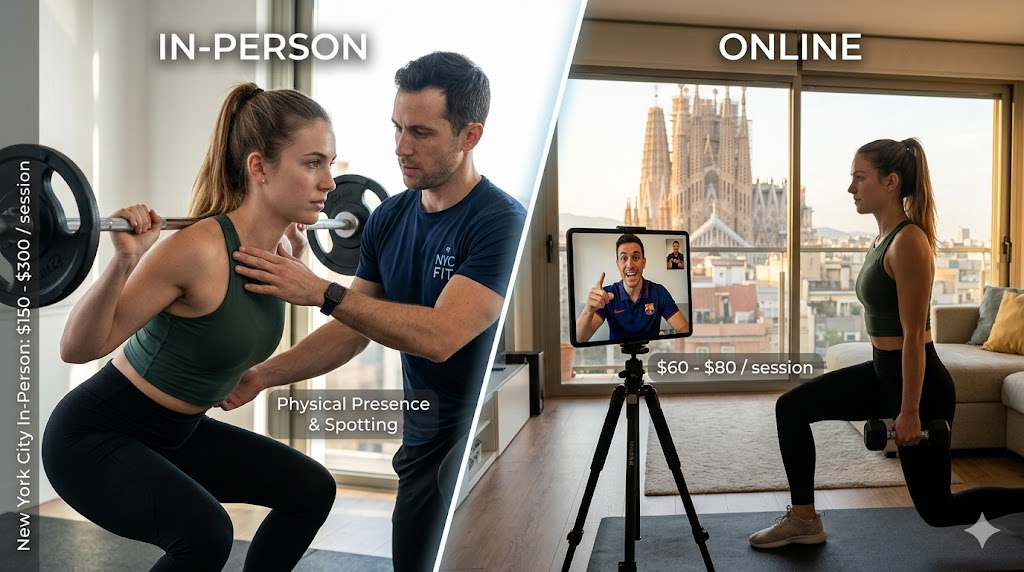
Ask most people whether they’d prefer to train with a personal trainer in person or online, and the instinctive answer is still in person. There’s something about physical presence, someone watching your form, adjusting your position, and pushing you when you slow down, that feels more serious, more real, and more likely to get results. That instinct isn’t entirely wrong. But it’s based on an assumption that deserves a harder look, especially when you factor in what in-person training actually costs in 2025.
This is the comparison that’s increasingly being made by Americans who want professional fitness coaching but have done the math on what it actually costs. And the conclusion more and more of them are reaching is that the online personal trainer cost advantage is significant enough to change the decision entirely.
The Honest Case for In-Person Training
Let’s start with what in-person training genuinely offers that online can’t fully replicate.
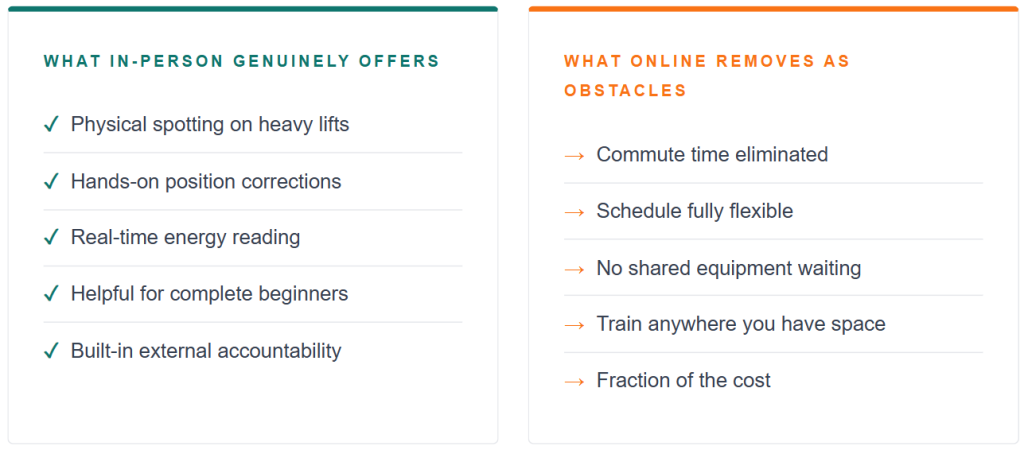
Physical presence means your trainer can spot you on heavy lifts, which has real safety implications. They can physically adjust your body position in ways that verbal cues sometimes fail to achieve. They can read your energy in real time in ways that a camera doesn’t always capture. For someone learning foundational movement patterns for the first time, having someone physically present during those early sessions can accelerate the learning curve. These are real advantages.
The Honest Case for Online Training
Here’s the other side of that equation.
The form correction advantage of in-person training is real but often overstated. The vast majority of what a trainer does, program design, exercise selection, loading recommendations, nutritional guidance, accountability, and motivation, has nothing to do with physical proximity. All of that transfers online without any loss of quality.
“Many coaches actually prefer video-based form review because it allows clients to watch the feedback multiple times rather than trying to absorb a correction in the moment.”
The scheduling flexibility of online training is a significant practical advantage. You don’t need to coordinate your schedule with a trainer’s availability and a gym’s opening hours simultaneously. You train when your day allows, in whatever space you have available, and check in with your coach on a rhythm that suits both parties.
The Numbers That Are Changing Minds
In New York City, a qualified personal trainer charges between $150 and $300 per hour for in-person sessions. In Los Angeles, Chicago, and other major metro areas, the range is similar. Even in smaller American cities, rates of $80 to $120 per hour are common.
Now consider what it costs to work with an equally qualified online personal trainer based in a city like Barcelona. Session rates typically run between $60 and $80. For an American training twice per week, the annual saving from switching to an online coach in Barcelona versus an in-person trainer in New York can easily exceed $15,000.
The reason for the difference isn’t about quality. It’s about geography. A professional personal trainer who lives in Barcelona, Spain, has local expenses denominated in a European economy. They can charge internationally competitive rates while earning a strong income relative to their local cost of living.
The Quality Question Examined
The concern most people have when they see lower prices from international coaches is whether the quality is comparable. Spain has excellent sports science universities. Barcelona specifically has a rich sporting culture and a strong tradition of professional athletics and football conditioning. Many coaches operating from personaltrainerbarcelona.com hold internationally recognized certifications and have worked with competitive athletes at serious levels.
The question to ask when evaluating any trainer, online or in person, local or international, is, “Can they assess properly?” Can they program intelligently? Can they communicate feedback clearly? Can they keep me engaged and progressing over time? Those answers don’t correlate with geography. They correlate with the individual coach.
Who Should Choose Online, and Who Should Stay In-Person
Online training is an excellent choice if you have some existing fitness experience, understand basic exercise technique, are self-motivated enough to follow a program without someone standing next to you, and want to work with a high-quality personal trainer without paying high-cost-of-living prices.
In-person training still makes the most sense if you’re a complete beginner with no movement foundation, if you have complex physical rehabilitation needs that require hands-on assessment, or if you genuinely struggle with self-discipline.
For the large majority of people in the middle, those who have trained before, who know their way around a gym, and who are primarily looking for better structure and accountability, online coaching is not a lesser option. It’s a different delivery mechanism for the same service, at a dramatically lower price.
That’s why Americans are choosing it in increasing numbers. The honest comparison points clearly in one direction. Do your research, find a coach whose credentials and approach you trust, and stop paying New York prices when Barcelona-level expertise is available globally.