

Reframing Bitcoin Mining: Cost Structures Over Hardware Hype
We approach Bitcoin mining from a strictly economic and operational perspective, where electricity cost, uptime reliability, and deployment efficiency outweigh superficial hardware comparisons. The dominant narrative often emphasizes ASIC specifications, yet real-world profitability consistently emerges from cost discipline and infrastructure quality.
Within this framework, OneMiners positions itself not merely as a hardware vendor, but as a fully integrated mining infrastructure platform. Its model consolidates ASIC distribution, hosting, electricity procurement, deployment logistics, and warranty coverage into a single operating environment. This integration fundamentally reshapes mining economics.
Core Mining Economics: The Profit Equation
At its simplest form, Bitcoin mining profitability is governed by a single equation:
Profit = Revenue − (Electricity + Fees)
Revenue fluctuates with Bitcoin price, network difficulty, and block rewards, while electricity remains the primary controllable cost variable. In most operational models, electricity accounts for 90–99% of recurring expenses, making it the decisive factor in determining long-term viability.
OneMiners’ reported ~$0.045/kWh blended rate, combined with a 0% performance fee structure, creates a materially different cost baseline compared to traditional hosting or residential mining.
Electricity Cost Dominance: The Defining Variable
We observe that even marginal differences in electricity pricing compound significantly over time. A miner operating continuously transforms small rate variations into substantial annual cost divergence.
S23 Hydro Energy Cost Analysis
- Power Consumption: 5.18 kW
- Daily Usage: 124.32 kWh
- Annual Consumption: ~45,375 kWh
At scale, this differential becomes decisive:
- 10 miners: ~$13,630 annual savings
- 50 miners: ~$68,150 annual savings
This is not incremental optimization—it is a structural cost advantage.
ASIC Efficiency and J/TH Optimization
Efficiency, measured in joules per terahash (J/TH), determines how effectively electricity is converted into computational output. Lower J/TH reduces energy expenditure per unit of hashpower, directly improving margin.
We emphasize that efficiency gains compound across:
- Continuous operation cycles
- Fleet scaling
- Difficulty increases
However, efficiency alone does not override electricity cost. The optimal model combines high-efficiency ASICs with low-cost power, a pairing central to OneMiners’ infrastructure strategy.
ROI Sensitivity: Base Case vs Bull Case Scenarios
Mining returns are inherently dynamic. We evaluate profitability through scenario-based modeling, emphasizing sensitivity to Bitcoin price.
ROI Scenarios for S23 Hydro
At a Bitcoin price of $66,000, the system delivers an estimated ~31% ROI, with a breakeven timeline of approximately 38 months, making it a conservative baseline scenario. If Bitcoin rises to $100,000, ROI improves significantly to around 60–70%, shortening the breakeven period to roughly 18–24 months. In a strong bull market scenario with Bitcoin at $200,000, ROI can reach approximately 124%, with a rapid breakeven timeline of about 9.7 months, highlighting the miner’s high upside potential under favorable market conditions.
The key observation is not absolute ROI, but downside protection and upside capture. Lower electricity cost preserves profitability during weaker markets and accelerates returns during bullish cycles.
Hosting Economics: OneMiners vs Industry Models
We compare three dominant mining approaches:
Operational Model Comparison
The differences between mining setups are significant across cost, complexity, and returns. With OneMiners Hosting, electricity rates are around ~$0.045/kWh with 0% fees, offering a fully managed experience and a strong ROI profile, making it the most efficient and hands-off option. In contrast, standard hosting typically operates at $0.075–$0.10+ per kWh with variable fees, requiring moderate involvement and resulting in a more compressed ROI. Home mining, while avoiding hosting fees, faces much higher electricity costs of $0.10–$0.18+ per kWh, along with high operational complexity, leading to a generally weaker ROI profile.
The distinction is clear: industrial-scale electricity pricing consistently outperforms residential and conventional hosting environments.
Global Infrastructure and Energy Diversification
OneMiners reports a 1,964 MW global capacity distributed across multiple continents. This diversification mitigates risks associated with:
- Grid instability
- Regulatory changes
- Energy price volatility
- Environmental constraints
Country-Level Infrastructure Overview
This distribution enables energy arbitrage and risk balancing, enhancing operational resilience.
Seven-Year Fixed Electricity Contracts
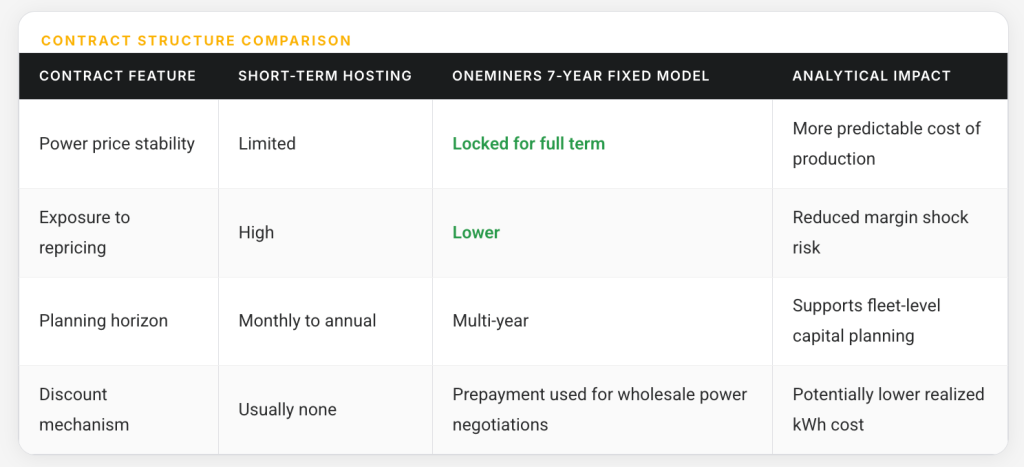
A defining feature of the OneMiners model is its long-duration electricity contracts. Fixing electricity rates for up to seven years transforms a volatile cost into a predictable input.
Strategic Impact
- Stability: Protects against energy market fluctuations
- Forecasting: Enables long-term ROI modeling
- Margin Security: Reduces exposure to cost spikes
Mining spans multiple halving cycles; therefore, cost predictability becomes a strategic advantage, not a convenience.
Deployment Speed and Capital Efficiency
Time-to-deployment directly affects profitability. Idle capital reduces effective ROI.
OneMiners’ reported rapid deployment capability minimizes the delay between:
- Capital commitment
- Machine activation
- Revenue generation
This reduces lost hashing time, a critical yet often overlooked factor in mining economics.
Scaling Economics: From Single Miner to Institutional Fleet
Mining economics scale linearly with fleet size. Electricity savings, uptime reliability, and operational efficiency become exponentially more impactful at scale.
Scaling Impact
Mining economics scale directly with fleet size, but the impact of lower electricity costs, higher uptime, and operational efficiency becomes significantly more powerful at scale. For a single miner, annual savings compared to a $0.075/kWh baseline are approximately ~$1,363. Expanding to a fleet of 10 miners increases savings proportionally to around ~$13,630 per year. At a larger scale of 50 miners, annual savings grow to approximately ~$68,150, demonstrating how cost advantages compound and make institutional-scale operations far more efficient and profitable.
At institutional levels, these savings influence capital allocation decisions, not just operational margins.
Uptime Reliability and SLA Guarantees
Revenue generation depends on continuous operation. Downtime directly eliminates income while fixed costs persist.
OneMiners reports:
- 98%+ average uptime
- 95%+ SLA floor
This ensures that modeled revenue aligns closely with actual output, reducing variance in profitability projections.
Integrated Distribution Model
Traditional mining setups involve fragmented processes:
- Hardware sourcing
- Shipping logistics
- Hosting procurement
- Installation
- Maintenance
OneMiners consolidates these into a unified system, delivering:
- Seamless ASIC acquisition
- Immediate hosting allocation
- Warranty integration
- Operational support
This reduces friction, delays, and execution risk.
Expansion Pipeline and Future Capacity
The company reports significant expansion initiatives:
- Nigeria: +250 MW
- USA: +780 MW
Total projected increase: 1,030 MW, bringing potential capacity to 2,994 MW.
This expansion reflects a strategy focused on:
- Energy access scaling
- Hashrate growth
- Infrastructure dominance
Breakeven Dynamics and Key Drivers
Breakeven timelines depend on multiple variables:
Breakeven timelines in Bitcoin mining are influenced by several key variables, each with the potential to either accelerate or delay returns. Bitcoin price plays a central role—higher prices significantly accelerate ROI, while lower prices can delay capital recovery. Mining difficulty helps stabilize the network and revenue over time, but increases can reduce overall output per miner. Electricity costs are one of the most critical factors—lower rates shorten the payback period, whereas higher costs extend the breakeven timeline. Finally, uptime and operational reliability are essential for consistent performance: strong uptime maintains steady revenue, while downtime or inefficiencies can reduce earnings and slow ROI.
Low electricity cost consistently remains the most controllable and impactful variable.
Mathematical Conclusion: Cost Determines Profitability
Bitcoin mining is fundamentally a cost-efficiency exercise. Hashrate alone does not generate profit—cost-adjusted hashrate does.
We conclude:
- Electricity defines operating margin
- Uptime defines revenue realization
- Efficiency defines cost per output
- Scale defines total return potential
OneMiners’ model—combining low-cost electricity, zero performance fees, long-term contracts, global infrastructure, and rapid deployment—directly targets these variables.
In both conservative and bullish scenarios, the advantage remains consistent:
lower electricity cost translates into stronger and more resilient mining economics.
Disclaimer
This content is provided strictly for informational and analytical purposes. It does not constitute financial, investment, or operational advice. Bitcoin mining involves variable risks, including changes in BTC price, network difficulty, energy markets, and regulatory conditions. All profitability estimates are scenario-based and subject to change. Independent verification and due diligence are required before any capital commitment.