

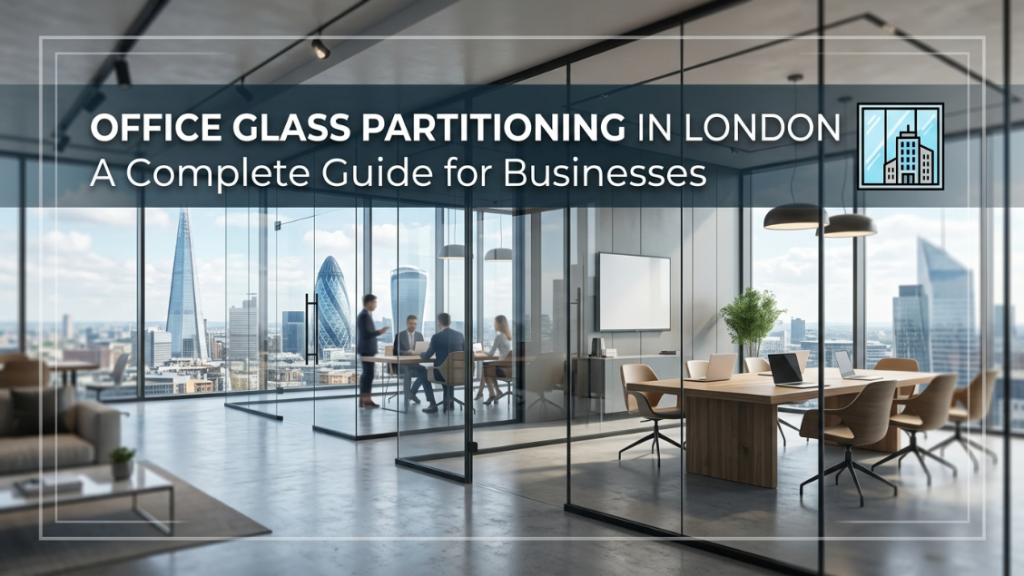
If you’re rethinking your office layout, you’re not alone. Businesses across London, from scrappy startups in Shoreditch to established firms in EC2, are quietly realising that the way their space is divided has a direct knock-on effect on how their teams actually work. Office glass partitioning has become one of the most practical and cost-effective ways to reshape a workspace without the upheaval of a full relocation. Done right, it can genuinely transform how a business operates day to day.
The following tips have been written for the benefit of those who are looking for ways to optimize the use of space available. We will discuss different kinds of partitions made of glass that are available today, what should be considered prior to installation and making sure that the product works as advertised.
Why Businesses Are Moving Towards Glass
Glass office partitions are what make them the ideal choice for so many London businesses, and it is not just because they look good. It all comes down to practicality.
A solid partition wall does not allow flexibility when you want to change the layout. A permanent wall installation is costly both to build and to destroy. However, if your company grows or contracts in size or changes structure, that same solid wall becomes an obstacle rather than an advantage.
Not to mention the lighting issue. Not only is natural light in the office pleasant to be around; it helps people concentrate better and decreases fatigue. If you subdivide a big floor plate at Canary Wharf or an old warehouse in Bermondsey into smaller units by means of solid partitions, you deprive those on one side of access to light, which won’t happen if the partition was made of glass. This is not insignificant; this is a considerable quality-of-life improvement for those working there.
Finally, there is a psychological advantage. An environment where people feel like they are all part of the same entity, even though their workspace might be delineated, contributes to collaboration.
The Main Types of Glass Partitioning You’ll Encounter
Frameless Glass Partitions
They are literally as advertised: full-height panels of glass with very little or no visible frame at all. They have a stunningly sleek appearance and are especially favored by business services companies, solicitors, and those in the financial industry within locations such as the City and Mayfair. The glass used can be either toughened or laminated for security purposes and may also include manifestation (those tiny spots of frosting that you’ll notice on the panels) to meet legal requirements.
While they aren’t necessarily the most cost-effective partitions available, frameless partitions send out a distinct message about the image of the office itself.
Aluminium Framed Glass Partitions
Framed systems use slim aluminium profiles to hold the glass panels in place. They’re slightly more budget-friendly than full frameless systems and arguably more managable when it comes to future reconfiguration, because the frame gives you clear fixing points.
You get plenty of choice here: single or double glazed, acoustic variants, and different finishes for the frame itself including powder-coated colours if you want to tie it into your brand palette. A lot of companies in open-plan tech offices around Old Street go for this route because it’s practical without sacrificing the modern look.
Acoustic Glass Partitions
This is a big one for businesses that need proper sound separation. Double-glazed partitions with an acoustic interlayer can significantly reduce sound transmission between areas. If you’ve got a team doing confidential client calls alongside an open sales floor, acoustic glass partitions aren’t optional, they’re essential.
It’s worth being honest here: no glass partition will be completely silent. But a well-specified acoustic system from a decent installer can bring sound levels down to a point where you can hold a private conversation without worrying about who can hear you on the other side.
Switchable and Manifestation Glass
Smart glass, sometimes called switchable or electrochromic glass, can go from clear to opaque at the flick of a switch. It’s particularly useful in meeting rooms where you want visibility most of the time but privacy when needed. It’s pricier, but for boardrooms or HR offices, a lot of businesses find it’s worth the investment.
Manifestation, as mentioned, refers to applied vinyl patterns or frosting to glass surfaces. Beyond the legal compliance aspect (glass above a certain size needs to be marked so people don’t walk into it), manifestation is a great way to add branding or a design element to an otherwise plain glass wall.
What to Think About Before You Start
It’s always a good idea to ask yourself a couple of practical questions prior to making contact with the installer. Oftentimes, failing to clarify these issues may cost you extra money, time, or, in the worst case, give you something that does not meet your requirements at all.
Namely, why do you actually need to zone your space? Do you require office cubicles? A secluded area? Or a conference room? All decisions on everything – including glass type, door, hardware, and acoustics – depend on this one factor.
Second: how permanent must the solution be? When there is even a possibility that your workspace could be rearranged within the next two or three years, you should favor a demountable partition solution over a fully-fixed installation. The initial cost may be slightly higher, but it will pay off later.
Third: what do your lease terms stipulate? This is something that most people overlook until the last minute. The fact is that many commercial lease agreements in London specify that upon the expiration of the lease term, the premises must be returned to their original condition. The installation of a demountable glass partition system is much easier to meet this obligation than the renovation of the wall structure. Fixed walls cannot always be disassembled, but glass partitions, which are made specifically for disassembly, can be usually dismantled without leaving marks on the floor and ceiling.
Lastly: consider integration with your existing M&E infrastructure. If there are sprinkler heads, air-conditioning vents or lighting tracks in your ceiling, you must include this consideration into your plans from the start. An experienced installer will certainly carry out such a survey before making a quote.
Working With a Specialist Installer in London
London has no shortage of companies offering glass partitioning, but the quality of survey, design, and installation varies quite a bit. It’s worth asking any company you’re considering for examples of previous work in similar settings, references from commercial clients, and a clear breakdown of what’s included in their quote.
At Dryline, the approach is hands-on from the initial site visit through to handover. We’ve worked in offices across London, from smaller suites in Soho to large corporate floors in the Square Mile, and the thing that trips most projects up isn’t the product itself, it’s a survey that didn’t catch a complication early enough. Getting that initial stage right makes everything else smoother.
The lead time question is another one that should be asked. This is particularly important for London fit outs because of the need to coordinate with the working day, building regulations, and at times delivery windows. A professional installer would have encountered such situations before and should be able to provide more definite information regarding the timeframe involved.
The Long-Term Value of Getting It Right
The upfront cost of glass office partitions is often the first number people focus on, which is understandable. But it’s worth framing the investment properly.
When properly implemented, glass partitioning can bring a lot to a leasehold property. This will not only increase its perceived value, making your medium-sized office feel much more spacious and luxurious, but this will also affect your clients’ or potential employees’ impressions of the place. Glass partitioning can also help to retain employees since they are provided with an improved working environment. In addition, it is always easier to adapt the current design, which does not have to be completely removed, than start from scratch again.
There are examples where our customers received additional benefits by redesigning the floor plan of the property. While glass partitioning itself did not change anything, the current design was hampering productivity, and no one had ever addressed the problem before.
At the stage where you’re considering your office planning options – from simple room partitions all the way to a complete redesign of an entire floor – it may be worthwhile discussing the end goal. We provide no obligation free site visits and consultations throughout London, and the discussion itself usually provides answers to many questions that people didn’t even realize they had.