

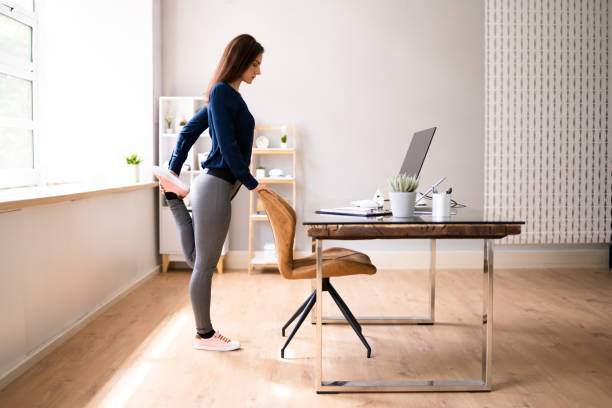
I used to think you had to block out a proper chunk of time to do any real training. Forty-five minutes minimum, warmed up, focused, shoes on, maybe some kind of pre-workout ritual that signaled the brain it was time to be athletic. Anything less felt like it did not really count. A few squats between meetings? That is just fidgeting. That is not training.
I held that belief for years, and it cost me a lot of consistency. Because when life is busy, which for most working adults is most of the time, those forty-five-minute blocks are the first thing to disappear. A deadline comes up, a meeting runs long, the kids need something, and the evening evaporates. And then another day has passed where the legs did not do anything useful at all.
What actually changed things for me was accepting a slightly embarrassing truth: short bursts of movement spread through the day really do work. Not as a complete replacement for structured training, but as a genuine strategy for building and maintaining leg strength when longer sessions are not reliably available. The research around exercise snacking backs this up, and more importantly, my own experience does too. Combined with smart choices about which movements to use, a solid leg press alternative approach can fit into almost any schedule without requiring a single dedicated hour.
The Problem With Waiting for the Perfect Window
The perfect training window does not exist in a consistent way for most people. It appears sometimes, usually at inconvenient hours, and it vanishes completely during the weeks when you need it most. Basing a training habit around its arrival is a losing strategy because you are essentially outsourcing your consistency to your schedule, and your schedule has no interest in your fitness goals.
The alternative is to stop thinking about exercise as something that happens in a block and start thinking about it as something that happens in the small gaps that already exist in the day. The gap between finishing one task and starting the next. The two minutes while the coffee is brewing. The moment before sitting back down after lunch. These gaps are not ideal for a full workout. But they are real, they exist every day, and they are more than enough for something useful.
Ten minutes of actual leg work spread across a day produces different results from ten minutes in a single session. But it produces far better results than zero minutes, which is what the wait-for-a-proper-block approach delivers on most days.
What Exercise Snacking Actually Looks Like
The term sounds slightly ridiculous, I know. But the idea is straightforward. Instead of one large meal of exercise, you eat small snacks of it throughout the day. Each snack is brief, two to five minutes at most, and targets the legs in a way that accumulates into something meaningful by the end of the week.
The key is having a small set of movements you know well enough to do without thinking about them. You do not want to be consulting a tutorial every time you have three minutes free. You want to know your three or four exercises, do them without ceremony, and get back to whatever you were doing.
2 Minutes
The Desk Break Squat
Stand up from your chair, do ten to fifteen slow bodyweight squats with a three-second lower, and sit back down. That is it. The whole thing takes under two minutes, and by the end of it, the quads have done real work. If you do this three times across a workday, you have done forty-five quality squats. That is not nothing. That is actually a decent training stimulus for someone maintaining or building from a moderate base.
90 Seconds
The Phone Call Wall Sit
The moment a call starts, stand up and find a wall. Back flat, thighs parallel, hold it for the duration of the call or until the quads give out, whichever comes first. I have been doing this for over a year, and it remains the most quietly effective thing in my routine. Nobody on the other end of the call has any idea. My quads absolutely do.
3 Minutes
The Lunchtime Lunge Circuit
Before sitting down to eat, do ten reverse lunges on each leg at a slow, controlled pace. Add ten glute bridges on the floor afterward if there is time and privacy. This combination hits the quads, glutes, and hamstrings in a way that wakes up the posterior chain that has been switched off since morning. The food tastes better afterward too, for whatever reason.
2 Minutes
The Stair Step-Up
If your home or office has stairs, they are one of the most underused pieces of exercise equipment in your life. Two minutes of deliberate step-ups on the bottom stair, one leg at a time, slow and controlled with the working leg doing the lifting, is a genuine single-leg strength exercise that requires no setup and no equipment. I do this every time I go upstairs anyway, just slowly and on one leg at a time rather than climbing normally.
2 Minutes
The End of Day Glute Bridge
Before the evening properly starts, two minutes on the floor. Twenty slow glute bridges, a ten-second hold at the top on the last one. The glutes have been sitting on a chair all day, and they genuinely need this. It takes less time than scrolling through your phone deciding what to watch, and it is considerably more useful.
The sessions I was waiting to have time for were never going to happen as often as I needed them to. The two-minute breaks I was dismissing as too small were happening every single day.
A Real Day That Adds Up to Something
Here is what a typical day looks like when you apply this approach consistently. None of these things feel like training while they are happening. Together they represent a genuinely useful amount of leg work.
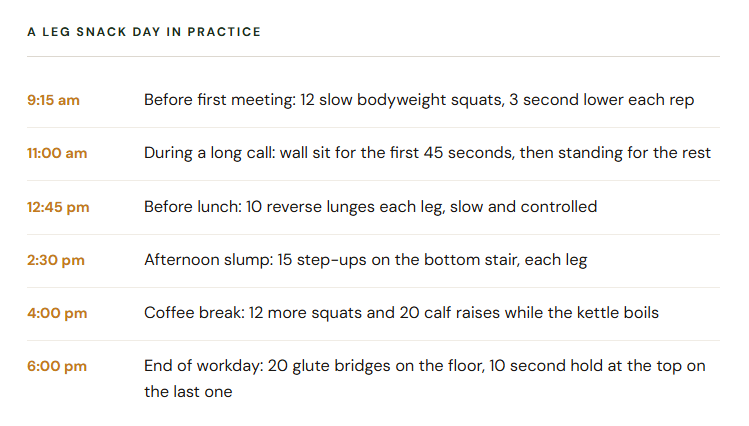
Add that up and you have somewhere around sixty squats, twenty lunges per leg, thirty step-ups per leg, twenty bridges, and a wall sit. Spread across eight hours, it felt like almost nothing in the moment. As a weekly total across five days, it is a serious amount of lower body training.
When You Do Have More Time, Use It Differently
The snack approach works well for maintenance and for people who are just starting out. But if you have a day where an extra thirty minutes genuinely appears, do not use it for more of the same. Use it for the harder variations that the quick breaks cannot accommodate.
Bulgarian split squats with dumbbells. Romanian deadlifts. Goblet squats at a weight that makes the last few reps genuinely difficult. These exercises build the kind of strength that the short breaks can then maintain between sessions. They are the foundation and the snacks are the upkeep. Both have a role and neither replaces the other.
Honest Expectation Setting
Exercise snacks will not turn you into an athlete. They will keep your legs functional, reduce the stiffness that builds up from sitting all day, and maintain a base of strength that makes everyday movement easier. If you want to significantly increase muscle size or train for a specific sport, you will need dedicated sessions too. But for the majority of desk workers whose main goal is to feel better and move more, snacking is genuinely enough to make a real difference.
The Mindset Shift That Makes It Stick
The hardest part of this approach is not the exercises. It is giving yourself permission to count two minutes of squats as real training. We have been conditioned to think that short bursts do not count, that only sustained effort over a meaningful block of time produces real results, and that anything less is barely worth doing.
That belief keeps a lot of people sedentary on busy days when something small was absolutely available to them. Letting it go is what makes the snack approach actually work in practice rather than just in theory.
Two minutes is not nothing. Ten minutes across a day is not nothing. Showing up for something small every day beats showing up for something perfect twice a month, and after a few weeks of doing this consistently the legs start to feel the difference in a way that makes it very easy to keep going.