

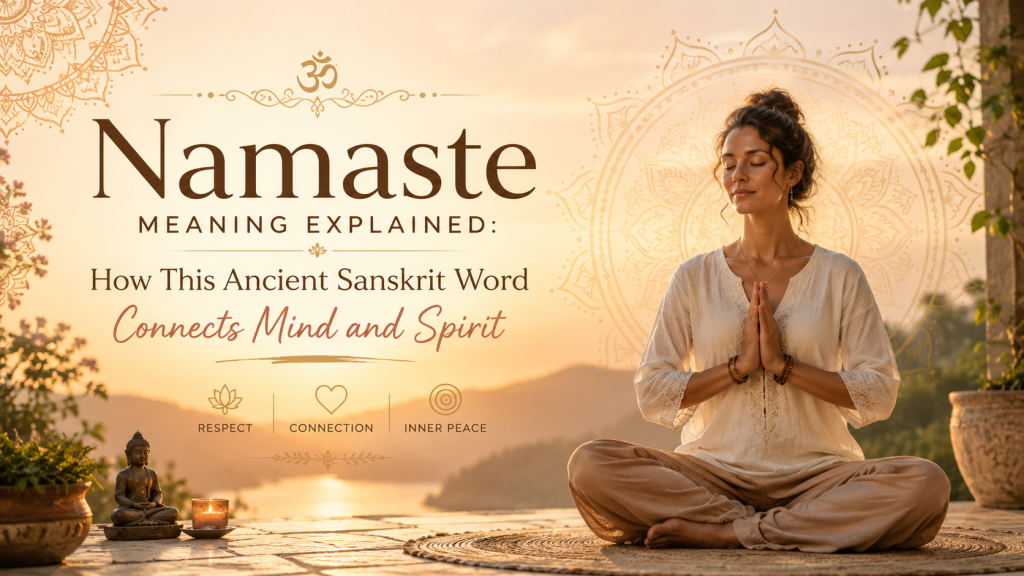
Understanding Namaste Beyond a Simple Greeting
In many yoga studios, “Namaste” is spoken softly at the end of class. Students sit with palms pressed together, eyes lowered, and breath steady. The word may sound familiar, yet its depth is often missed when it is treated as a pleasant sign-off. Namaste carries a layered meaning shaped by language, culture, respect, and inner awareness.
At its simplest, Namaste means “I bow to you.” It is both a spoken word and a gesture, usually offered with hands joined at the heart or near the forehead. In yoga practice, it points to something more intimate than etiquette. It recognizes the quiet dignity of another person and the possibility that every meeting can become mindful.
The Sanskrit Origin of Namaste
To understand the word properly, we need to look at its Sanskrit roots. Namaste comes from “namas,” meaning bow, reverence, or respectful salutation, and “te,” meaning to you. Together, the word expresses “bowing to you” or “salutations to you.”
Sanskrit is one of the ancient languages of India and has influenced spiritual, philosophical, and literary traditions across South Asia. Many important yoga terms, such as asana, pranayama, mantra, and dharma, also come from Sanskrit. These words often carry meanings that cannot be fully captured by one direct English translation.
That is why the phrase Namaste meaning, yoga philosophy, Sanskrit origin fits naturally into any thoughtful study of the word. It brings together three essential layers: what Namaste means, how it functions within yogic thought, and where its linguistic roots begin.
In traditional Indian culture, Namaste is not limited to yoga classes. It is used as a respectful greeting in daily life, often accompanied by the anjali mudra, the gesture of joining the palms. This simple act communicates courtesy without needing physical contact.
The Gesture That Speaks Without Words
The physical gesture associated with Namaste is as meaningful as the word itself. When the palms meet at the heart center, the body creates a shape of balance. The right and left hands come together, symbolizing unity, harmony, and respect. The slight bow adds humility.
This gesture is often called anjali mudra. “Anjali” suggests offering, blessing, or reverence, while “mudra” refers to a symbolic hand gesture. In yoga, mudras are used to guide energy, attention, and intention. Anjali mudra invites the practitioner to pause and gather awareness inward.
The gesture can express several ideas at once:
- Respect for the person in front of you
- Gratitude for shared practice or presence
- A reminder to bring the mind and heart together
- A peaceful alternative to distracted communication
Namaste in Yoga Philosophy
Yoga philosophy teaches that human beings are more than body and thought. Beneath personality, habits, and changing emotions, there is a deeper awareness. Different traditions describe this inner presence in different ways, but the general idea is that each person carries an essential spiritual nature.
In this context, Namaste is often interpreted as “the light in me honors the light in you.” While this is not a literal translation, it expresses the spirit many practitioners associate with the word. It reflects the yogic view that there is something sacred, worthy, and shared within all beings.
When a teacher says Namaste at the end of class, it can mark a transition. The practice is complete, but the awareness developed on the mat is meant to continue. The word becomes a gentle reminder to carry patience, kindness, and steadiness into ordinary life.
Respect-Based Communication in Everyday Life
One reason Namaste remains powerful is that it centers respect. In a world where communication often feels rushed, reactive, or transactional, the word invites a different tone. It says, “I see you,” without demanding attention or dominance.
This is especially meaningful in settings where people come from different backgrounds. Namaste does not rely on status, age, appearance, or achievement. It offers respect first. That quality makes it valuable not only in yoga spaces, but also in wellness communities, classrooms, and personal relationships.
Using Namaste thoughtfully means understanding that it comes from a living cultural and spiritual context. It should not be reduced to a decorative phrase or trendy slogan. When people use it with awareness, they honor its background and avoid treating it as a fashionable sound detached from meaning.
Respectful use includes:
- Learning its basic Sanskrit meaning before using it publicly
- Avoiding exaggerated or mocking pronunciation
- Recognizing its roots in Indian culture
- Using it sincerely, not as a casual branding shortcut
Why Namaste Is Often Said at the End of Yoga Class
Many yoga teachers say Namaste at the end of practice because the final moments of class are usually calm and reflective. After movement, breathwork, and relaxation, students are often more receptive. The nervous system has softened, and the mind may feel clearer than it did at the beginning.
In that quiet space, Namaste works as a closing ritual. It acknowledges the shared effort of teacher and students. It also honors the practice itself. Instead of ending abruptly, the class closes with gratitude.
For students, hearing Namaste can signal that the benefits of practice are not meant to stay confined to the mat. The patience used in a difficult pose can become patience in conversation. The awareness found in breathing can become awareness before reacting. The stillness felt in savasana can become a calmer response to stress.
Namaste and the Mind-Spirit Connection
The title of this article points to a central idea: Namaste connects mind and spirit. The mind often separates, labels, compares, and judges. It measures one person against another and creates distance. Spiritual awareness, however, invites connection. It notices what is shared beneath surface differences.
Namaste gently bridges these two modes of experience. The mind understands the word as a respectful greeting. The spirit feels it as recognition. Together, they create a small but meaningful practice of presence.
This matters because mindfulness is not only about being calm. It is also about becoming more awake to how we relate. A person can meditate daily and still communicate harshly. A person can perform advanced poses and still overlook others. Namaste reminds practitioners that inner growth should soften the way we meet the world.
The Modern Use of Namaste in Wellness Culture
As yoga has spread globally, Namaste has become widely recognized outside India. It appears in studios, retreats, wellness books, social media captions, and meditation spaces. This popularity has helped many people discover Indian spiritual language, but it has also raised important questions about depth and respect.
Modern use is most meaningful when it remains connected to learning. Saying Namaste should not be about sounding spiritual. It should reflect an honest intention to honor another person and the tradition from which the word comes.
For teachers, this means explaining the word occasionally instead of assuming students understand it. For students, it means receiving it with curiosity rather than habit. A few seconds of reflection can turn a repeated class ending into a genuine moment of practice.
Carrying Namaste Beyond the Mat
Namaste is easy to say, but its deeper invitation takes practice. It encourages us to pause before speaking, to honor the humanity of others, and to remember that presence is part of communication. Its power lies in simplicity.
When you understand Namaste through its Sanskrit origin and yogic background, the word becomes more than a class ritual. It becomes a compact teaching. It reminds you that respect can be embodied, that mindfulness can shape relationships, and that spiritual awareness can appear in everyday gestures.
The next time you bring your palms together and say Namaste, let it be more than a closing word. Let it be a moment of gratitude, a bow to shared awareness, and a quiet promise to meet the world with a steadier heart.