
In the fast-paced digital ecosystem of 2026, the age-old debate—MVP vs. Full Product—has shifted from a simple “budget vs. features” discussion to a complex strategic maneuver. With the global startup landscape increasingly dominated by AI-native platforms and hyper-personalized user expectations, choosing your entry point isn’t just about survival; it’s about establishing trust and value in a market that no longer tolerates “half-baked” ideas.
According to a recent Forrester 2026 Prediction report, this year marks a “reckoning” where businesses must pivot from AI experimentation to delivering measurable, secure business outcomes. For startups, this means the “Minimum Viable Product” has evolved into the Minimum Viable Experience (MVE).
The MVP Evolution: From “Functional” to “Formidable”
Historically, an MVP was the bare-bones version of a product designed to test a hypothesis. In 2026, the definition has matured. Today’s users are spoiled by seamless interfaces and instant AI responses. Launching a clunky MVP is no longer a “learning opportunity”—it’s a brand risk.
Why 2026 Startups Still Start Small
Despite the pressure to launch big, new product development services still advocate for the lean approach. Why? Because the “No Market Need” remains the #1 cause of startup failure, cited in 42% of cases by CB Insights.
- Risk Mitigation: Validating the core value proposition before burning through Series A funding.
- Speed to Market: In the era of, getting your product into users’ hands in 6–10 weeks is a competitive necessity.
- Investor Attraction: Modern VCs rarely fund “napkin ideas.” They fund traction. A live MVP with active user data is the most potent pitch deck you can have.
Full Product Launch: The “All-In” Gamble
A Full Product is a feature-complete version, polished for a mass-market launch. While it sounds ideal, the development cycle can stretch from 12 to 18 months, which, in 2026’s tech timeline, is an eternity.
When to Build the Full Product First?
- Deep Tech/Niche Markets: If you are building a proprietary medical diagnostic tool or a quantum-encryption platform, a “minimal” version might be dangerous or illegal.
- Established Brand Extensions: If a tech giant like Apple or Meta launches a new tool, users expect a high-fidelity experience from Day 1.
- Highly Competitive Red Oceans: If you’re entering a saturated market, your USP might need a suite of secondary features just to reach parity with existing players.
MVP vs. Full Product: The 2026 Comparison Matrix
| Feature | Minimum Viable Product (MVP) | Full-Scale Product |
| Development Time | 4 – 12 Weeks | 6 – 18 Months |
| Primary Goal | Market Validation & Learning | Market Dominance & Scaling |
| Cost Range (2026) | $20,000 – $70,000 | $150,000+ |
| Risk Level | Low (Incremental investment) | High (All-or-nothing launch) |
| User Feedback | Integrated into the core roadmap | Gathered post-launch |
| Tech Stack | Cross platform mobile development | Often Native for high performance |
The AI Factor: Accelerating the “Minimum”
In 2026, the role of AI in product development cannot be overstated. Generative AI and multi-agent systems have drastically reduced the time required to build complex backends. Startups are now leveraging AI-native platforms to automate code generation, reducing the MVP cost-to-market by nearly 35%.
By utilizing it consulting services that specialize in LLM integration, startups can now offer “Full Product” feelings within an MVP framework. For example, an AI-powered customer support bot that learns in real-time can be integrated into an MVP for a fraction of what a human-staffed support desk would cost.
Technical Strategy: Choosing Your Tech Stack
One of the biggest pitfalls for 2026 startups is over-engineering their MVP. To remain lean yet scalable, cross platform mobile development has become the default choice.
Why React Native is Dominating the 2026 Startup Scene
If you want to reach both iOS and Android users simultaneously without doubling your budget, you should hire dedicated react native developers.
- Code Reusability: Share up to 90% of your code across platforms.
- Performance: With the “New Architecture” (Fabric) fully matured in 2026, the performance gap between React Native and Native is negligible for 95% of use cases.
- Ecosystem: The abundance of pre-built libraries means your developers aren’t “reinventing the wheel.”
ROI Calculation: The Math of Starting Small
For the financially inclined founders, the decision often comes down to the Return on Investment (ROI). Building a full product early often results in “feature waste”—features that 60% of your users will never touch.
The ROI for an MVP can be modeled as:
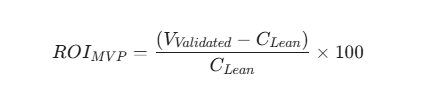
Where:
- Vvalidated = Value of validated market insights and early revenue.
- CLean{Lean}$ = Minimal cost of development using mvp development companies.
By minimizing $C_{Lean}$, you maximize your potential for a positive pivot before your “runway” ends.
The Decision Framework: What Should You Build?
Ask yourself these four questions to determine your path:
- Is your core value proposition unproven? (Build an MVP)
- Does your product rely on high-fidelity user trust (e.g., FinTech)? (Build a “Polished” MVP or MVE)
- Is your budget under $100k? (Build an MVP)
- Are you entering a market where the competition is stagnant? (Build an MVP to disrupt quickly)
Partnering for Success: IT Consulting & MVP Experts
Building in a vacuum is a recipe for disaster. In 2026, the complexity of AI in product development requires specialized knowledge. Working with seasoned mvp development companies ensures that your product is built with “scalability-first” in mind.
Effective it consulting services will help you identify which features are “must-haves” for your MVE and which are “nice-to-haves” for Version 2.0. This prevents technical debt—the “interest” you pay later for taking shortcuts now.
Conclusion: The “Viable” Path Forward
In 2026, the “Full Product” is a destination, but the “MVP” is the vehicle that gets you there. By focusing on the Minimum Viable Experience, leveraging cross platform mobile development, and integrating AI strategically, startups can navigate the volatile market with agility and precision.
The goal isn’t to build the perfect product first; it’s to build the right product for the right people at the right time.