
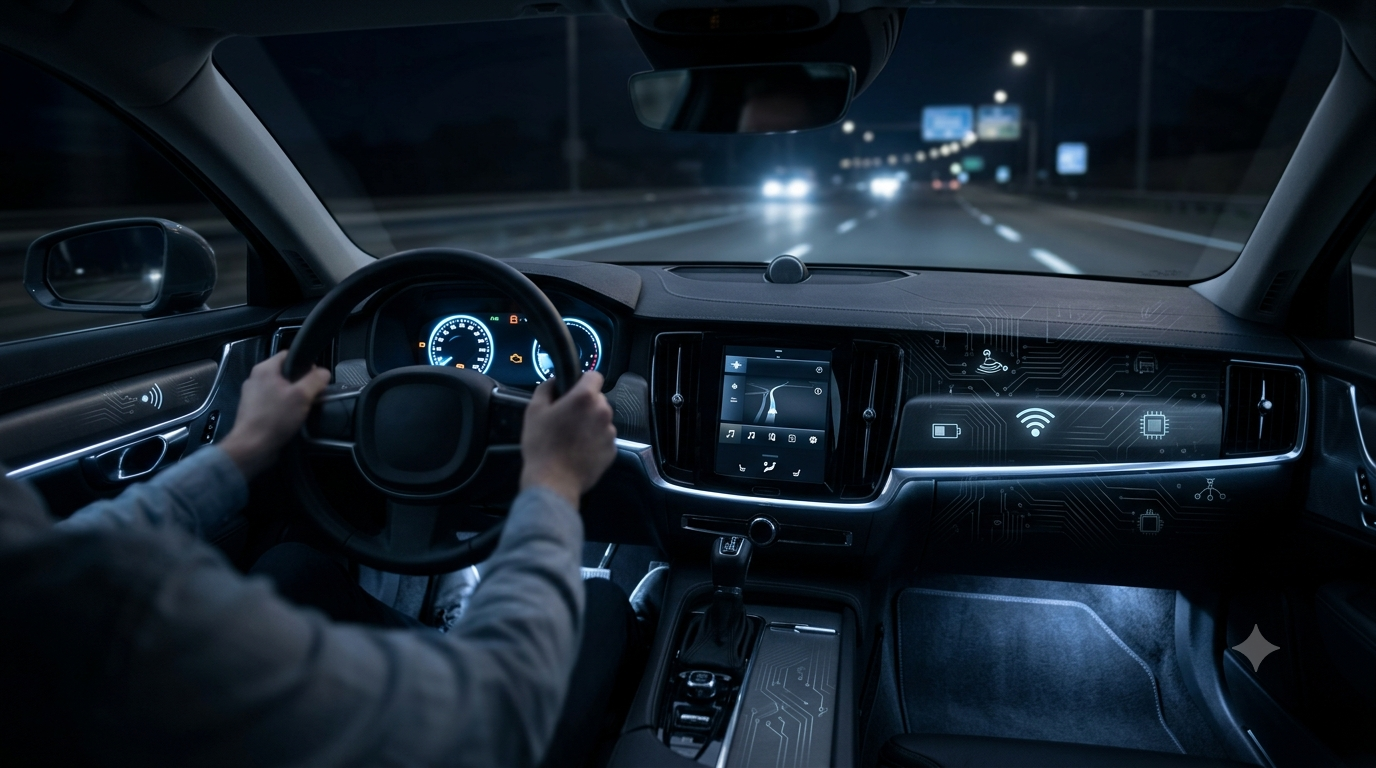
My view after years around vehicles: electronics haven’t made cars complicated for the sake of technology. They’ve made them more honest. A modern car can tell you what it needs, where a problem is starting, and sometimes how to prevent a breakdown before you even notice anything wrong.
I’ve spent years watching how vehicles actually behave, not just reading specification sheets in brochures. Here’s the biggest misunderstanding I run into: people think modern cars are becoming less mechanical.
They’re not.
They’re becoming more measurable.
You don’t just operate a car anymore. You’re interacting with a network of sensors, computers, and software that monitors what is happening every second you are driving.
What are modern vehicle electronics actually doing?
Modern vehicle electronics are systems that use sensors, computers, and software to control everything from engine performance and braking to safety features and driver comfort. They help vehicles detect problems earlier, improve efficiency, and give owners more information about how their car is performing.
Most people picture vehicle electronics as the touchscreen in the dashboard. That’s the part they see.
The real work happens behind it.
A modern vehicle can contain 70 or more electronic control units (ECUs), each handling specific tasks. One manages engine performance. Another controls airbags. Another manages transmission behaviour, while others handle parking assistance, climate control, lighting, and driver assistance features.
Think of these ECUs as coworkers constantly exchanging information.
The engine computer may tell the transmission computer how much torque is being produced. Safety systems communicate with wheel-speed sensors before deciding whether stability control needs to intervene.
All of this happens within milliseconds.
Why do modern cars need so many computers?
The answer is simple: precision.
Older vehicles relied more heavily on mechanical systems. Drivers usually discovered problems through obvious symptoms: strange noises, poor performance, vibrations, or difficulty starting.
Modern vehicles detect changes much earlier.
An engine control unit can adjust fuel delivery thousands of times per minute while monitoring oxygen levels, airflow, engine temperature, and position sensors.
This is why two vehicles with identical engines can feel completely different on the road. Software calibration plays a much bigger role than many drivers realise.
One common misunderstanding is that more electronics automatically mean worse reliability.
I hear this often: “Older cars were simpler, so they were better.”
Sometimes older vehicles were easier to repair. But they also lacked the ability to warn owners about problems before failures occurred.
A properly maintained modern vehicle can comfortably reach high mileage because its electronic systems help identify issues before they become major failures.
How do vehicle electronics improve safety?
Safety is where electronic systems have created some of the biggest changes.
Modern vehicles use cameras, radar sensors, and ultrasonic technology to understand what is happening around them.
Common examples include:
- Automatic Emergency Braking
- Lane Departure Warning
- Adaptive Cruise Control
- Blind Spot Monitoring
- Electronic Stability Control
- Parking Assistance
These systems are not designed to replace the driver.
They are designed to provide support during moments when human reactions may not be enough.
A driver looking away for a second, a sudden traffic slowdown, or an unexpected obstacle can create dangerous situations. Electronic assistance systems provide an additional layer of protection.
The Euro NCAP evaluates many of these technologies through its vehicle safety testing programme. Its assessments have helped encourage manufacturers to include advanced driver assistance systems across a wider range of vehicles.
The part most owners ignore: diagnostics
This is where I believe modern electronics have changed ownership the most.
Many drivers still wait until something feels wrong before checking their vehicle. That approach worked better with older cars.
Modern vehicles are already collecting information.
A diagnostic scanner communicates with the vehicle computer and retrieves stored fault codes. Workshops use professional diagnostic platforms to understand what is happening inside the vehicle.
A common mistake is buying a cheap OBD scanner and assuming the first code shown is the complete answer.
It isn’t.
A fault code is a clue, not a diagnosis.
For example, a sensor-related code does not always mean the sensor itself has failed. It could be damaged wiring, poor electrical connections, software issues, or another component causing incorrect readings.
The code points you in the right direction. Experience determines the actual cause.
For owners interested in understanding how these components work together, resources from SMELECOM can provide further insight into modern vehicle electronic systems, components, and automotive technology.
How connected cars are changing daily driving
Cars are becoming increasingly connected.
Many modern vehicles can communicate with smartphones and online services, allowing owners to:
- Check vehicle information remotely
- Locate parked vehicles
- Control climate settings
- Receive maintenance reminders
- Monitor charging levels on electric vehicles
For electric vehicle owners, access to battery information is especially valuable.
Knowing charging status, battery condition, and energy consumption helps drivers plan journeys more effectively.
Software updates are another major shift.
For decades, improving a car usually meant replacing a physical component. Now, manufacturers can improve certain features through software.
Are software updates really the future of cars?
Mostly, yes.
Vehicle manufacturers increasingly use software updates to improve performance and reliability.
Updates can:
- Fix software problems
- Improve battery management
- Update navigation systems
- Improve infotainment performance
- Add new functions
The SAE International develops engineering standards connected to vehicle technology, including areas related to connected and automated mobility systems.
However, there is still a balance to maintain.
A vehicle should not become something owners constantly have to troubleshoot like a computer.
Reliability must remain the priority.
What actually causes electronic problems?
Many people assume electronic failures happen because modern systems are fragile.
Usually, that is not the case.
Common causes include:
- Weak batteries
- Corroded electrical connections
- Water damage
- Incorrect repairs
- Poor aftermarket installations
A weak battery is one of the biggest causes of strange dashboard warnings.
A driver may see multiple warning lights appear and assume several expensive problems have developed.
Sometimes the actual cause is simply unstable voltage from an ageing battery.
One battery issue can create several confusing symptoms.
What should a car owner learn about electronics?
You do not need to become a technician.
You simply need enough knowledge to make better decisions.
Pay attention to warning messages. Keep service records. Use reliable diagnostic equipment. Do not ignore small issues for months.
Helpful areas to explore include:
- Automotive diagnostic tools
- OBD diagnostic equipment
- Vehicle electronic systems
Understanding these systems changes the relationship between driver and vehicle.
Instead of being a machine that suddenly fails without warning, a modern car becomes a system that provides information if you know how to interpret it.
The future of vehicle ownership
Cars will continue relying more heavily on electronics.
Electric vehicles, driver assistance systems, connected services, and predictive maintenance all depend on smarter computing.
I am not entirely sure why some drivers adapt quickly while others resist these changes. My guess is that it comes down to trust.
Once people understand what a system is doing, the technology becomes less intimidating.
The best approach is not learning every circuit or control module.
It is learning enough to ask better questions, recognise warning signs, and make smarter decisions when something goes wrong.
That is the real value of modern vehicle electronics: not replacing the driver, but giving them better information to work with.